
Living plant profile
Golden mosaic ctenanthe
Ctenanthe lubbersiana
Comprehensive botanical dossier for Golden mosaic ctenanthe (Ctenanthe lubbersiana). Identification, lighting calibration, porous substrate formulation, and cultivation guide by Saigon Cay Canh.
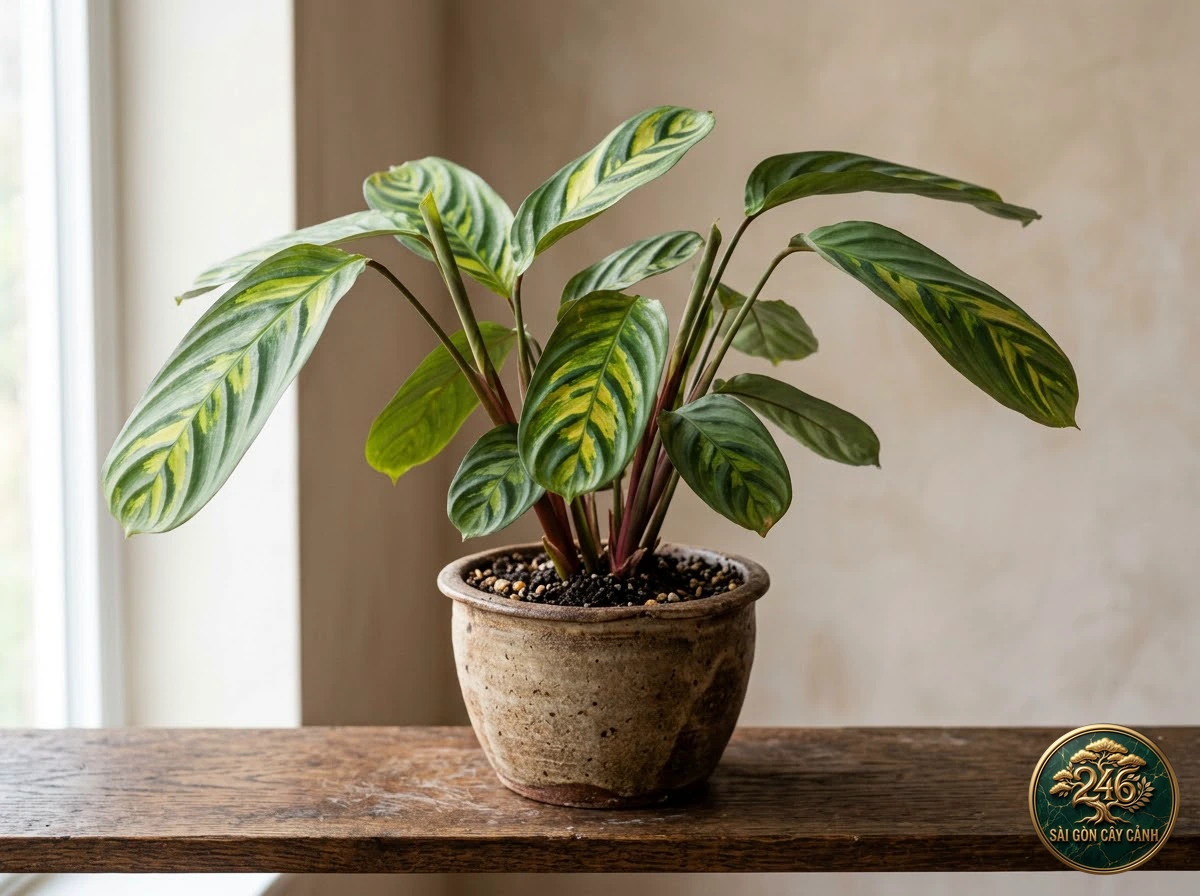
Golden mosaic ctenanthe (Ctenanthe lubbersiana) is one of the most magnificent chimeric foliage selections within the Marantaceae family originating from eastern Brazilian rainforests. Every oblong leaf represents a one-of-a-kind living canvas, displaying unpredictable mosaic splashes of canary-yellow and fresh cream splashed across deep emerald green, infusing residential interiors with warm tropical vitality.
Sài Gòn Cây Cảnh Care Compass
1. Core Botanical Taxonomy & Cultural Specifications
| Scientific Name | Ctenanthe lubbersiana |
|---|---|
| Botanical Family | Marantaceae (Prayer Plant Family) |
| Native Distribution | Eastern Brazil (Tropical Rainforests of Bahia and Minas Gerais) |
| Growth Demeanor | Bushy clumping perennial branching freely into multi-tiered foliage stands |
| Lighting Threshold | Generous bright diffused indirect light (1,400 – 2,200 lux) |
| Hydration Cadence | Hydrate with demineralized water once upper 2-3cm of substrate desiccates |
| Substrate Formulation | 35% pumice, 25% fine bark nuggets, 20% sphagnum moss, 20% perlite |
| Thermal Range | 20°C – 29°C (68°F – 84°F), vegetative arrest below 16°C (60°F) |
| Relative Humidity | Ideal atmospheric humidity 65% – 85% |
| Cultivation Difficulty | Moderate (Requires ample filtered light to sustain golden chimera) |
| Pet Safety Profile | Completely non-toxic to companion animals (ASPCA verified) |
Formally circumscribed in the nineteenth century by Belgian botanist Edouard Morren, the specific name lubbersiana pays homage to Louis Lubbers, head horticulturist at the Brussels Botanic Garden. The taxon is distinguished within genus Ctenanthe by stable somatic chimera, where chlorophyll-deficient tissue zones produce vivid canary-yellow patches beside photosynthetic green sectors.
Native to streambank borders and shaded moist hillsides across Bahia and Minas Gerais, Ctenanthe lubbersiana forms lush bushes standing 45 to 75 cm tall with spreads reaching 90 cm. Diverging from relatives bearing purple abaxial surfaces, this species possesses pale green undersides that optimize light transmission throughout dense foliage canopies.
Taxonomic classifications validated by Kew POWO confirm Ctenanthe lubbersiana as an accepted distinct species (historically traded under Stromanthe lubbersiana). Its vigorous cauline branching from above-ground nodes produces exceptionally dense, spherical specimen canopies unmatched among prayer plants.
2. Morphological Identification & Foliar Architecture
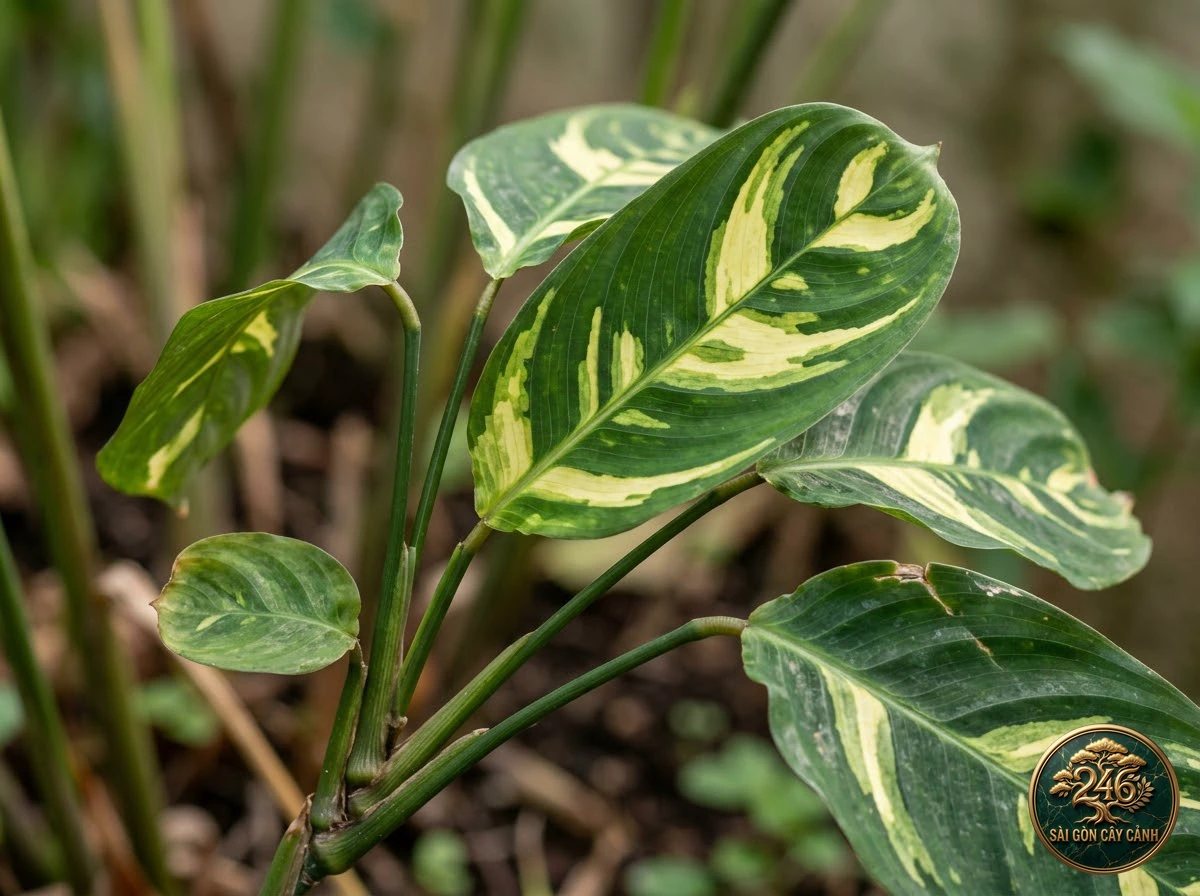
Morphological identification centers upon oblong-elliptic leaves measuring 18 to 28 cm in length and 6 to 9 cm across, terminating in slightly asymmetric mucronate tips. Adaxial variegation displays a dynamic mosaic of lemon-yellow, canary, and ivory strokes splashed irregularly across deep glossy emerald fields.
No two leaves share identical variegation patterns; individual blades may display up to 70% golden coverage while adjacent leaves feature delicate linear streaks. Slender pale green petioles span 12 to 20 cm, uniting with blades via the articulated pulvinus joint.
The chimeric foliar variegation of Ctenanthe lubbersiana originates from somatic plastid mutations within the L2 embryonic cell layer. Bright canary-yellow tissue sectors lack functional chloroplasts but accumulate abundant carotenoid pigments that serve a photoprotective role, shielding delicate unpigmented cells from photo-oxidative degradation.
3. Photometric Calibration & Window Exposure Optimization
Because it carries substantial chlorophyll-deficient yellow sectors, Ctenanthe lubbersiana demands slightly higher diffused photonic energy than solid green counterparts, ideally 1,400 to 2,200 lux. Deep shade prompts emerging foliage to revert toward solid green to compensate for reduced photosynthetic surface area.
Conversely, direct midday sun quickly blisters delicate yellow variegation patches lacking protective melanin and chlorophyll shields. Position containers behind sheer curtains receiving cool eastern morning illumination to preserve immaculate foliar tissues.
To sustain an optimal 40% to 60% golden chimera ratio across blades, ambient PPFD levels must register between 55 and 95 µmol/m²/s. When illumination drops beneath 35 µmol/m²/s for over a month, compensatory survival pathways prompt emerging leaves to revert toward solid green, forfeiting prized mosaic patterns.
4. Foliar Mosaic Chimera & Pulvinus Nyctinastic Mechanics
The pulvinus motor mechanism of Ctenanthe lubbersiana operates in tandem with its multi-tiered branching habit. The swollen joint dynamically calibrates individual blade angles toward ambient light vectors during daytime hours to maximize photon absorption across photosynthetic green sectors.
At night, the golden mosaic canopy elevates into an upright prayer alignment. Illuminated under subtle accent lamps, the canary-yellow sectors glow dramatically against the green backdrop, creating a luminous botanical silhouette in evening rooms.
The ideal ambient temperature spans 20°C to 29°C (68°F – 84°F). It flourishes vigorously in warm tropical conditions, but shoot development arrests when night temperatures drop below 16°C (60°F).
Maintaining 65% to 85% relative humidity is essential to prevent variegated margins from crisping. In air-conditioned environments, an ultrasonic humidifier should be deployed to safeguard foliar suppleness.
Stabilizing vapor pressure deficit (VPD) between 0.65 and 0.95 kPa is vital for preserving delicate yellow chimera sectors. Because yellow tissues lack dense cuticular wax layers, dry air transpires water from yellow patches twice as rapidly as green sectors, causing localized necrosis unless ambient humidity is kept above 65%.
Diverging from purple-backed relatives, Ctenanthe lubbersiana exhibits pale green abaxial undersides containing active chloroplasts. This morphological feature captures photons reflected upward from the forest floor, compensating for photosynthetic deficits incurred by the unpigmented yellow mosaic sectors on the upper surface.
5. Porous Aggregate Substrate Engineering & Aeration Dynamics
The root system of this species expands vigorously, demanding continuous oxygen diffusion to support its dense foliar canopy. The optimal substrate comprises 35% Indonesian pumice (3-6mm), 25% boiled pine bark nuggets, 20% sterile sphagnum moss, and 20% horticultural perlite.
This matrix evacuates surplus irrigation without stagnant pooling, preserving consistent rhizosphere moisture around rhizomes and protecting nascent subterranean shoots from pathogenic damp-off.
The potting aggregate for Golden mosaic ctenanthe benefits from 15% natural zeolite mineral granules (3-5mm). Zeolite’s porous honeycomb framework enhances cation exchange capacity, adsorbing surplus ammonium and potassium to release them gradually per root demand, preventing fertilizer burn.
6. Organic Nutrition Schedules & Periodic Micronutrient Priming
Nutritional management demands balanced organic macronutrients. Supply diluted liquid organic fertilizer every 3 to 4 weeks during active growth. Avoid excessive synthetic nitrogen, which triggers overproduction of chlorophyll and suppresses golden variegation.
Flush the container thoroughly with pure water every 2 to 3 months to leach out accumulated fertilizer salts, preserving pristine rhizosphere conditions.
Fertilization strategies must avoid high-nitrate synthetic formulations. Employing organic fertilizers naturally fortified with potassium and phosphorus (such as aged bat guano tea or composted hull mulch) thickens foliar cell walls and sharpens chromatic contrast between golden mosaic sectors and deep emerald fields.
7. Clinical Diagnostic Matrix & Rapid Correction Protocols
| Clinical Symptom | Primary Etiology | Diagnostic Evaluation | Corrective Prescription |
|---|---|---|---|
| Yellow variegated sectors suffer crisp brown scorch lesions | Direct solar beam exposure or ambient heat exceeding 32°C (90°F) | Verify sunbeam trajectory across the window aperture throughout the day | Draw sheer curtains immediately and reposition specimen into cool diffused light |
| Emerging foliage reverts to solid green without yellow variegation | Chronic light deficit beneath 1,000 lux suppressing chimeric expression | Assess ambient lux levels with digital photometer | Relocate planter to brighter indirect daylight measuring 1,500 to 2,000 lux |
| Canopy collapse accompanied by basal leaf shedding | Substrate waterlogging causing root asphyxiation or chilling below 15°C (59°F) | Unpot root ball to inspect root integrity and evaluate room warmth | Excise decayed roots, repot into fresh aerated pumice aggregate, and sustain room warmth above 19°C |
| Fine webbing and yellow punctate stippling in foliar axils | Two-spotted spider mites stimulated by dry indoor air beneath 50% relative humidity | Examine variegated leaf undersides closely using magnification loupe | Boost ambient humidity with ultrasonic misting and wipe foliage with biological neem emulsion |
8. Cryptic Pest Prophylaxis & Foliar Surface Sanitation
Because its multi-tiered canopy is exceptionally dense, regularly inspect variegated leaf undersides and petiole axils for two-spotted spider mites and mealybugs. Mist foliage with clean water and apply cold-pressed neem oil monthly.
Regularly excise senescent foliage and non-variegated stems to channel energy into emerging variegated shoots, maintaining a compact, well-aerated specimen shape.
Routine foliar cleansing via gentle showers of lukewarm rainwater removes particulate grime from sensitive variegated tissues. Routinely inspect internodal axils for mealybugs, treating nascent infestations with biological alcohol swabs.
9. Asexual Propagation Methodology & Root Strike Protocols
Propagation is highly rewarding thanks to generous cauline branching and active basal nodes. The most effective methods involve clump division during spring repotting or rooting multi-node stem cuttings bearing aerial root primordia.
Harvest cuttings using sterilized shears, placing them into pure water or moist sphagnum under warm, shaded conditions above 75% humidity; vigorous root systems establish over a 25 to 35 day period.
When propagating via stem node cuttings, select canes carrying balanced 30% to 50% golden variegation. Cuttings with excessive yellow (over 80%) lack sufficient chlorophyll to sustain themselves prior to root formation, while all-green cuttings produce offspring that permanently forfeit mosaic chimera.
10. Companion Animal Safety Profile & ASPCA Non-Toxic Verification
This verified biological safety enables plant enthusiasts to showcase specimens on low credenzas or floor planters with complete peace of mind regarding curious pets.
11. Biophilic Curation & Contemporary Interior Design Styling
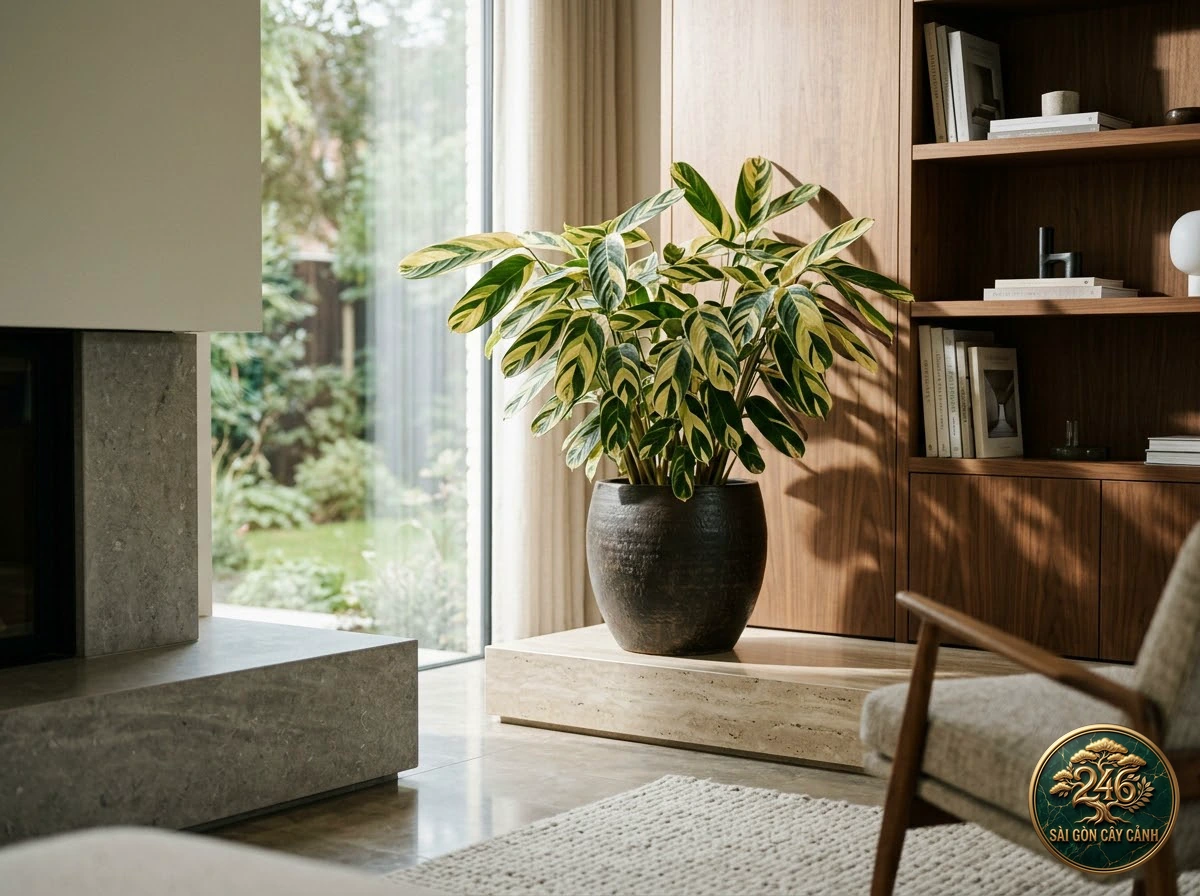
Featuring warm, luminous golden variegation, the Golden mosaic ctenanthe excels at brightening shaded interior corners, accentuating executive desks, or creating dynamic chromatic contrasts alongside solid green foliage.
In interior Biophilic design, its warm yellow variegation evokes sunshine and wholesome vitality, infusing modern living environments with an uplifting natural ambiance.
In Biophilic architectural psychology, the warm canary-yellow tones of Ctenanthe lubbersiana act as a powerful visual stimulant. Positioning specimens within dining rooms, living areas, or entry vestibules dispels spatial gloom, fostering optimistic vitality and welcoming hospitality.
12. Master Principles for Sustainable Indoor Acclimatization
Three foundational axioms for maintaining vibrant golden variegation on Ctenanthe lubbersiana:
- Hydration axiom: Diffused Spectral Balance: Provide strong 1,800 lux indirect light to sustain yellow chimera; shield strictly from scorch-inducing direct sun.
- Illumination axiom: Soft Water Standard: Supply dechlorinated pure water once topsoil dries; avoid mineral-heavy tap water to forestall edge necrosis.
- Maintenance axiom: Atmospheric Humidity Buffer: Sustain ambient relative humidity above 65% with ultrasonic humidification to preserve foliar suppleness.
Nursery Care Journal & Living Greenery Moments
At Saigon Cay Canh greenhouse, each photograph captures genuine everyday care moments between plant lovers and living greenery, spreading a passion for nature and green-living inspiration.

13. Frequently Asked Questions Regarding Golden mosaic ctenanthe (FAQs)
Why does Golden mosaic ctenanthe lose its bright yellow variegation?
Reversion occurs when the plant is kept in deep shade, forcing cells to produce green chlorophyll to survive. Relocate to brighter indirect light.
Can this species be cultivated in semi-hydroponics?
Yes, it adapts readily to semi-hydroponic culture using pure leca clay pebbles or pumice aggregate paired with mild nutrient solutions.
Is Golden mosaic ctenanthe toxic to companion animals?
Completely non-toxic. The ASPCA validates that it is 100% safe around domestic dogs, cats, and humans.
What is the optimal watering time of day?
Early morning irrigation is ideal, allowing the root system to absorb moisture throughout daylight hours while foliar surfaces dry before nightfall.
When should repotting occur?
Repot every 1 to 2 years in spring when vigorous clumping stems fill the pot volume.
Why does Golden mosaic ctenanthe occasionally produce entirely solid green leaves?
This reflects natural chimera reversion when an axillary meristem inherits solely normal chloroplast-bearing cells. Pruning solid green canes back to the base redirects vital resources toward emerging variegated shoots.