
Living plant profile
Pyramidal crassula (Crassula pyramidalis)
Crassula pyramidalis
Comprehensive botanical monograph on the Pyramidal crassula (Crassula pyramidalis): geometric four-angled columnar morphology, CAM physiology, and monocarpic offset regeneration.
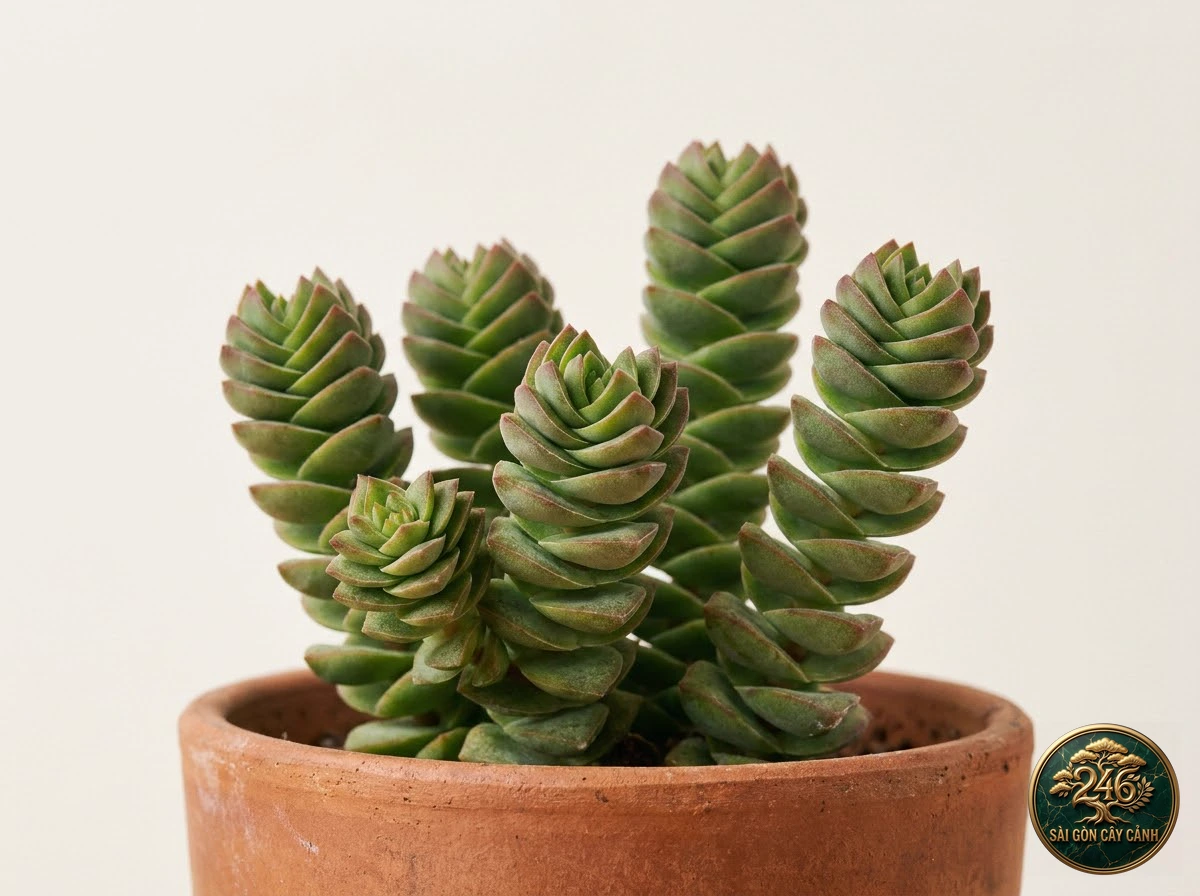
Pyramidal Crassula (Crassula pyramidalis)
The Pyramidal crassula (botanical binomial: Crassula pyramidalis Thunb.) stands as one of the most astonishing geometric wonders in the botanical kingdom. Evoking the awe-inspiring architectural precision of an ancient stepped Mayan or Aztec ziggurat emerging from desert sands, this miniature stonecrop forms immaculate four-angled square columns standing 10 to 15 cm in height. Hundreds of flattened, triangular scale leaves clasp in rigid decussate ranks, ascending in mathematical symmetry to create a miniature living pyramid of solemn grandeur and contemplative beauty.
Discovered in 1778 by Swedish naturalist Carl Peter Thunberg within the quartz flats and rocky gravel plains of South Africa’s Great Karoo, this species represents the zenith of xerophytic cryptic camouflage. Operating on nocturnal Crassulacean Acid Metabolism (CAM) and fortified with tightly imbricated foliar armor, it endures blistering desert heat and prolonged droughts without cellular collapse. In contemporary biophilic design and minimalist interiors, it serves as a peerless living art object, embodying disciplined order, quiet strength, and timeless architectural grace.
Sài Gòn Cây Cảnh Care Compass
1. Comprehensive Botanical Taxonomy & Key Specifications
To establish an authoritative botanical baseline for researchers and interior landscape architects, Saigon Cay Canh provides the definitive scientific specifications below:
| Taxonomic Descriptor / Biological Parameter | Empirical Botanical Metric & Cultural Value |
|---|---|
| Valid Botanical Binomial | Crassula pyramidalis Thunb. (Nova Acta Phys.-Med. Acad. Caes. Leop.-Carol. Nat. Cur. 6: 329, 1778) |
| Standard International Common Names | Pyramidal crassula, Pagoda stonecrop, Miniature pyramid plant |
| Taxonomic Rank (Family / Genus) | Crassulaceae (Stonecrop family) / Genus Crassula |
| Native Geographical Range | Quartz flats, gravel ridges, and shale slopes of the Great Karoo, South Africa |
| Growth Habit & Morphology | Strictly erect, solitary to slowly clustering geometric columnar succulent, 8-15 cm |
| Foliar Structure & Arrangement | Triangular, thin, flattened leaves, densely imbricate in 4 square stepped ranks |
| Photosynthetic Flux Density Need | Bright filtered daylight or gentle direct morning sunshine (4,000 – 7,500 lux) |
| Reproductive Biology & Flowering Habit | Flowering stems are monocarpic; basal adventitious offsets sustain the clone |
| Companion Animal Safety Status | Certified non-toxic to domestic canines, felines, and avian companions (ASPCA certified) |
| Engineered Substrate Composition | 75% coarse mineral aggregate (pumice, perlite, scoria) + 25% washed organic loam |
The species grows with meditative slowness, producing merely a few tiers of geometric leaves each season. In our conservatory, each columnar clone is conditioned under intense morning light to ensure crisp four-angled quadrangular symmetry.
2. Morphological Diagnostic Keys & Foliar Anatomy
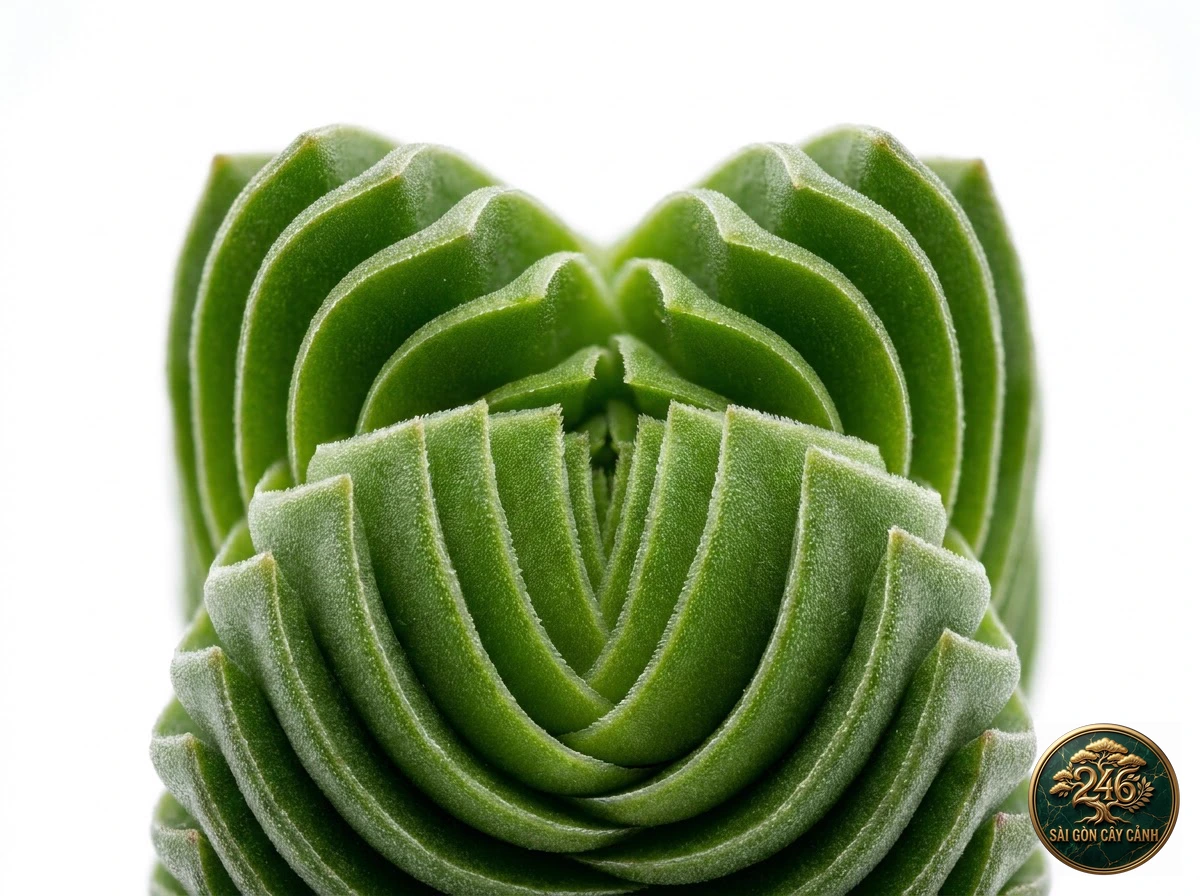
An anatomical dissection of this miniature stonecrop highlights an array of specialized morphological adaptations engineered to survive intense solar desiccation:
Stepped Pyramidal Foliar Stacking: The leaves are flattened, triangular, measuring 8 mm to 15 mm in length and 10 mm to 14 mm in basal width, with margins slightly curved upward to acute tips. Clasping tightly in decussate phyllotaxy, successive opposite pairs imbricate closely over preceding tiers. This compressed vertical tiling forms an immaculate, four-sided square column whose cross section exhibits four sharp corners, inspiring the specific epithet pyramidalis.
Epidermal Cuticle & Cryptic Coloration: The leaf surface displays an understated brownish-green, olive-gray, or bronze patina under full sunlight. A tough, waxy cuticular coating protects underlying tissues from ultraviolet radiation and minimizes transpirational water loss, providing camouflage among quartz stones.
Stem Axis & Fibrous Root Anchorage: The true central stem is entirely concealed within the overlapping foliar armor. Beneath the soil line, a shallow fibrous root system anchors firmly into rock fissures, securing the plant against fierce desert gales.
Capitate Inflorescence & Monocarpic Shoots: Upon reaching maturity after several seasons, the apex terminates in a dense, rounded capitate cyme bearing numerous minute, star-shaped, five-petaled blossoms in creamy-white or blush-pink tones. The flowers exhale a rich, honeyed fragrance. Although the flowering shoot naturally senesces after seed maturation (monocarpic behavior), several basal plantlets promptly erupt from lower nodes to sustain the clone.
3. Botanical Taxonomy & Nomenclatural History
The formal botanical classification of this plant traces to Carl Peter Thunberg’s exploration of South Africa’s Karoo flora. Published in 1778 within the Nova Acta of the Leopoldina Academy, the specific epithet pyramidalis commemorates the stepped geometric silhouette of its foliage.
Within the APG IV system, the species is placed in family Crassulaceae, order Saxifragales. It forms part of a specialized morphological clade alongside Crassula columella and Crassula plegmatoides, representing an evolutionary peak in transpirational surface minimization.
In 19th-century nursery literature, botanist Adrian Hardy Haworth briefly segregated this taxon into the genus Tetraphyle (signifying four ranks of leaves), though contemporary molecular phylogenetics firmly reaffirms its position within the genus Crassula.
4. Native Ecology & Crassulacean Acid Metabolism (CAM)
Wild populations inhabit the arid gravel plains and rocky shale hillsides of South Africa’s Great Karoo and Little Karoo. In this severe biome, annual rainfall drops below 150 mm to 200 mm, accompanied by blistering daytime temperatures exceeding 42°C and cool night air.
To endure sustained drought, the plant operates on full Crassulacean Acid Metabolism (CAM). Foliar stomata remain sealed during hot daylight hours, completely preventing moisture loss from internal hydrenchyma storage tissues.
At night, stomata open to harvest atmospheric CO2. The enzyme PEPC fixes carbon into malic acid, safely stored inside central cellular vacuoles overnight. Daylight triggers internal decarboxylation, feeding RuBisCO for carbohydrate synthesis via the Calvin cycle without requiring daytime gas exchange. Combined with protective foliar layering, this nocturnal carbon fixation pathway optimizes water efficiency, ensuring survival across barren terrain.
5. Photosynthetic Irradiance & Photoperiod Management
Light intensity is the critical cultural driver governing the geometric precision of the foliar pyramid. To maintain tightly packed leaf tiers and rich bronze coloration, the plant requires abundant light flux ranging from 4,000 to 7,500 lux.
Position specimens along eastern or southeastern windows or balconies receiving 4 to 5 hours of direct morning sunlight daily. Morning sun supplies optimal UV wavelengths that trigger compact growth without inducing thermal tissue damage.
Avoid unacclimated exposure to scorching midday sun through closed window glass, which can burn the leaves into brown scars. Conversely, deep shade below 2,000 lux causes internodal stretching, loose foliar spacing, and loss of pyramidal geometry. In dark interiors, provide 8 to 10 hours of daily illumination via full-spectrum horticultural LED fixtures.
6. Hydraulic Dynamics & The Soak-and-Dry Protocol
Given its flattened leaf structure and fine root system, the pyramidal crassula is exceptionally sensitive to water stagnation. Moisture trapped around the root zone causes rapid root rot.
Adhere strictly to the soak-and-dry irrigation methodology. Apply water only after the potting substrate has remained completely dry for several days. Verify dryness by inserting an unpainted wooden skewer to the bottom of the container; water only when the skewer emerges bone-dry.
Bottom-watering is the superior technique: submerge the lower container in shallow water for 10 to 12 minutes, allowing capillary absorption to hydrate the roots while keeping the dense foliage completely dry. Avoid overhead sprinkling, as trapped water droplets within leaf crevices foster bacterial soft rot.
7. Granular Mineral Substrate Formulation & Aerobic Porosity
In wild habitats, root networks anchor within porous quartz gravel detritus where storm runoff percolates instantly through macroscopic voids. Replicating this high-drainage environment in container culture is essential to prevent root asphyxiation.
The standardized potting formulation perfected by Saigon Cay Canh features 75% coarse inorganic minerals (45% horticultural pumice sized 2-4 mm, 15% expanded perlite, 15% crushed red scoria) blended with 25% sterile organic matter (15% triple-rinsed coco coir fiber and 10% sieved organic vermicompost).
This open aggregate structure allows irrigation water to drain through bottom holes in moments, while maintaining rich oxygen tension throughout the root zone. High rhizosphere oxygen suppresses anaerobic water-mold pathogens like Pythium. Maintain substrate pH between 6.3 and 6.8 to support efficient trace mineral uptake.
8. Thermal Tolerances, Ambient Humidity & Airflow Dynamics
The species prospers within a thermal range of 16°C to 28°C, showing vigorous growth during spring and autumn. During severe summer heat waves surpassing 35°C, the plant enters a semi-dormant state to conserve metabolic resources.
Cold tolerance extends down to approximately 6°C, provided the potting medium is kept thoroughly dry. Sub-zero temperatures combined with wet substrate cause aqueous cells to rupture, resulting in irreversible stem collapse.
Maintain relative humidity between 35% and 55%. Provide consistent, buoyant airflow: gentle air circulation dries moisture droplets, prevents foliar heat buildup during sunny afternoons, and supplies fresh ambient CO2 for nighttime CAM carbon capture.
9. Clinical Diagnostics & Plant Pathology Matrix
Use this verified clinical diagnostic matrix to identify and remediate cultural disorders in the pyramidal crassula:
| Observable Clinical Symptom | Underlying Pathology & Etiology | Curative Horticultural Protocol |
|---|---|---|
| Stem base turns black and water-soaked; the entire pyramid column topples over | Substrate hyper-saturation causing root hypoxia and secondary soft rot bacterial infection | Halt watering immediately; sever the firm upper green tip to root as a cutting; discard rotten base and replant in dry pumice grit |
| Column stretches abnormally tall; leaf tiers widen and lose four-angled geometry | Chronic light deprivation disrupting normal CAM carbon fixation and causing etiolation | Prune back elongated top to stimulate compact basal branching; relocate pot to receive 4-5 hours of direct morning sun daily |
| Lower leaf tiers appear shriveled, thin, and deflated without black discoloration | Severe root zone dehydration depleting internal water reserves stored within stem tissues | Administer a 12-minute bottom soak in room-temperature water; foliage will regain firm turgidity within one to two days |
| White cottony webbing appears within tight leaf crevices; leaves curl abnormally | Citrus mealybug (Planococcus citri) infestation feeding within sheltered foliar folds | Dab individual pests using a cotton swab dipped in 70% isopropyl alcohol; apply neem oil emulsion during evening hours |
Observing the density and firmness of the square foliar columns provides an infallible barometer of plant health.
10. Biological Pest Management & Sanitation
Protected by its tight foliar armor, the pyramidal crassula is resilient against larger chewing pests. However, citrus mealybugs (Planococcus citri) may occasionally lodge within the tight crevices where paired leaves overlap.
When spotted, dab individual pests using a cotton swab dipped in 70% isopropyl alcohol. The alcohol dissolves their protective waxy coating instantly without damaging succulent tissue.
Prophylactic nursery stewardship for this stepped succulent centers upon maintaining flawless airflow across the vertical foliar ranks. Remove spent basal leaf fragments with fine forceps, and administer a preventive spray of botanical soap-emulsified pongamia or cold-pressed neem essence every six weeks during twilight.
11. Specialized Asexual Propagation Protocols
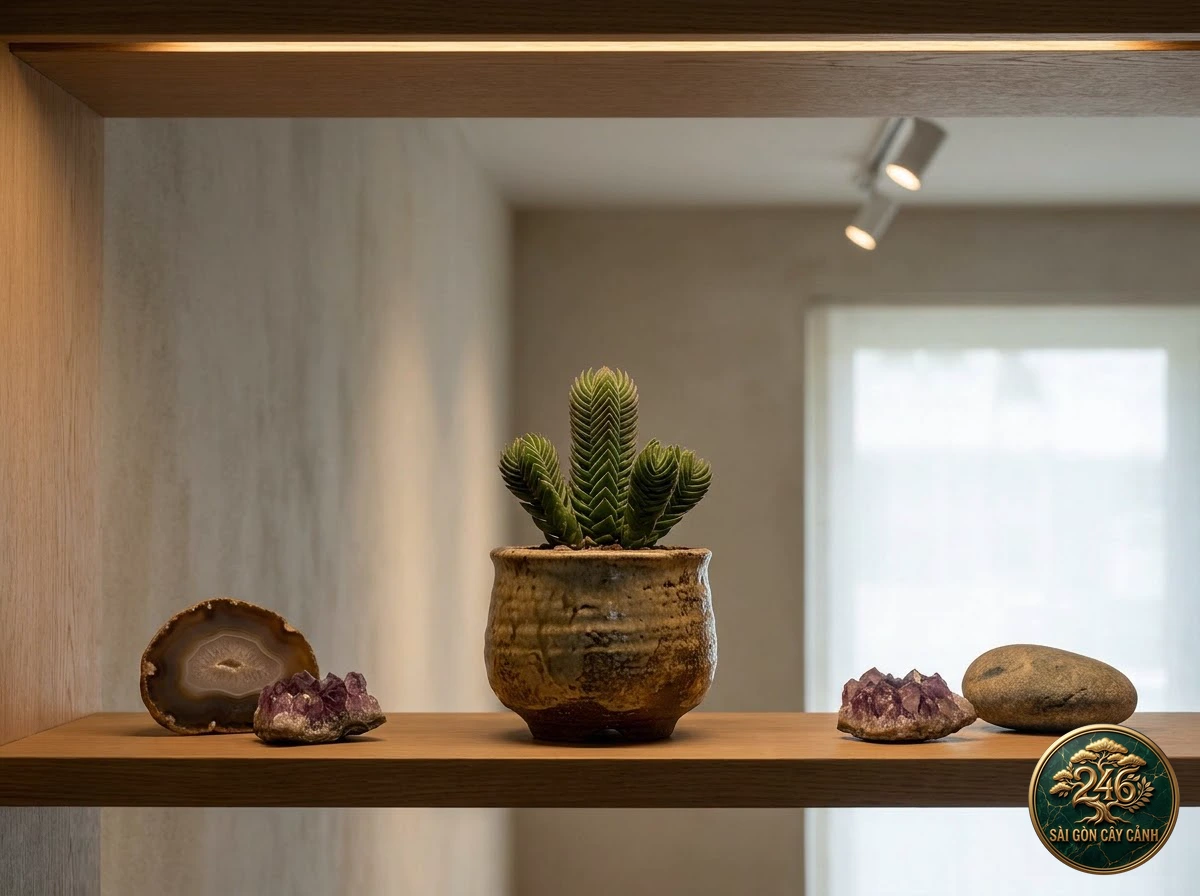
Propagating the pyramidal crassula requires patience due to its slow growth rate. The plant is best propagated by dividing basal offsets produced after flowering.
Seasonal Timing: Early spring provides optimal warmth and active meristematic division for swift rooting.
Basal Offset Division Procedure:
- When basal offsets reach 3 cm to 5 cm in height with several complete leaf tiers, sever them cleanly from the parent stem using a sterile scalpel.
- Allow cuttings to rest in dry, shaded air for 3 to 5 days until cut ends form a protective corky callus.
- Insert the callused base into fine pumice or clean coarse sand. Avoid heavy watering for the initial week; instead, provide light surface misting around the pot rim. Adventitious roots establish firmly within a short time.
12. Companion Animal Safety & ASPCA Certification
The botanical tissues contain no dangerous cardiac glycosides, neurotoxins, or caustic sap compounds. It is completely safe for household handling and causes no dermatological irritation during routine grooming.
Nonetheless, pet owners should practice sensible placement. Domestic carnivores cannot digest large quantities of dense, fibrous succulent foliage. Consuming foliage out of curiosity can cause mild mechanical stomach upset accompanied by self-limiting regurgitation. Elevating prized specimens upon stable plant stands or high shelves preserves specimen symmetry while maintaining a harmonious environment for four-legged companions.
13. Biophilic Design & Modern Interior Landscaping
With its striking architectural silhouette and ancient stepped pyramid form, the pyramidal crassula functions as a living botanical sculpture in modern biophilic interior design.
Minimalist Planter Pairing: The geometric silhouette pairs exquisitely with minimalist matte black ceramic planters, raw concrete pots, or unglazed stoneware in warm charcoal and sand tones. The stepped columns stand out sharply against neutral backdrops on desks, open shelving, and architectural niches.
Rare Succulent Showcase: In miniature desert dish gardens, a specimen of pyramidal crassula serves as an immediate focal point, evoking the sacred mystery of ancient monuments.
14. Brand Ambassador & Saigon Cay Canh Cultivation Philosophy
At Saigon Cay Canh, plant cultivation is an art form rooted in profound respect for botanical science. Our specialists nurture every pyramidal crassula specimen with meticulous care, acclimating them to Southern Vietnam’s equatorial climate so that each living plant delivers long-lasting beauty and vitality to your living space.

The portrait of our nursery specialist gently grooming columnar stems with hands dusted in mineral pumice reflects our authentic dedication to living botanical craftsmanship. We believe that cultivating living greenery within urban dwellings is the ultimate restorative practice for the human spirit.
15. Frequently Asked Questions (FAQs)
Why are the leaf tiers on my pyramidal crassula stretching apart?
Internodal stretching indicates insufficient natural sunlight. Move the container to receive 4 to 5 hours of direct morning sunshine daily and maintain soak-and-dry watering to encourage compact, tightly stacked leaf foliage.
Does the plant die after flowering finishes?
The flowering stem is monocarpic and naturally senesces after seed production. However, basal offsets erupt from lower nodes to sustain the plant. Simply prune the faded flower stem and care for the basal offsets.
How do I prevent mealybugs in the tight leaf folds?
Ensure buoyant air circulation and apply a monthly evening spray of organic neem oil emulsion. Spot-treat any visible pests using a cotton swab dipped in 70% isopropyl alcohol.
How long does this miniature pyramid plant live in container culture?
As a perennial species, it can thrive for decades in containers when provided with ample light and fast-draining mineral media, continually renewing itself through successive generations of basal offsets.