Living plant profile
Maughanii haworthia (Haworthia maughanii)
Haworthia maughanii
Comprehensive botanical monograph on Maughanii haworthia (Haworthia maughanii): structural morphology, physiological adaptations, porous mineral substrate, and specialized cultivation guidelines.
Maughanii haworthia (Haworthia maughanii)
Sài Gòn Cây Cảnh Care Compass
1. Botanical Introduction & Taxonomic Identity
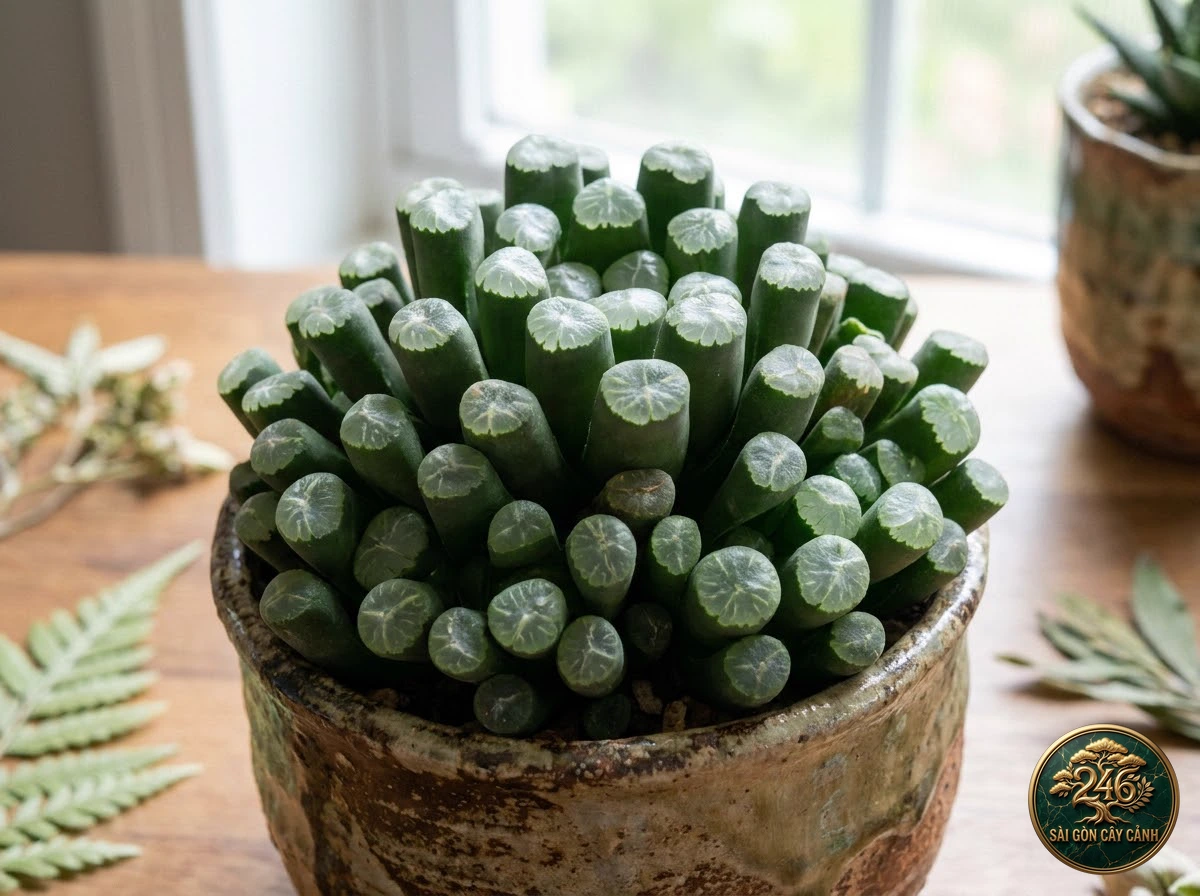
Haworthia maughanii (often treated as a sister species to Haworthia truncata or as Haworthia truncata var. maughanii) ranks among the rarest and most coveted treasures in international succulent connoisseurship. The pivotal divergence from truncata lies in its leaf architecture: rather than compressed, two-ranked ribbons, the leaves of maughanii are plumply cylindrical, resembling truncated subterranean fingers arranged in a spiral rosette. The apical termination of each cylindrical column is sheared squarely off like a glass bottle cap or sliced bamboo stalk, exposing an orbicular, translucent window. Through this frosted circular lens, natural daylight penetrates directly into subterranean chlorenchyma columns, operating as an exquisite natural fiber-optic mechanism.
Haworthia maughanii was discovered in the late 1920s near Calitzdorp by Dr. H. Maughani, an ardent botanical explorer in South Africa. Specimen material was dispatched to German botanist Karl von Poellnitz, who formally described it in 1932 in the monograph journal Repertorium Specierum Novarum Regni Vegetabilis. Displaying remarkable cylindrical club-shaped leaves with sheared bottle-cap window facets, maughanii instantly became an international botanical sensation. Taxonomic debate persisted for decades regarding whether it warranted full species rank or should be treated as a cylindrical variety of Haworthia truncata (Haworthia truncata var. maughanii); nonetheless, its aesthetic reverence remains unparalleled. In ecological field surveys throughout the Little Karoo, researchers noted that Haworthia maughanii frequently establishes cryptic micro-associations beneath low spiny Aizoaceae scrub; the canopy reduces surface soil temperatures by up to 8°C, creating favorable nurse microclimates for maughanii seedlings to anchor their taproots across decades.
2. Native Habitat & Geographical Distribution
The native distribution of Haworthia maughanii is exceptionally localized, restricted almost entirely to a narrow enclave surrounding Calitzdorp in the arid Little Karoo basin of the Western Cape, South Africa. This harsh locality receives scarce annual precipitation rarely reaching 150 mm, featuring weathered quartz scree embedded in reddish alluvial clay. Summer conditions are relentlessly arid with ambient air temperatures frequently soaring past 42°C. To endure these life-threatening extremes, maughanii minimized its transpiration surface by morphing its leaves into stout subterranean cylinders buried beneath reflective quartz gravel, utilizing the circular terminal skylights as its sole visual connection to the sky.
3. Detailed Morphological Characteristics
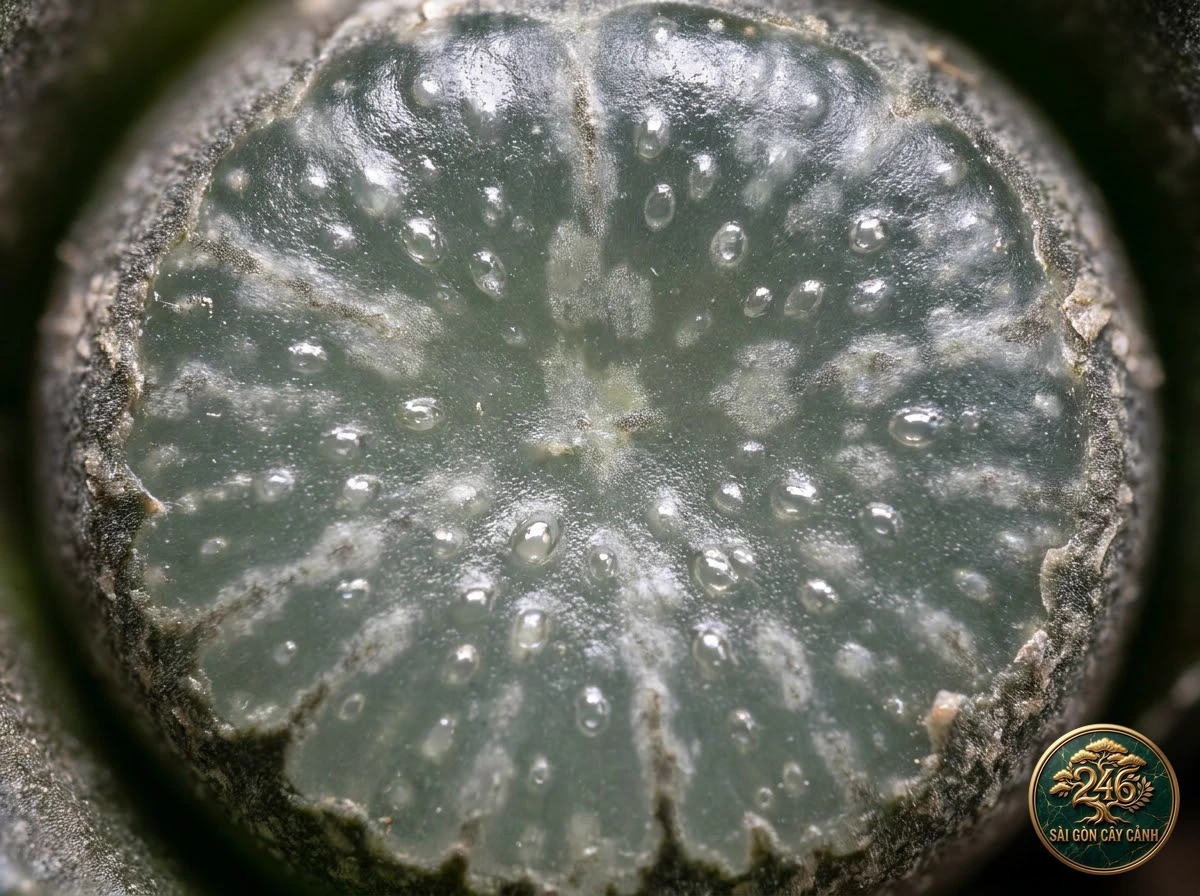
Morphologically, Haworthia maughanii produces a compact rosette 5 to 8 cm in diameter, remaining predominantly solitary throughout its early decades. A specimen typically comprises 7 to 15 cylindrical, club-like leaves 1.0 to 2.0 cm in diameter and 2 to 4 cm in subterranean length. The truncated apex forms a circular to broadly elliptical planar window with a frosted, micro-papillate texture veined with emerald or chocolate subcutaneous lines. The root system features robust contractile taproots capable of seasonal elastic contraction that drags the crown deeper during desiccation phases. Slender scapes 15 to 25 cm high display dainty tubular florets of off-white etched with faint green central veins.
Micro-anatomical studies of Haworthia maughanii highlight geometric optimization for hyper-arid survival: a cylinder provides the lowest surface-area-to-volume (S/V) ratio among common natural structures (surpassed only by a sphere), drastically curtailing transpirational water loss. The apex of each cylinder forms an orbicular window composed of clear epidermal cells enriched with microscopic silica granules that refract overhead solar glare into diffused light feeding the vertical photosynthetic mantle around a water-storing core. Deep succulent taproots serve as subterranean reservoirs sustaining life across rainless desert months. The cylindrical foliar architecture of Haworthia maughanii represents a supreme evolutionary adaptation for surviving the arid quartz plains of Calitzdorp. Each cylindrical leaf column acts as an independent subterranean water reservoir operating under high osmotic pressure. The truncated terminal facet functions not merely as a passive light aperture, but exhibits bio-optical modulation depending on ambient irradiance: under fierce solar radiation, protective pigments increase opacity to shield internal chlorenchyma, whereas under softer light, the window clears to crystal transparency to maximize photosynthetic photon capture.
4. Core Botanical Matrix
Core taxonomic and cultivation parameters:
| Botanical Parameter | Observed Trait | Saigon Cay Canh Horticultural Recommendation |
|---|---|---|
| Scientific Name | Haworthia maughanii Poelln. | Maintain certified taxonomic labeling across nursery stock |
| Plant Family | Asphodel family (Asphodelaceae) | Observe specialized succulent physiology within Asphodelaceae |
| Native Distribution | Hyper-arid quartz and shale clay flats surrounding Calitzdorp in the Little Karoo basin, Western Cape, South Africa | Replicate native climatic parameters in indoor cultivation |
| Illumination Intensity | 16,000 – 28,000 lux | Bright diffused illumination or gentle morning sun; requires protection from fierce summer noon rays |
| Thermal Window | 12°C – 28°C | Protect against cold below 8°C and provide active ventilation during heat |
| Relative Humidity | 35% – 50% | Sustain gentle atmospheric air movement to disperse stagnant moisture |
| Substrate pH | 6.2 – 6.8 | Utilize porous neutral mineral components for rapid drainage |
| Substrate Formulation | 55% fine pumice, 25% hard akadama, 10% zeolite, 5% crushed black lava, 5% sterile worm humus | Maintain coarse granular structure; avoid dense suffocating soils |
| Irrigation Strategy | Highly conservative watering; allow ninety percent medium dryness before applying water gently | Enforce thorough substrate dry-down between watering sessions |
| Propagation Pathways | Rare offset division or patient propagation from hand-cross-pollinated authentic seeds | Perform during warm spring or early wet season for peak vigor |
| Veterinary Toxicology | NON-TOXIC TO COMPANION ANIMALS (ASPCA Non-Toxic) | COMPLETELY SAFE FOR DOMESTIC ANIMALS (ASPCA Non-Toxic); non-toxic to cats and dogs. |
5. Toxicity Profile & Domestic Safety
Toxicologically, Haworthia maughanii is confirmed entirely NON-TOXIC to feline and canine companions by the ASPCA. Its cellular sap contains zero dangerous compounds or irritant crystals. It represents a tranquil, pet-safe botanical curiosity suitable for peaceful domestic coexistence with animal companions.
6. Lighting Dynamics & Photosynthetic Adaptations
Light requirements for maughanii require attentive calibration: an ambient range between 16,000 and 28,000 lux proves ideal. Plants favor clear diffused brightness or gentle morning sun lasting 3 to 4 hours. Unfiltered tropical summer noon sun must be avoided, as the intense solar heat can permanently discolor and burn the terminal window glass.
7. Moisture Equilibrium & Irrigation Regimes
Watering discipline for Haworthia maughanii is critical: irrigate only after ninety percent substrate dryness is reached. During spring and autumn vegetative phases, provide a thorough soak every 7 to 10 days. Throughout hot summer months, plants enter dormitive stasis; apply minimal perimeter hydration every 12 to 16 days at dusk to keep root fibrils viable.
8. Substrate Architecture & Nutrition Strategy
The specialized substrate for Haworthia maughanii demands uncompromising aeration: blending 55% fine pumice (2-4mm), 25% hard akadama clay pellets, 10% natural zeolite, 5% crushed black volcanic scoria, and a modest 5% sterile organic matter. This delivers supreme porosity, preventing moisture stagnation around sensitive root crowns.
9. Temperature Dynamics & Aeration Strategy
Optimal temperatures for Haworthia maughanii range between 12°C and 28°C. Specimens thrive in airy, temperate surroundings with ambient relative humidity between 35% and 50%. Constant gentle air circulation provides the vital cultural foundation for maintaining long-term vitality across decades.
10. Specialized Propagation Protocols
Propagating Haworthia maughanii demands advanced horticultural discipline and patience. Because plants remain persistently solitary throughout their youth, propagation relies primarily upon controlled hand-pollination between unrelated parent specimens using micro-fine brushes. Fresh seeds are sown over fine sterile pumice under high humidity at 18°C to 24°C; growth is deliberately slow, requiring 2 to 3 years to reach 2 cm in crown width. Occasionally, controlled root-cutting surgery on massive mature taproots stimulates adventitious plantlet budding at the callous margin.
11. Diagnostic Matrix & Preventative Health
The most destructive hazard threatening Haworthia maughanii is anaerobic moisture stagnation around the subterranean root collar, inviting Fusarium and Erwinia soft rot to devour internal parenchyma. Symptoms include cloudy, softened window panes and exudation of watery fluid. Preventive hygiene hinges upon breathable ceramic containers with generous drain holes, substrates comprising over ninety percent mineral aggregates, and strictly conservative watering. If an individual leaf column rots, immediately excise it surgically, sanitize with mild alcohol, and dust with sulfur.
Clinical diagnostics and remedial actions:
| Observed Symptom | Primary Root Cause | Saigon Cay Canh Remedial Action |
|---|---|---|
| Circular bottle-cap window panes sink inward with cloudy loss of optical clarity | Prolonged moisture deficit during the specimen’s active metabolic growth phase | Apply gentle hydration around the inner pot rim at dusk; the cylindrical columns plump up steadily |
| Subterranean cylindrical columns become waterlogged, translucent yellow, and weep fluid | Erwinia soft rot bacterium invading through roots under hot, airless, waterlogged conditions | Surgically pare away the affected leaf column, dust with activated charcoal, and dry unpotted for two weeks |
| Cylindrical leaf stems stretch unusually tall with reduced apical window diameters | Insufficient photon irradiance causing etiolated stretching as the plant seeks light | Increase exposure to gentle morning sunlight to 4 or 5 hours daily to preserve stout proportions |
| Mealybugs forming white waxy deposits around the subterranean neck just beneath the surface | Pests sheltering beneath top-dressing gravel to evade direct light and desiccation | Remove top gravel layer, brush away mealybugs with a soft brush, and treat with organic insecticidal soap |
12. Living Architecture & Interior Styling
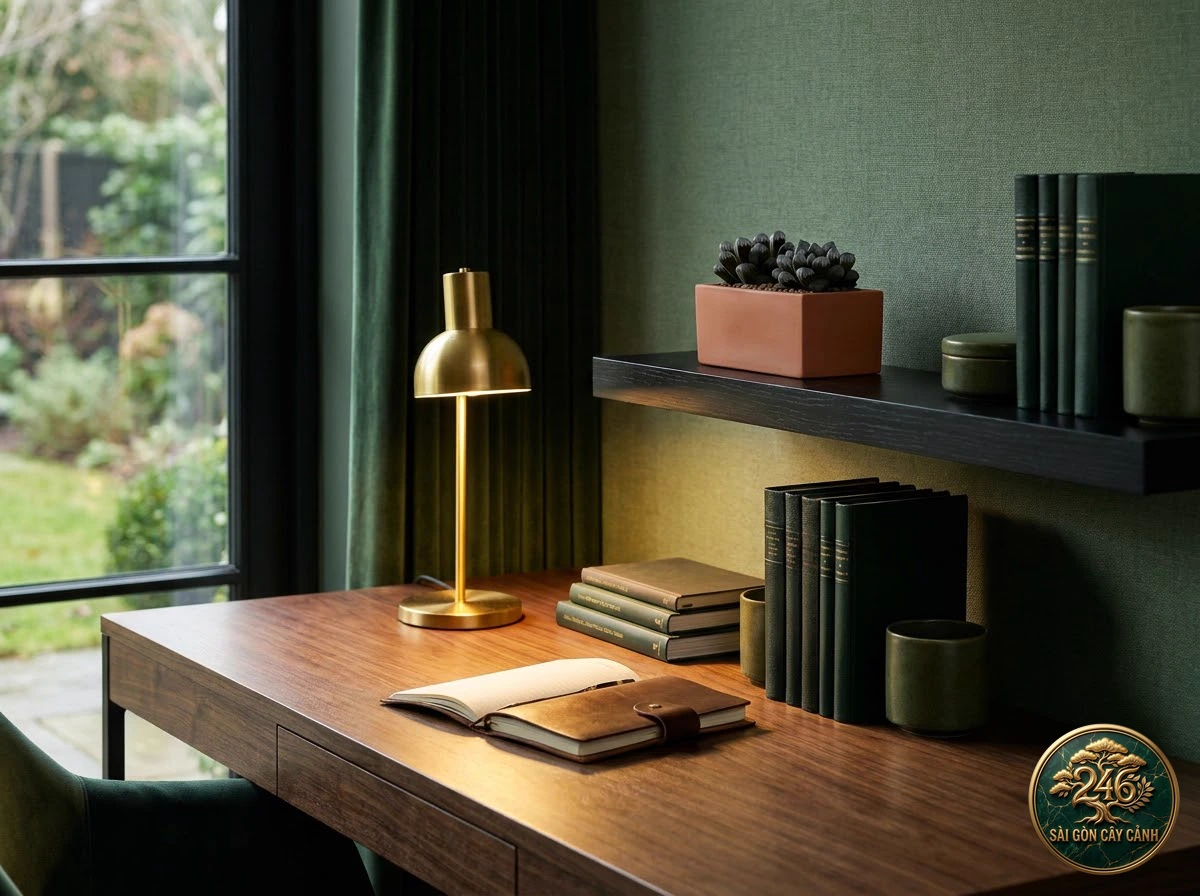
Haworthia maughanii is naturally displayed alongside elite succulent oddities such as Haworthia truncata, Haworthia bayeri, and slow-growing cacti like Ariocarpus and Astrophytum asterias. The dynamic dialogue between stout cylindrical columns and frosted circular lenses creates an enchanting miniature landscape that ignites botanical curiosity and admiration.
Haworthia maughanii represents a zenith of quiet minimalist elegance in contemporary interior living design. Its plump cylindrical pillars emerging from clean quartz gravel resonate profoundly with Zen sensibilities and Wabi-Sabi philosophy. It attains aesthetic harmony within wood-fired artisan pottery, carved sandstone vessels, or refined patinated bronze dishes. Positioned upon tea ceremony tables or executive architectural desks, it imparts meditative depth and enduring creative inspiration.
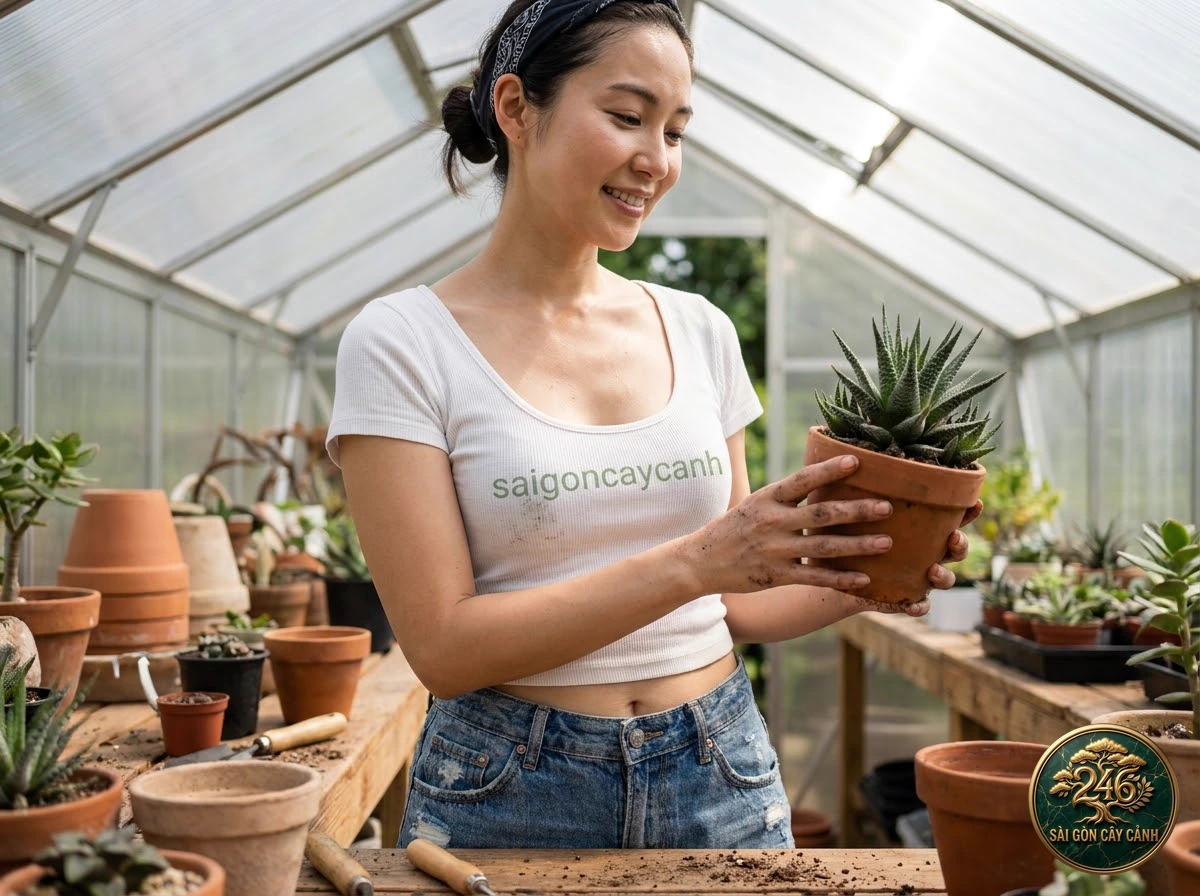
Nursery Care Journal & Living Greenery Moments
At Saigon Cay Canh greenhouse, each photograph captures genuine everyday care moments between plant lovers and living greenery, spreading a passion for nature and green-living inspiration.
13. Frequently Asked Questions & Botanical Summary
Frequently Asked Question: How do I maintain optimal clarity and plumpness across the circular window panes of my Haworthia maughanii?
Expert Diagnosis from Saigon Cay Canh: Maintaining luminous transparency and turgid circular form across maughanii windows requires three cultural pillars: bright diffused light shielded from harsh noon sun, high-porosity mineral substrate allowing unrestricted root respiration, and measured twilight watering once ninety percent dryness is reached. Sustained in clean mineral grit with gentle root humidity, window parenchyma stays richly hydrated, reflecting ambient light with crystalline brilliance.
Maughanii haworthia Haworthia maughanii embodies meditative serenity and extraordinary bio-optical design, standing as an elite living wonder authenticated by the curators at Saigon Cay Canh.