
Living plant profile
Sweet plum (Sageretia theezans)
Sageretia theezans
📌 CLINICAL & BIOLOGICAL ABSTRACT — Sweet plum (Sageretia theezans)Sweet plum (Sageretia theezans) Sageretia theezans, universally known as the Chinese sweet plum or bird plum, stands as a cherished treasure in classical East Asian penjing and bonsai culture. It captivates enthusiasts with its multi-toned exfoliating bark that peels to reveal smooth multicolored patches, miniature glossy […]

Sweet plum (Sageretia theezans)
Sageretia theezans, universally known as the Chinese sweet plum or bird plum, stands as a cherished treasure in classical East Asian penjing and bonsai culture. It captivates enthusiasts with its multi-toned exfoliating bark that peels to reveal smooth multicolored patches, miniature glossy leaves emerging in bronze-red flushes, and edible sweet dark purple berries. Its extraordinary ramification capacity and supple wood render it a quintessential subject for refined shohin compositions.
Sài Gòn Cây Cảnh Care Compass
1. Botanical Identity & Taxonomic Nomenclature History
Sageretia theezans was initially documented by Swedish botanist Pehr Osbeck as Rhamnus theezans in 1757, before French botanist Adolphe Theodore Brongniart transferred it to Sageretia in 1826 during his seminal revision of Rhamnaceae. The generic name honors French agronomist Augustin Sageret, while the epithet theezans references the traditional Cantonese practice of brewing the dried leaves as an invigorating herbal tea substitute.
Within the Lingnan penjing tradition of southern China, sweet plum is celebrated among elite classical bonsai subjects, treasured for its naturally exfoliating mottled bark, vigorous adventitious budding, and effortless adaptation to clip-and-grow artistic styling.
2. Morphological Anatomy & Structural Architecture
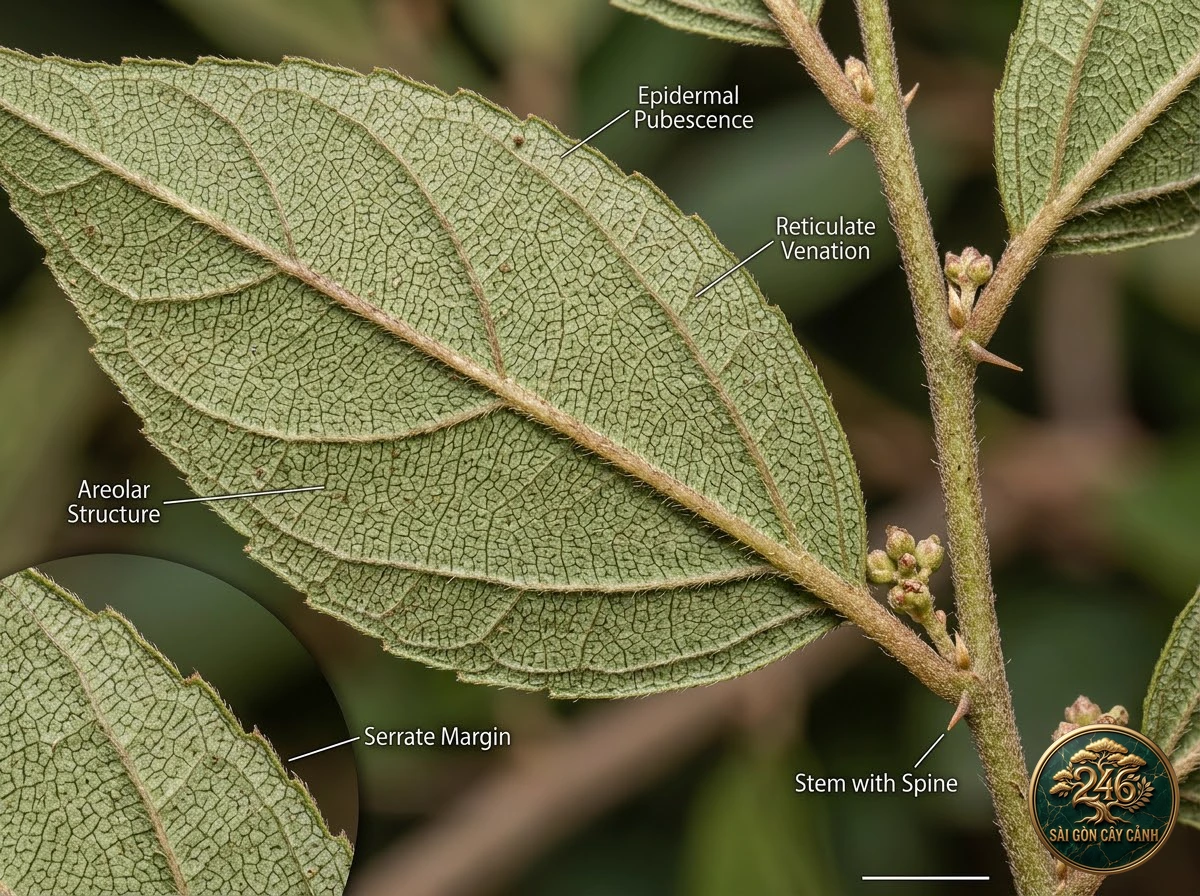
Anatomically, Sageretia theezans forms an evergreen to semi-deciduous woody shrub or small tree reaching 1 to 3 meters in native habitats. The signature anatomical characteristic is its papery exfoliating bark, which peels away in irregular thin plates to reveal a glass-smooth inner trunk mottled with subtle patches of cream, tan, dove grey, and olive green reminiscent of crape myrtles.
The leaves are opposite to sub-opposite, ovate to elliptic, measuring 1.5 to 3.5 centimeters. Tender spring flushes emerge in striking bronze-red or copper-pink hues before maturing into lustrous deep emerald blades with prominent secondary veins. Inflorescences form slender terminal spikes of minute creamy-white fragrant blossoms, developing into small globose drupes that transition to edible glossy blue-black berries.
3. Solar Irradiance Thresholds & Photosynthetic Dynamics
Sageretia theezans thrives in bright indirect illumination and gentle direct morning sunshine, developing optimally within light intensity boundaries of 25,000 to 55,000 lux. Ample light maintains tight nodal spacing, enhances anthocyanin coloration in juvenile foliage, and supports abundant fruit set.
While accommodating warm climates comfortably, providing a light 20% to 30% shade screen during extreme tropical summer heat waves above 36 degrees Celsius shields the smooth, thin bark from sunscald while preventing moisture desiccation in delicate leaf margins.
4. Mineral Substrate Mechanics & Root Aeration Porosity
The vigorous root system of the sweet plum generates dense capillary root mats that demand high gaseous exchange. The benchmark substrate mixture comprises 50% medium hard Akadama, 30% Japanese Pumice, and 20% volcanic black lava grit supplemented with a trace of aged leaf compost.
Substrate pH should be regulated between 6.0 and 6.8. Repotting is advised every two years in early spring just as dormant buds swell, trimming roughly one-third of the root mass to stimulate vigorous new feeder root generation.
5. Hydraulic Equilibria & Irrigation Regimens
Hydraulic management for Sageretia theezans necessitates steady root-zone moisture. The tree transpires actively during growth flushes but will not tolerate soggy, stagnant conditions. Irrigate thoroughly whenever the upper aggregate layer dries to a light crumbly tan.
Never allow the root ball to dry out to dusty desiccation, as sweet plum rapidly drops juvenile foliage and aborts fine twig ramification under drought stress. In dry air-conditioned rooms, light morning foliar misting restores humidity and preserves foliar vitality.
6. Nutrient Biogeochemistry & Fertilization Protocols
Nutritional inputs for sweet plum must remain steady from early spring through mid-autumn to sustain successive flushes of growth. Apply slow-release organic fertilizer pellets in perimeter baskets every 45 days.
Supplement with bi-weekly foliar applications of chelated iron, magnesium, and potassium to nourish smooth bark coloration and fortify leaf cuticles. Taper fertilizer inputs during mid-winter when vegetative activity slows.
7. Clonal Propagation & Germplasm Conservation
Sageretia theezans propagates readily via stem cuttings and fresh seed germination. Take 8 to 10 cm semi-hardwood tip cuttings in late spring, treat cut bases with 1,000 ppm IBA powder, and insert into moist fine pumice or perlite. Kept under warm humid shelter, root formation occurs within 3 to 4 weeks.
Seeds cleaned from ripe black berries germinate uniformly within 15 to 20 days when sown immediately in moist aggregate seedbeds, yielding vigorous seedlings.
8. Phytochemical Toxicity & Pet Safety Standards (ASPCA)
Phytochemical toxicity and ASPCA pet safety evaluation: Sageretia theezans is verified as completely NON-TOXIC to dogs, cats, and humans under ASPCA criteria. The ripe dark berries are harmless, juicy, mildly sweet, and historically consumed as a wild forage snack across East Asia.
The foliage contains no hazardous alkaloids or glycosides, having traditional use as a mild tea. When pruning and shaping, always wipe tool blades with 70% medical alcohol and seal significant cuts with wound mastic to preserve smooth cambial margins.
9. Clinical Pathology Diagnostics & Treatment Strategies
Clinical screening for terminal twig dieback prevention and smooth multicolored exfoliating bark cultivation in Sageretia theezans:
| Clinical Manifestation | Etiological Cause | Standard Treatment Protocol |
|---|---|---|
| Dieback of fine terminal twigs accompanied by intermittent foliar drop | Localized substrate desiccation or excessive fertilizer salinity burning fine roots | Flush substrate thoroughly with pure water, prune dead tips, relocate to dappled shade, and mist canopy |
| Aphids and mealybugs clustering heavily on tender emerging shoots | Dry stagnant indoor atmosphere allowing sap-sucking pest populations to surge | Swab colonies with 70% medical alcohol, followed by evening application of cold-pressed neem oil spray |
| Foliage loses lustrous sheen, becoming washed out and chlorotic yellow | Insufficient solar illumination coupled with iron and magnesium deficiency | Move specimen to receive 4 to 5 hours of gentle morning sun and apply chelated micronutrient drench |
10. Comparative Morphology & Allied Taxa Diagnosis
Taxonomic comparative matrix evaluating thin mottled exfoliating bark plates and metallic copper-red spring flushes of Sageretia theezans:
| Diagnostic Parameter | Sageretia theezans (Sweet plum) | Comparative Specimen A | Comparative Specimen B |
|---|---|---|---|
| Trunk Bark Behavior | Thin bark exfoliates in plates revealing smooth multicolored patches | Rough fissured dark grey-brown bark without exfoliating plates | Fibrous deeply furrowed bark exhibiting rugged ancient crevices |
| Juvenile Shoot Pigmentation | New flushes emerge in striking metallic bronze-red or copper-pink | Shoots emerge pale green with subtle reddish undertones | Shoots emerge bright green cloaked in soft white pubescence |
| Floral and Fruit Traits | Slender spikes of tiny fragrant cream flowers, sweet edible black fruit | Five-petaled starry white flowers with persistent scarlet berries | Funnel-form white starry flowers, seldom producing fleshy berries |
11. Biophilic Design Harmony & Contemporary Spatial Aesthetics

Within Asian spatial philosophy, the sweet plum embodies continuous renewal, youthful vitality, and abundant blessings. The natural peeling of aged bark to reveal fresh luminous inner wood symbolizes shedding past obstacles to embrace new prosperity and creative rejuvenation.
A gracefully styled Sageretia theezans bonsai gracing a living room, executive desk, or tea alcove infuses the environment with refreshing natural energy and timeless biophilic elegance.
12. Saigon Cay Canh Provenance & Cultivation Assurance
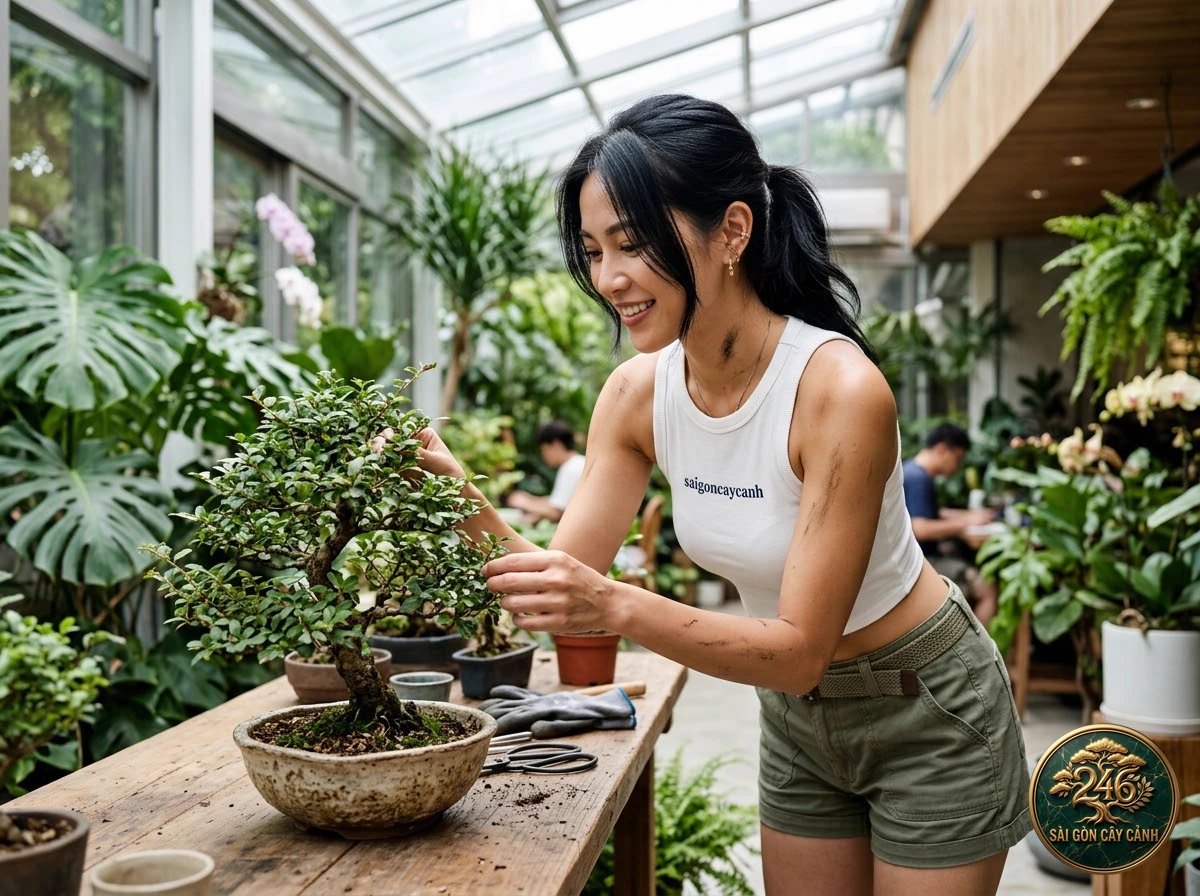
Saigon Cay Canh curates premier, healthy Sageretia theezans specimens exhibiting striking multi-toned exfoliating bark, tightly developed ramification, and established root balls in fine ceramics.
We provide verified botanical stock, accompanied by comprehensive shohin cultivation guides and lifelong styling advisory from our master horticulturalists.
💬 Góc Tư Vấn & Hướng Dẫn Kỹ Thuật SGCC
Chuẩn E-E-A-T Kinfolk❓ Chăm sóc Sweet plum (Sageretia theeza cần lưu ý điều gì quan trọng nhất?
💡 Dạ điều quan trọng nhất là giữ môi trường sống ổn định, tránh sốc nhiệt hay dao động thông số đột ngột, đồng thời cung cấp khẩu phần ăn sạch và tươi mới ạ.
❓ Làm thế nào để phòng ngừa bệnh tật hiệu quả cho các bé?
💡 Dạ anh chị nên giữ vệ sinh chuồng/hồ nuôi sạch sẽ, thay nước hoặc dọn dẹp định kỳ và bổ sung vitamin, men tiêu hóa đều đặn để tăng sức đề kháng ạ.
🌿 Trang Thiết Bị, Đất Trồng & Dụng Cụ Bonsai Tuyển Chọn
Dụng cụ tỉa, giá thể hữu cơ & phân bón chuyên dụng cho cây cảnh.

SWEET 3 Cái / bộ Bộ Dụng Cụ Làm Vườn Mini Cho Cây Vườn …

ĐẤT GIÁ THỂ TRỘN SẴN SOIL NEW MIX CHUYÊN SEN ĐÁ – XƯƠNG…

1 kg phân trùn quế Sfarm dạng viên nén phân bón hữu cơ …

Dây nhôm hình cây cảnh màu đen chống uốn cong Dây nhôm …

Combo 1-5 Cây lá dổi, cây dổi đất – Gia vị Tây Bắc – Là…

Dây nhôm bọc chỉ 2-3-4-5(mm) set 500gr (0,5kg)- Dây nhô…

Đôn gỗ hương đá chạm khắc hoa sen kích thước cao 20,30c…

Đất Nung Akadama bao 14 lít nặng 8-9kg loại cứng nhập t…

ATONIK- Thuốc kích thích Nảy Mầm hạt giống, Ra Rễ

GÓI 30 HẠT GIỐNG CÀ CHUA BI LÙN VÀNG F1 SIÊU TRÁI – SIÊ…

Chế phẩm sinh học Nấm Trichoderma – Bacillus (Nấm đối k…

Gói 30 HẠT GIỐNG HOA HỒNG LEO Pháp Mix Gói 30 Hạt-SHOP …

Japanese persimmon (Diospyros kaki)
Japanese persimmon (Diospyros kaki) Diospyros kaki, universally cherished as Japanese persimmon or Asian persimmon, is an iconic deciduous...
Read Monograph →
Tea plant (Camellia sinensis)
Tea plant (Camellia sinensis) Camellia sinensis, universally revered as the tea plant or green tea tree, is a...
Read Monograph →
Boxleaf ebony (Diospyros buxifolia)
Boxleaf ebony (Diospyros buxifolia) Diospyros buxifolia, esteemed as boxleaf ebony, is a rare hardwood botanical subject prized in...
Read Monograph →
Japanese privet (Ligustrum japonicum)
Japanese privet (Ligustrum japonicum) Ligustrum japonicum, acclaimed as Japanese privet or waxleaf privet, is an imposing evergreen woody...
Read Monograph →Expert Q&A, Recommended Supplies & Article Feedback
Tap once to connect instantly via Google, Facebook or TikTok — no long forms required!
No questions yet for this article. Tap Google / Facebook / TikTok above to ask the first question!