
Living plant profile
Baseball plant
Euphorbia obesa
Euphorbia Euphorbiaceae Living Herbarium Master V2 Baseball Plant (Euphorbia obesa): Spineless Spherical Geometry, Dioecious Flowering and Karoo Xeriscape Conservation Scientific Name: Euphorbia obesa Hook.f. Common Name: Baseball Plant / Living Baseball Family: Euphorbiaceae Native Range: Great Karoo, Eastern Cape, South Africa Euphorbia obesa is an extraordinary spineless spherical succulent endemic to the Great Karoo, celebrated […]
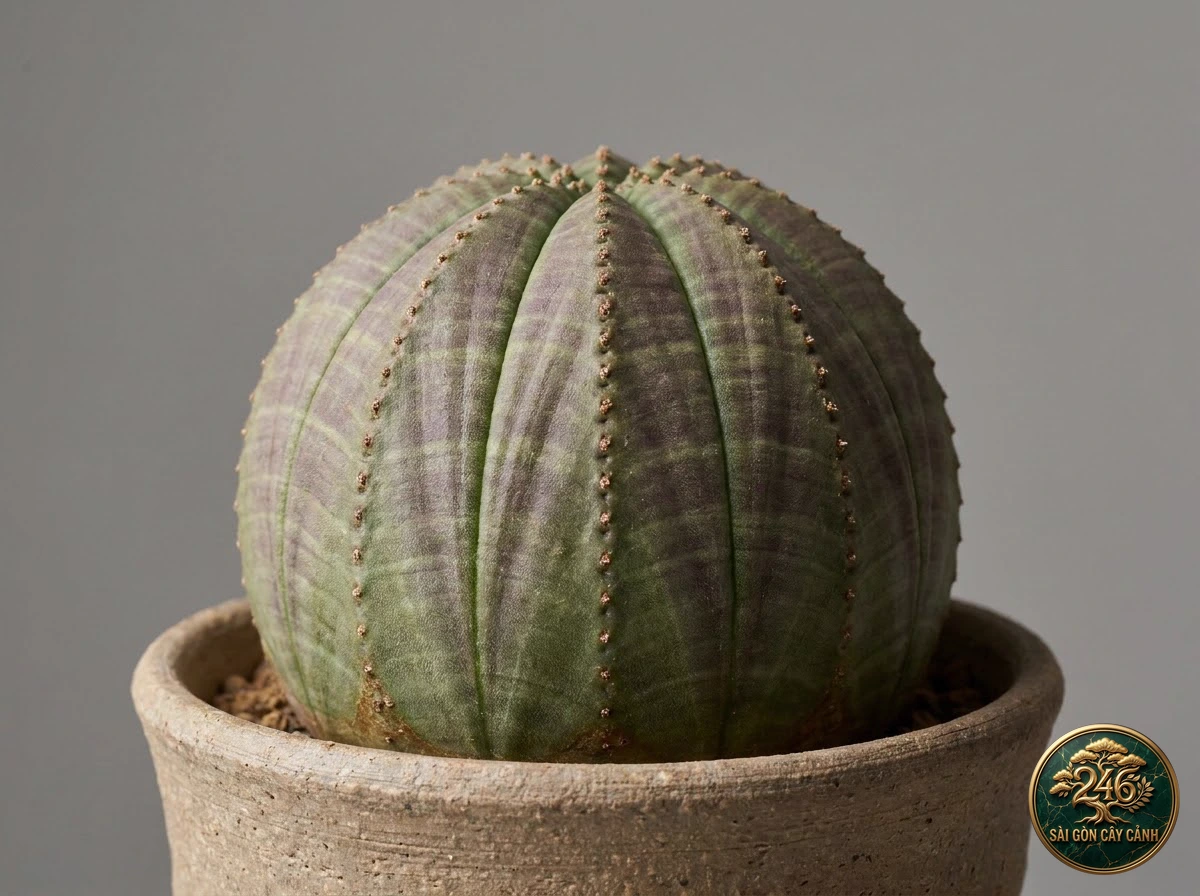
Baseball Plant (Euphorbia obesa): Spineless Spherical Geometry, Dioecious Flowering and Karoo Xeriscape Conservation
Common Name: Baseball Plant / Living Baseball
Family: Euphorbiaceae
Native Range: Great Karoo, Eastern Cape, South Africa
Euphorbia obesa is an extraordinary spineless spherical succulent endemic to the Great Karoo, celebrated for its 8 geometric ribs marked by purple-green stitching resembling a baseball seam.
Sài Gòn Cây Cảnh Care Compass
1. Geographic Origin & Taxonomic Nomenclature History
Euphorbia obesa was scientifically documented by Joseph Dalton Hooker in 1855. This extraordinary spherical succulent is strictly endemic to gravelly ridges of the Great Karoo in the Eastern Cape, South Africa.
Its vegetative body evolved into an immaculate spineless sphere divided into eight geometric ribs accented by purple-green chevron stitching reminiscent of a baseball seam.
2. Morphological Architecture & Anatomical Specializations
Anatomical examination reveals a leathery epidermal jacket enclosing spongy water-storage parenchyma that preserves hydration through severe Karoo droughts.
The species exhibits obligate dioecious breeding biology, where separate male and female specimens produce tiny sweet-scented cyathia across apical crowns.
3. Photosynthetic Radiance & Urban Microclimate Dynamics
Cultivation requires high-intensity filtered daylight paired with gentle morning sunshine between 3,500 and 6,000 lux to keep the globe compact and deepen purple stitch marks.
Locate containers on east-facing sills or ventilated balconies; avoid dim interior corners that cause apical etiolation and ruin spherical symmetry.
4. Mineral Substrate Engineering & Fast Percolation Dynamics
Substrate formulation mandates an 85% mineral composition: combine 50% pumice, 25% perlite, 10% crushed scoria, and 15% coarse sandy loam.
This ultra-porous mineral matrix prevents any moisture stagnation around subterranean crowns, safeguarding delicate root systems from desert rot pathogens.
5. Biological Irrigation Protocols & Seasonal Rhythm
Water application mandates supreme restraint: irrigate strictly when the medium is 100% bone-dry, every fourteen to twenty days during warm dry seasons.
During prolonged wet spells or chilly winter periods, withhold water entirely; the succulent globe easily withstands months of dry dormancy unscathed.
6. Trace Mineral Nutrition & Slow-Release Fertility Protocols
Keep nutrient inputs strictly minimal; apply only minute amounts of diluted worm casting tea in spring awakening to support floret differentiation.
Never force growth with high-nitrogen fertilizers; rapid expansion risks rupturing outer dermal walls and permanently scarring geometric perfection.
7. Vegetative Propagation Protocols & Aseptic Methodology
Because solitary globes produce no lateral offsets, propagation proceeds exclusively via fresh seeds gathered from hand-pollinated male and female pairs.
Sow seeds atop damp mineral grit at warm ambient temperatures of 22-26 deg C; seedlings germinate within two weeks, forming tiny spherical globes.
8. Botanical Toxicity Profile & Contact Protocols
Although completely smooth and free of thorns, inner tissues of Euphorbia obesa contain caustic diterpene sap causing stomach distress if punctured by pets.
Elevate containers onto collector shelving to afford prime viewing angles while ensuring full protection for curious domestic animals and toddlers.
9. Physiological Diagnostics & Integrated Pest Management
The physiological monitoring guide below outlines early clinical symptoms for managing spherical succulents:
| Clinical Symptom | Primary Root Cause | Standard Corrective Protocol |
|---|---|---|
| Spherical dome elongates into conical distorted point | Etiolation from inadequate photon levels breaking geometric spherical equilibrium | Acclimate gradually to 3-4 hours direct morning sun to re-establish compact growth |
| Basal contact zone with soil becomes soggy yellowish-brown | Excess moisture stagnation inducing collar rot from stagnant bottom grit | Unpot immediately, excise rot, dust with sulfur, dry 10 days on bare mesh, replant in pure pumice |
| Transverse dermal fissures crack open revealing scarred parenchyma | Over-irrigation following prolonged drought bursting taut outer epidermal cell walls | Establish moderate cyclical watering; fissures will suberize into permanent natural corky scars |
| Flowers bloom prolifically at apical apex but never set seed | Dioecious breeding biology requiring separate male and female plants for pollination | Acquire opposite-sex specimen; use fine sable brush to transfer golden pollen when florets open |
10. Comparative Taxonomic Evaluation Across Allied Taxa
The diagnostic matrix below clarifies morphological boundaries between Euphorbia obesa and neighboring globular succulents:
| Species Taxon | Morphological Trait | Growth Architecture | Diagnostic Indicator |
|---|---|---|---|
| Body Architecture | Solitary flawless spineless sphere, slightly sub-cylindrical in age | Massive upright candelabriform branched columns | Densely clustering multi-stemmed upright shrub |
| Spine Armature | Entirely spineless with minute button-like floral scars | Persistent rigid woody peduncular spines along rib margins | Sharp paired stipular thorns flanking leaf bases |
| Sexual Strategy | Strictly dioecious with obligate male and female individuals | Mixed or bisexual cyathia on branching cymes | Small cyathia clustered along active node segments |
| Conservation Status | Critically over-collected historically, strictly protected under CITES App II | Widespread wild range across savannah habitats, Least Concern | Locally abundant wild colonies on rocky Karoo kopjes |
11. Urban Landscape Architecture & Living Display Design
The geometric spherical harmony of Euphorbia obesa functions as a living natural sculpture when displayed on executive desks or minimalist tea tables.
Its serene presence radiates zen tranquility and quiet resilience, enriching modern urban interiors with timeless desert elegance.
Nursery Care Journal & Living Greenery Moments
At Saigon Cay Canh greenhouse, each photograph captures genuine everyday care moments between plant lovers and living greenery, spreading a passion for nature and green-living inspiration.