Living plant profile
Black Diamond Anthurium
Anthurium luxurians
Masterclass botanical guide to Black Diamond Anthurium (Anthurium luxurians): lighting, chunky substrate, quadrangular petiole morphology, and humidity care.
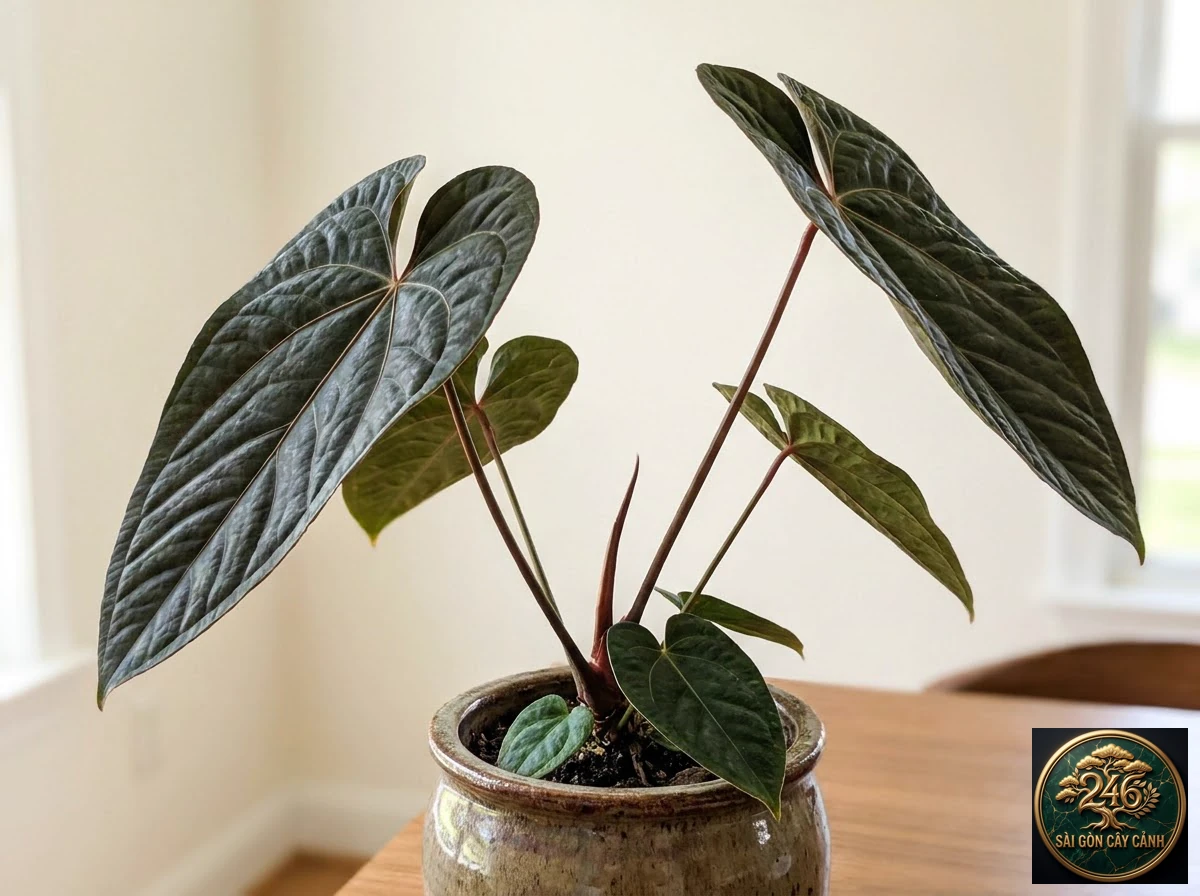
Black Diamond Anthurium (Anthurium luxurians) is widely revered by global aroid connoisseurs as one of the most magnificent and sculptural masterpieces of the Araceae family. Characterised by heavily bullate, coriaceous foliar lamina that glimmers with deep obsidian hues reminiscent of raw black diamond facets, coupled with distinctive quadrangular winged petioles, this lowland rainforest jewel embodies the absolute pinnacle of luxury Biophilic interior aesthetics. Cultivating a flourishing specimen within modern urban living spaces requires an intimate command of microclimate stability, high root-zone aeration, and disciplined ambient moisture protocols.
1. Botanical Profile & Wild Origin Ecology
| Scientific Name | Anthurium luxurians Croat & R.Cirino |
|---|---|
| Plant Family | Araceae (Aroid family) |
| Native Origin | Lowland pluvial rainforests of Colombia (elevations below 500m) |
| Growth Habit | Compact herbaceous rosette, short internodes, intensely bullate foliar lamina |
| Light Requirement | Bright indirect / dappled shade (1,200 – 2,500 lux); absolute protection from direct sun |
| Watering Protocol | Irrigate when top 40-50% of chunky mix is dry; immediate 3-second drainage |
| Optimal Substrate | Chunky aroid matrix: 35% small pine bark, 25% pumice, 20% coco chips, 10% perlite, 10% worm castings |
| Ideal Temperature | 20°C – 28°C (68°F – 82°F; thrives in climate-controlled spaces with gentle air circulation) |
| Ambient Humidity | 70% – 85% (High relative humidity vital for lamina expansion and foliar gloss) |
| Cultivation Difficulty | Advanced (Demanding specialist collector specimen) |
| Pet Safety | Toxic (Contains microscopic insoluble calcium oxalate raphides) |
2. Key Diagnostic Morphology & Hybrid Differentiation
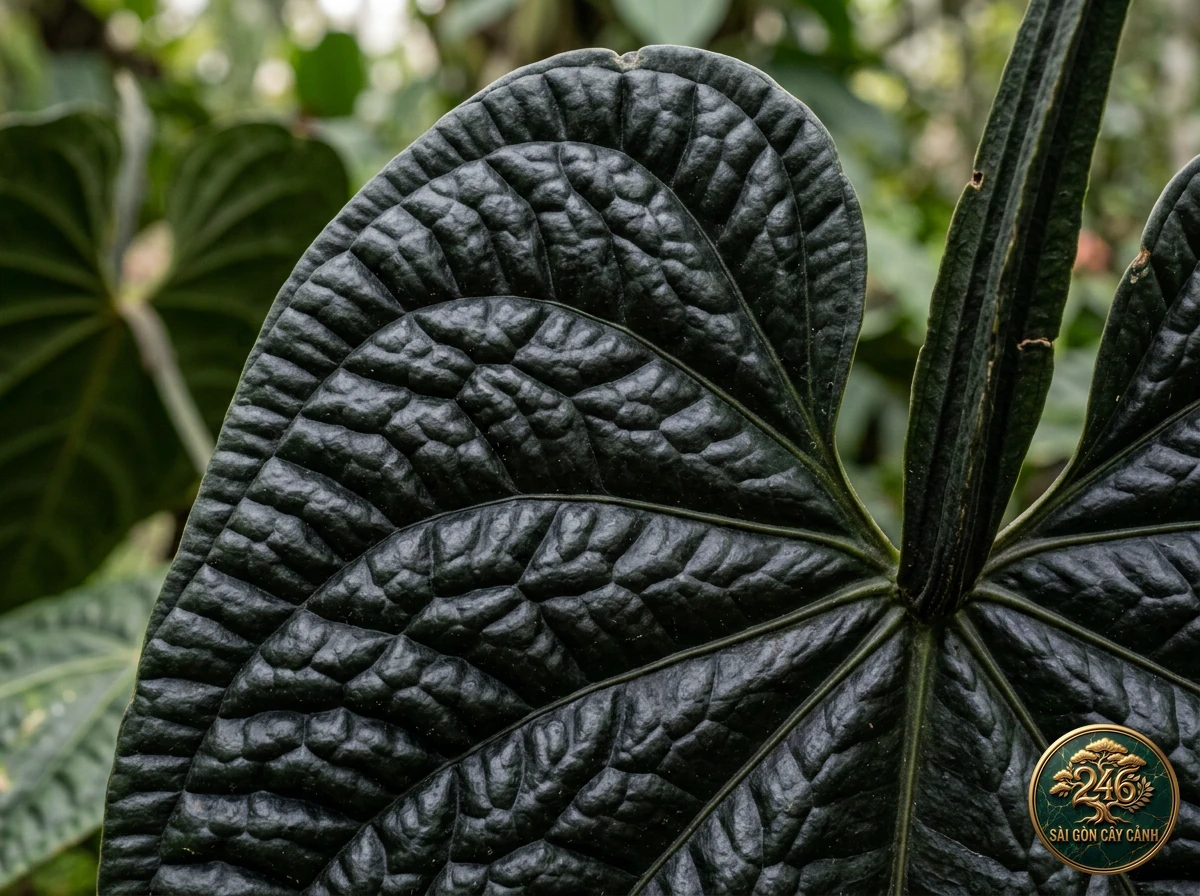
Authenticating a true-to-type Anthurium luxurians requires rigorous morphological verification across three unmistakable botanical markers:
- Intensely Bullate Lamina Topography: The foliar surface is not planar; it exhibits profound polygonal pillows (cushions) rising dramatically between deeply sunken primary and secondary veins. This textured architecture scatters ambient light, creating the signature metallic “black diamond” iridescence. Mature blades are stiff, thick, and leathery.
- Quadrangular Winged Petiole: This is the vital morphological distinction separating Anthurium luxurians from Anthurium splendidum (which possesses cylindrical petioles clothed in fine glandular hairs and much thinner leaf tissue). Anthurium luxurians features a square cross-section with four prominent longitudinal wing-like ridges extending along the petiole.
- Chromophoric Transition of Emergent Leaves: Nascent emergent cataphylls and blades unfold in a breathtaking chocolate-bronze or warm cognac hue with an oily lacquer-like sheen. Over 3 to 4 weeks of photosynthesising, the blade progressively hardens into deep forest green and finally reaches its iconic obsidian-black maturity.
3. Calibrated Indirect Illumination for Urban Living Spaces
In its native Colombian pluvial jungle habitat, Anthurium luxurians thrives under the dappled shelter of towering rainforest emergents, sheltered from direct solar radiation. The plant possesses substantial photosynthetic capacity due to its dense chloroplast concentration, but its delicate bullate epidermal cushions are extraordinarily susceptible to solar heat stress.
Apartment & Home Positioning Guidelines:
- Golden Zone: Position the pot 1 to 1.5 meters away from an unobstructed East or South-East facing window, where it receives gentle morning illumination before 8:30 AM through sheer linen drapes.
- Danger Zones: Never expose the plant to unshaded Western or midday Southern sun. Infrared radiation exceeding 35°C will cause irreversible necrotic bleaching and cellular collapse on the raised lamina ridges within hours.
- Artificial Grow Lighting: In darker offices or penthouses, deploy full-spectrum horticultural LED fixtures (PPFD 100-180 µmol/m²/s) positioned 40-50 cm above the foliage, delivering 10 to 12 hours of steady, cool illumination daily.
4. Caudex Care & Short-Internode Aerial Root Management
Unlike climbing aroids such as Monstera deliciosa or vining Philodendron, Anthurium luxurians displays a compact, semi-arborescent rosette habit with exceedingly compressed internodes. It slowly forms a stout, upright woody caudex that continually pushes out thick, stubby aerial roots near the soil line.
Professional Nursery Insight: Maintain a breathable collar of damp, sterilised Chilean sphagnum moss gently tucked around the base of the crown. This moist micro-envelope shields emerging root tips from drying out in air-conditioned environments, allowing them to rapidly transition into anchoring feed roots that delve into the potting medium. A robust root crown directly dictates the enlargement and vigor of succeeding leaf flushes.
5. High-Aeration Chunky Aroid Substrate Matrix
The epiphytic root architecture of Anthurium luxurians requires constant aerobic gaseous exchange. Fine garden loam, peat moss, or unrinsed coco coir quickly compact into an anaerobic mire, triggering lethal root rot (Pythium / Phytophthora) during extended rainy seasons.
Saigon Cây Cảnh Signature Chunky Matrix:
- 35% Steamed Orchid Pine Bark (9-12mm): Establishes enduring structural macropores and fungal resistance.
- 25% Horticultural Pumice (5-8mm): Inorganic mineral aeration that never degrades or packs down.
- 20% Desalinated Coarse Coconut Husk Chips: Washed free of tannins to provide resilient, fibrous moisture buffers.
- 10% Jumbo Grade Perlite: Accelerates gravitational water percolation and oxygen circulation.
- 10% Organic Worm Castings: Sustains beneficial rhizosphere microbiology and slow-release micronutrients.
When irrigated, water must freely discharge through the base drainage holes within 3 to 5 seconds. Use unglazed terracotta containers or specialized aroid aeration pots with side ventilation slots.
6. Calcium-Magnesium & Trace Element Nourishment Regimen
To cultivate leaves that achieve the thickness of fine saddlery leather and maintain structural rigidity across expansive surfaces, Anthurium luxurians requires disciplined, low-salinity nutrition enriched with essential secondary macronutrients:
- Dilute Balanced NPK: Administer a balanced water-soluble fertilizer (such as 20-20-20 or 15-15-15 + TE) diluted to 1/4 the manufacturer’s suggested concentration, applied every 14 days during active vegetative flush cycles.
- Chelated Calcium-Boron Supplementation: Foliar spray or soil drench a dilute chelated calcium-boron supplement monthly. Calcium forms pectate bonds in cell walls, giving the bullate ridges extraordinary mechanical strength and preventing tearing as leaves expand.
- Magnesium for Chlorophyll Density: Magnesium acts as the core atom of the chlorophyll molecule, intensifying the deep obsidian black-green foliar coloration and crystalline luster.
7. Foliar Pathogen & Physiological Diagnostic Matrix
| Observable Symptom | Underlying Root Cause | Practical Inspection Test | Safe Remedial Action |
|---|---|---|---|
| Water-soaked soft patches on bullate cushions with yellow halo | Water stagnant in leaf grooves combined with bacterial pathogen in stagnant air | Gently press affected tissue; verify soft pulp texture and faint sour odor | Blot tissue completely dry; isolate pot; enhance air circulation; apply 70% alcohol or silver nanoparticle disinfectant |
| Crispy brown tips and brittle foliar margins | Relative humidity below 50% or direct blast from air conditioning unit | Place digital hygrometer adjacent to the foliage to check real-time ambient RH | Relocate away from AC airflow vents; deploy ultrasonic humidifier to sustain 70-80% RH |
| Emergent leaves torn, deformed, or failing to unfurl smoothly | Insufficent moisture during unfolding or cellular calcium deficiency | Inspect developing cataphyll and nascent leaf blade tightly packed at caudex | Lightly mist sheath with fine distilled water; administer dilute chelated calcium-boron |
| Basal leaves turning bright yellow, soggy heavy substrate | Anaerobic root suffocation caused by overwatering or blocked drainage | Insert a dry wooden dowel to the pot bottom; check for sour damp smell | Withhold water for 7 days; elevate pot base; unpot and excise black rotten roots if necessary |
8. Proactive Biological Management of Thrips & Spider Mites
The intricate valleys of bullate lamina offer ideal micro-refuges for piercing-sucking pests, predominantly greenhouse thrips and spider mites. By rasping foliar cells, they leave microscopic silvery speckles that irreversibly mar the foliage.
Integrated Organic Protocol:
- Weekly Foliar Shower: Gently rinse both upper and lower foliar surfaces with a fine lukewarm spray during morning hours, ensuring the plant dries within one hour under good ventilation.
- Bi-weekly Cold-Pressed Neem Application: Spray an emulsified cold-pressed neem oil solution (5ml neem + 3 drops organic castile soap per 1L warm water) in late afternoon after sunset.
- Targeted Spot Treatment: Eradicate isolated scale or thrips colonies instantly by dipping a cotton swab in 70% isopropyl alcohol and applying directly onto the pests.
9. Conservative Basal Division & Stem Internode Propagation
Given the slow growth rate and high value of Anthurium luxurians, propagation must be conducted conservatively to preserve the parent plant’s apical integrity. The optimal window for vegetative division occurs at the onset of the monsoon season (May to July) when ambient warmth and sap pressure peak.
Safe Division Protocol:
- Attempt division only when an offshoot has produced at least 2-3 fully hardened leaves and established 2 or more independent aerial roots exceeding 4 cm in length.
- Employ a sterilized surgical scalpel to make a clean, decisive excision at the basal connection point.
- Immediately coat both wounded surfaces with horticultural wound sealant or pure organic cinnamon powder, allowing cuts to air-callus for 2 to 3 hours.
- Pot the division into damp, sterile long-fiber sphagnum moss or fine mineral grit inside a humid propagation vessel with gentle indirect illumination. Independent root establishment typically solidifies within 4 weeks.
10. Pet Safety & Toxicology: Insoluble Calcium Oxalate Raphides
11. Biophilic Architectural Integration & Scandinavian Minimalism
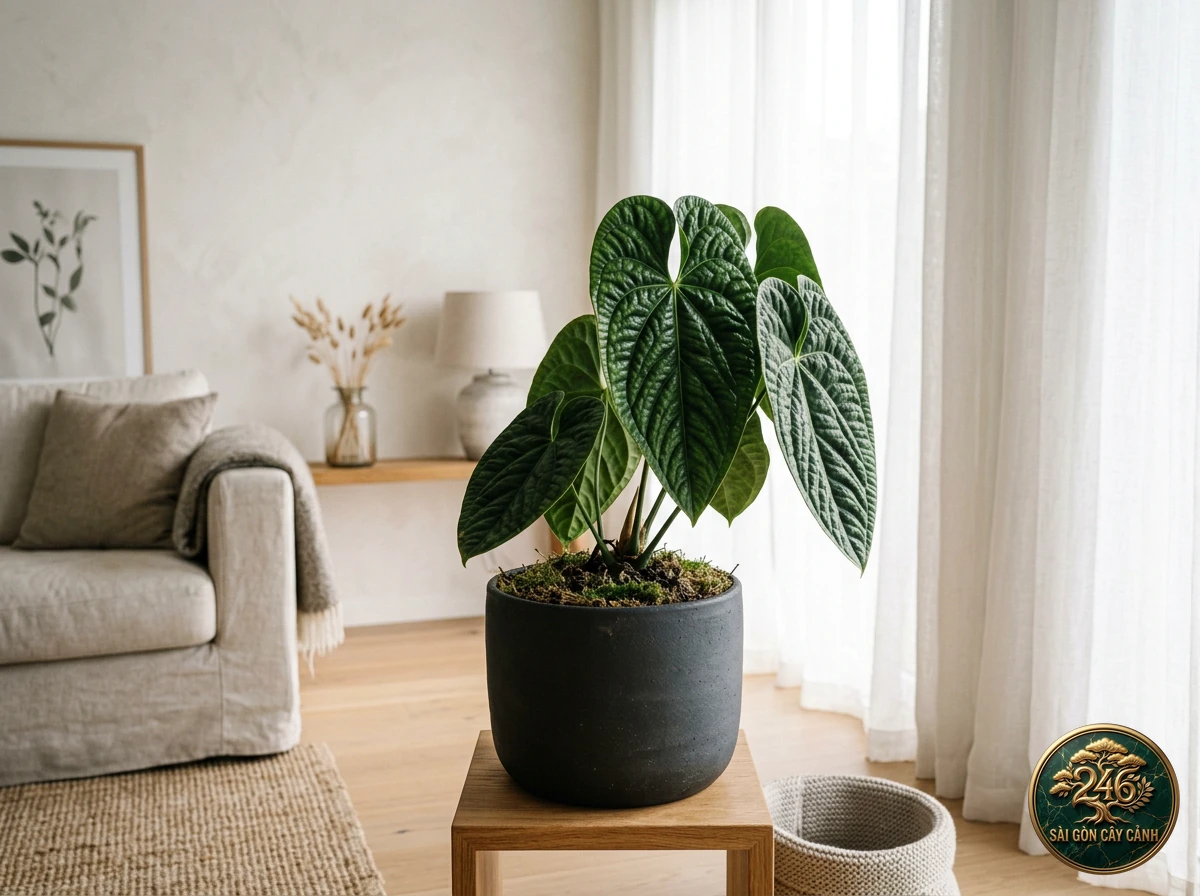
With its commanding sculptural silhouette and mesmerizing obsidian foliar luster, Anthurium luxurians serves as an unrivaled organic showpiece within contemporary interior architecture.
It pairs exquisitely with matte black handcrafted stoneware, honed terrazzo planters, or raw terracotta vessels displayed atop natural white oak stands. Positioned as a focal accent on low living room coffee tables, executive consoles, or penthouse reception galleries, it introduces a serene, grounded majesty that effortlessly elevates the sophistication of any curated residential environment.
12. Critical Misconceptions in Anthurium Luxurians Culture
“Heavy daily overhead foliage misting is required to maintain leaf humidity” — This represents the single most prevalent fatal error among novice aroid hobbyists. The intricate bullate relief features hundreds of water-trapping valleys. When heavily misted in stagnant air-conditioned rooms at night, water pools indefinitely, inviting devastating bacterial soft rot (Erwinia) and anthracnose leaf spot. Elevate atmospheric ambient humidity using dedicated ultrasonic cool-mist humidifiers or wide gravel evaporation trays rather than wetting the foliage.
13. Frequently Asked Questions (FAQs)
Why do emergent leaves emerge in chocolate-bronze rather than deep green?
This is a completely natural and healthy physiological adaptation. Juvenile leaf tissue produces concentrated anthocyanin pigments to shield fragile, unhardened cells from UV radiation damage before dense chlorophyll synthesis commences. The leaf will steadily transform into deep green and ultimately obsidian black as it matures over 3-4 weeks.
Can Anthurium luxurians thrive in an air-conditioned room year-round?
Yes, it adapts remarkably well to moderate temperatures between 20°C and 26°C. However, it cannot endure desiccating artificial drafts. Simply position the specimen at least 2 meters away from direct AC output vents and maintain ambient relative humidity above 65%.
What is the ideal repotting interval for a mature specimen?
Given its measured growth pace, repotting is typically required every 1.5 to 2 years, or when root tips emerge abundantly through drainage ports and organic substrate components begin to break down. Always upsize conservatively, choosing a new vessel only 3 to 5 cm larger in diameter.
How can I maintain brilliant foliar shine without mineral water spots?
Never apply mayonnaise, cooking oils, or commercial leaf-shine sprays, as these seal stomatal pores and suffocate the foliage. Simply wipe the leaf blades every one to two weeks with a soft microfiber cloth dampened with reverse osmosis (RO) or distilled water.
Does this species require a climbing moss pole like Monstera?
No. Anthurium luxurians is a naturally compact, short-internode rosette plant with a self-supporting caudex. It does not possess a vining or climbing habit. It requires only a stable, wide-bottomed pot and a moist sphagnum moss collar around its basal crown.