Living plant profile
Donkey ears kalanchoe (Kalanchoe gastonis-bonnieri)
Kalanchoe gastonis-bonnieri
Comprehensive botanical monograph on Donkey ears kalanchoe (Kalanchoe gastonis-bonnieri): structural morphology, physiological adaptations, porous mineral substrate, and specialized cultivation guidelines.
Donkey ears kalanchoe (Kalanchoe gastonis-bonnieri)
Sài Gòn Cây Cảnh Care Compass
1. Botanical Introduction & Taxonomic Identity
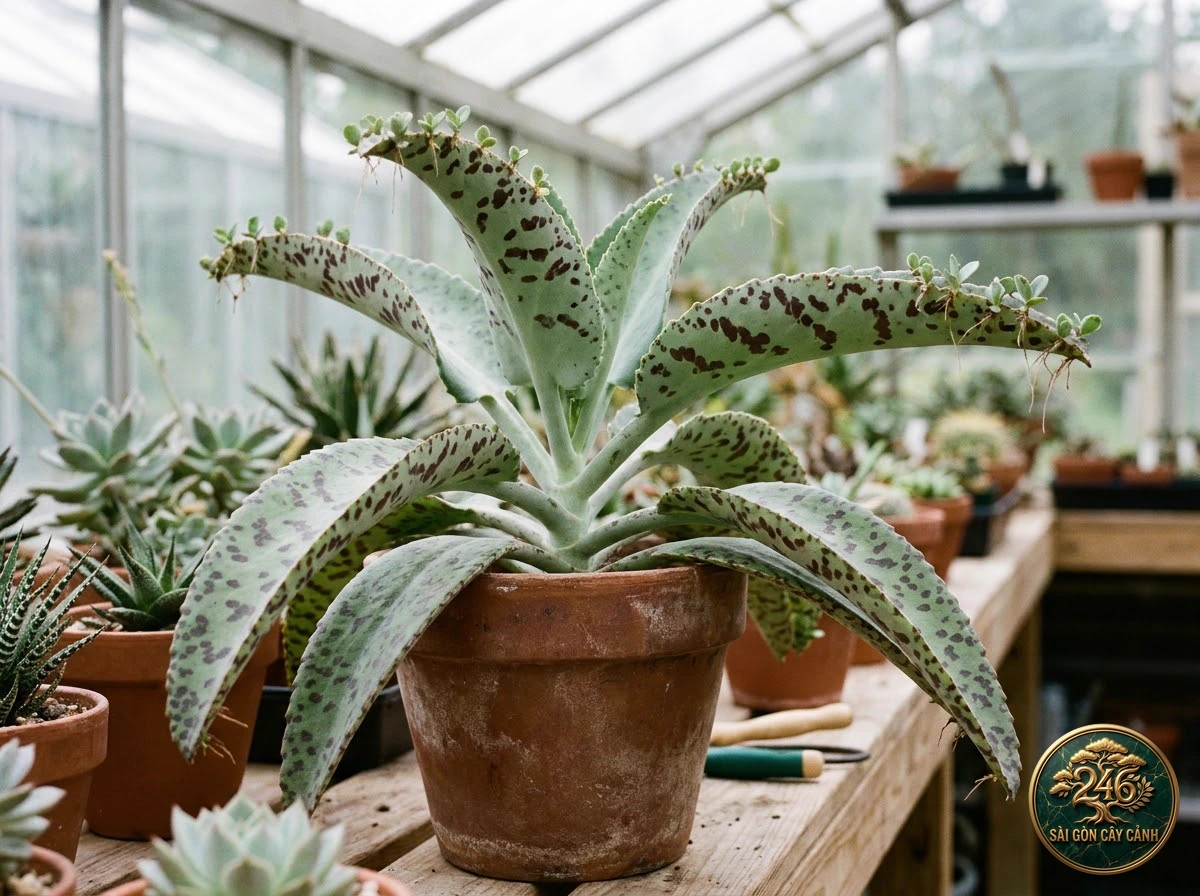
Kalanchoe gastonis-bonnieri, universally designated in botanical trade as the donkey ears kalanchoe or giant life plant, ranks among the most imposing and architecturally magnificent succulents in the entire genus Kalanchoe. Scientifically dedicated to the eminent French botanist Gaston Bonnier, the species is immediately recognized by its enormous lanceolate foliar blades that routinely achieve lengths of 40 to 50 cm, arching gracefully like the expressive ears of a donkey. The glaucous green epidermis is cloaked in a tactile white farina coating, exquisitely accentuated by dark purplish-brown or bronze chevron markings running in symmetrical chevron bands along the central vein, projecting an untamed primeval aesthetic.
Kalanchoe gastonis-bonnieri was scientifically published in 1903 by Raymond-Hamet and Perrier de la Bathie, dedicated to Professor Gaston Bonnier (1853-1922), a prominent French botanist renowned for his pioneering studies in plant morphology and ecology at the Sorbonne University in Paris. The holotype specimens were discovered clinging to razor-sharp limestone karst pinnacles in northwestern Madagascar. With massive donkey-ear leaves and spectacular apical vivipary, this architectural marvel was soon distributed to major botanical conservatories worldwide as an emblem of Madagascar’s primeval evolutionary wonder.
2. Native Habitat & Geographical Distribution
In its native wild habitat, Kalanchoe gastonis-bonnieri is narrowly endemic to northwestern Madagascar, thriving predominantly upon the precipitous, razor-sharp limestone karst pinnacles of Tsingy de Bemaraha. In this extreme rock ecosystem, weathered limestone spires offer virtually no soil, compelling the plant’s fibrous roots to penetrate deeply into hairline fissures in search of subterranean humidity. The local climate endures a severe dry season extending up to seven months without rainfall, forcing this species to store vast aqueous reserves inside its thick foliage, while its arching habit minimizes physical wind resistance against frequent dry gusts.
3. Detailed Morphological Characteristics
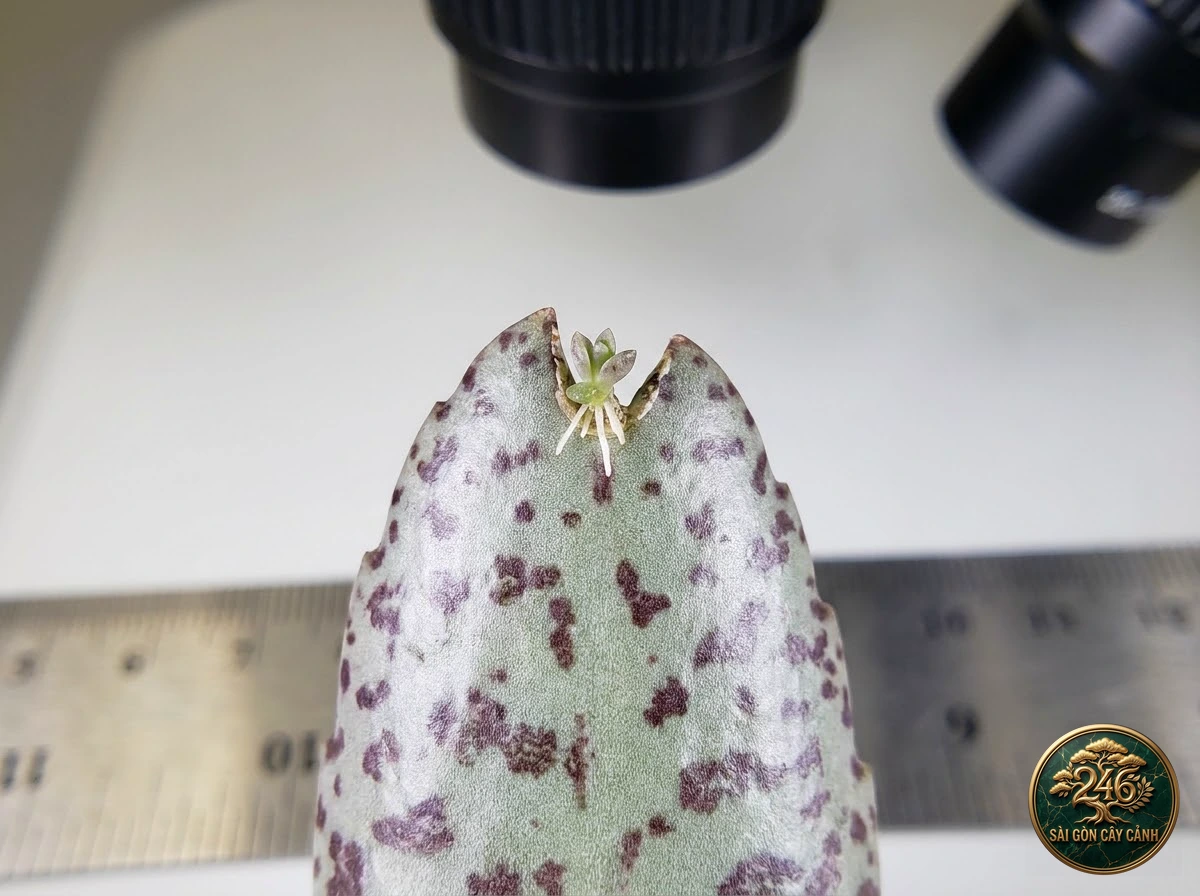
Anatomically, Kalanchoe gastonis-bonnieri forms an expansive, unbranched basal rosette whose stout stem is quickly obscured by massive overlapping leaf bases. The lanceolate leaves span 30 to 50 cm in length and 6 to 10 cm in width, bordered by coarse, irregular undulating teeth. The defining biological phenomenon of this species is apical foliar vivipary: at the tapering terminal tip of mature leaves, miniature plantlets equipped with developing roots sprout autonomously. As the elongated leaf arches under its own weight to contact surrounding soil, these adventitious plantlets instantly take root. During its reproductive peak, the terminal apex produces an immense floral scape exceeding one meter, displaying coral-salmon tubular corollas enveloped by inflated greenish-red calyces.
Anatomical examination of the tapering foliar apex in Kalanchoe gastonis-bonnieri reveals the biological machinery behind apical vivipary: the extreme leaf tip houses a localized embryonic meristem of pluripotent cells. As the mature leaf elongates and arches downwards, changes in hydrostatic pressure and endogenous hormone gradients induce rapid mitotic differentiation into embryonic leaflets and adventitious rootlets within days. Concurrently, adaxial epidermal cells synthesize concentrated flavonoid and anthocyanin complexes, forming protective chocolate-bronze chevron chevrons that facilitate thermal absorption and camouflage against rocky limestone.
4. Core Botanical Matrix
Core taxonomic and cultivation parameters:
| Botanical Parameter | Observed Trait | Saigon Cay Canh Horticultural Recommendation |
|---|---|---|
| Scientific Name | Kalanchoe gastonis-bonnieri Raym.-Hamet & H.Perrier | Maintain certified taxonomic labeling across nursery stock |
| Plant Family | Stonecrop family (Crassulaceae) | Observe specialized succulent physiological requirements |
| Native Distribution | Sheer limestone karst pinnacles across the Tsingy de Bemaraha region, northwestern Madagascar | Replicate native climatic parameters in indoor cultivation |
| Illumination Intensity | 22,000 – 50,000 lux | Prefers bright indirect light or direct early morning sun; insufficient light causes bronze chevron markings to fade |
| Thermal Window | 18°C – 35°C | Protect against frost below 8°C and provide ventilation during heat |
| Relative Humidity | 40% – 70% | Sustain gentle atmospheric air movement to disperse stagnant moisture |
| Substrate pH | 6.5 – 7.5 | Utilize porous neutral mineral components for rapid drainage |
| Substrate Formulation | 40% coarse pumice, 20% mineral perlite, 15% sanitized basalt scoria, 15% desalinated coco fiber, 10% vermicompost pellets | Maintain coarse granular structure; avoid dense suffocating soils |
| Irrigation Strategy | Drench around the root zone once completely desiccated; avoid overhead watering that pools inside tapering foliar tips | Enforce thorough substrate dry-down between watering sessions |
| Propagation Pathways | Harvesting tip-borne adventitious plantlets (vivipary), or rooting healthy mature terminal stem cuttings | Perform during warm spring or early wet season for peak vigor |
| Veterinary Toxicology | TOXIC TO COMPANION ANIMALS (ASPCA Toxic) | Accumulates bryotoxins and bufadienolides throughout foliar tissues capable of inducing severe cardiac toxicity in pets. |
5. Toxicity Profile & Domestic Safety
The clinical toxicology profile for Kalanchoe gastonis-bonnieri demonstrates significant accumulation of bufadienolide and bryotoxin compounds within all vegetative and reproductive tissues. These potent cardiac toxins selectively target cell membrane ion pumps in myocardial tissue. For companion animals such as dogs and cats, chewing on the fleshy foliage induces acute poisoning marked by excessive salivation, intractable vomiting, severe diarrhea, painful abdominal cramping, irregular cardiac rhythms, and potentially fatal cardiovascular depression. Saigon Cay Canh strongly advises animal owners to position this massive succulent on high architectural consoles or within dedicated solariums isolated from roaming household pets.
6. Lighting Dynamics & Photosynthetic Adaptations
Solar illumination dictates the foliar thickness and chromatic patterning of Kalanchoe gastonis-bonnieri. The species prospers best under intense indirect light or unhindered direct morning sun, requiring light intensities between 22,000 and 50,000 lux. Ample illumination intensifies the chocolate-maroon chevron chevrons against the chalky glaucous foliage. In dimly lit interior settings, leaf blades stretch abnormally, turn limp, and forfeit their contrasting waxy blotches to become uniformly pale green. However, exposing indoor-acclimatized plants directly to scorching afternoon sun without gradual conditioning may induce localized yellow sunscald on leaf surfaces.
7. Moisture Equilibrium & Irrigation Regimes
Watering protocols for the donkey ears kalanchoe demand allowing the potting substrate to dry out comprehensively between hydration cycles. In warm tropical environments, a watering interval of once every 7 to 10 days during dry months, extended to 12 to 16 days during wet humid weather, maintains ideal tissue firmness. Apply water gently around the root collar or through bottom subirrigation; avoid splashing water directly onto the foliar canopy, as trapped water inside the tapering tips causes rotting of fragile embryonic plantlets and invites black rot spores. Ensure the container has open, unobstructed drainage holes.
8. Substrate Architecture & Nutrition Strategy
The optimal potting substrate for Kalanchoe gastonis-bonnieri requires exceptional porosity and swift drainage: 40% coarse volcanic pumice (3-6mm), 20% expanded perlite, 15% sanitized basalt scoria, 15% desalinated neutralized coco peat, and 10% pelletized organic worm castings. This formulation creates open air spaces around the root system, preventing suffocating soil compaction and stagnant moisture buildup. A substrate pH between 6.5 and 7.5 mirrors its native limestone affinity. Amending with a conservative sprinkle of balanced phosphorus-potassium slow-release fertilizer at the onset of the active growing season reinforces muscular foliar development.
Sustaining half-meter donkey-ear leaves while preserving rigid structural firmness and crisp chevron patterning requires nutritional regimes rich in bio-available silica, calcium, and natural trace elements. High-nitrogen chemical fertilizers must be avoided as they induce rapid, watery foliar expansion that turns tissues brittle, prone to breakage, and dulls the bronze chevron blotches. Periodic amendments of pulverized calcified shells, iron-rich basalt scoria, or modest top-dressings of biological vermicompost at the onset of active growth ensure durable foliar architecture and long-term health.
9. Temperature Dynamics & Aeration Strategy
The preferred thermal range for vigorous growth in Kalanchoe gastonis-bonnieri is 18°C to 35°C. The species displays remarkable heat tolerance adapted from equatorial karst habitats, easily enduring brief peak temperatures up to 40°C if root zones remain moderately hydrated and well-aerated. However, temperatures dropping below 8°C in damp conditions cause catastrophic cell damage and stem collapse. Ambient humidity between 40% and 70% is well-tolerated. Continuous convective airflow is indispensable to dissipate heat pockets around the enormous foliar canopy and keep the leaf surfaces pristine.
10. Specialized Propagation Protocols
Propagating Kalanchoe gastonis-bonnieri is a fascinating biological process driven by apical vivipary. As foliage reaches maturity, self-sufficient miniature plantlets equipped with juvenile leaves and adventitious roots sprout at the leaf tips. The cultivator simply plucks these plantlets when they span 2 to 3 cm across and rests them onto moist pumice grit; they establish independent root networks within several days. In addition, rooting severed stem tips or laying entire mature detached leaves horizontally atop dry mineral substrate achieves virtually complete success.
11. Diagnostic Matrix & Preventative Health
Brown scale insects and cottony mealybugs nestled within foliar crevices constitute the primary pests affecting the donkey ears kalanchoe. Upon sighting white waxy patches or brown scale encrustations along veins, swab the area thoroughly with 70% medicinal alcohol to eliminate the colony without harming plant tissue. If leaf tips turn black and soft due to stagnant moisture, excise the necrotic section with sterile shears, coat the wound with sulfur powder, and suspend watering until dry. Regularly removing withered lower leaves maintains cleanliness and airflow around the root collar.
Clinical diagnostics and remedial actions:
| Observed Symptom | Primary Root Cause | Saigon Cay Canh Remedial Action |
|---|---|---|
| Lower leaves turn soft, thin, and wrinkled | Prolonged moisture deficit in the root medium | Provide a deep perimeter soak for Kalanchoe gastonis-bonnieri; tissues recover within 48 hours |
| Black soft decay at the stem base with leaf drop | Anaerobic fungal root rot due to waterlogged substrate | Unpot immediately, excise necrotic pulp, treat with sulfur powder, and repot into bone-dry pumice |
| Elongated, weak internodes with pale drooping foliage | Chronic insufficiency of direct solar radiation | Relocate Kalanchoe gastonis-bonnieri to receive unshaded morning sunlight for 4 to 6 hours daily |
| White cottony clusters nested in foliar axils | Foliar mealybug infestation (Pseudococcidae) | Apply 70% medicinal alcohol directly with a cotton bud to dissolve waxy insect cuticles without foliar damage |
12. Living Architecture & Interior Styling
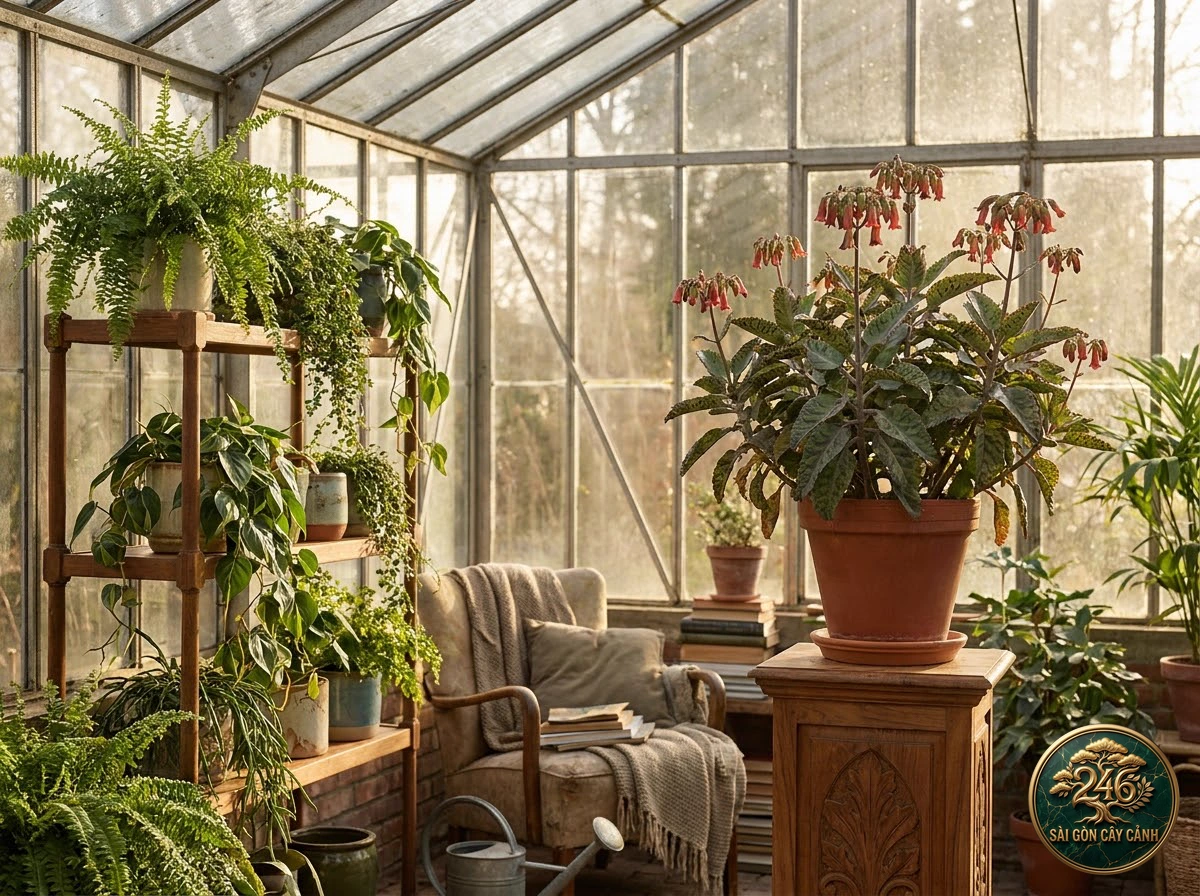
With its massive leaves and primeval chevron patterning, Kalanchoe gastonis-bonnieri serves as a spectacular botanical statement for tropical landscape architecture, upscale resorts, and luxury penthouse solariums. It achieves maximum dramatic impact when showcased in large raw cement planters, rustic carved stone urns, or expansive terrace beds. The presence of this giant donkey-ear succulent infuses modern living environments with an untamed, sculptural dynamism and enduring architectural distinction.
Boasting immense arching leaves and wild primeval chevron markings, Kalanchoe gastonis-bonnieri serves as a commanding botanical sculpture for contemporary tropical architecture, luxury holiday villas, and expansive penthouse solariums. It achieves monumental dramatic impact when staged as a solitary centerpiece within oversized raw cement urns, rough-hewn stone planters, or open sun-drenched terrace borders. The presence of this giant donkey-ear succulent infuses modern living environments with an untamed, sculptural majesty and enduring natural distinction.
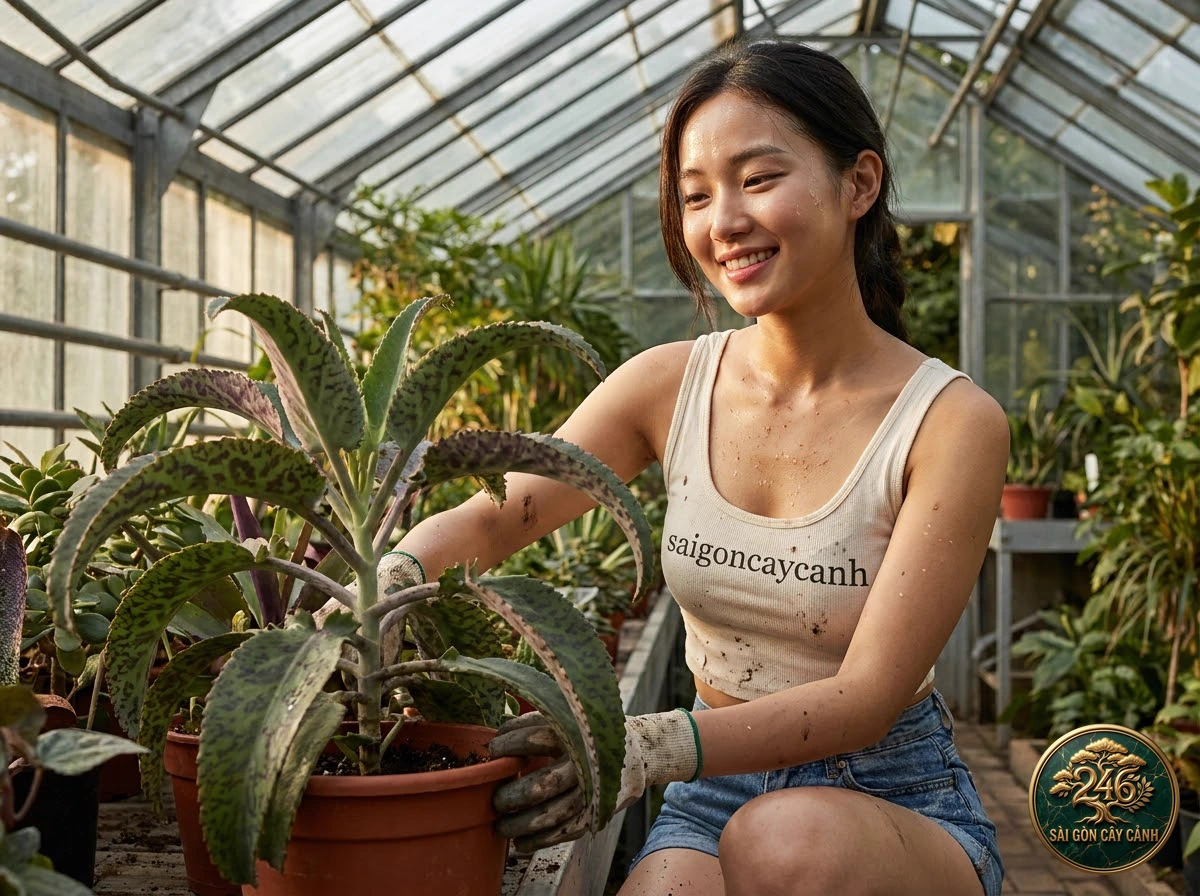
Brand Ambassador & Living Herbarium Botanical Philosophy
At Saigon Cay Canh botanical nursery, each specimen is curated and tended under the guidance of our brand ambassador, ensuring vibrant vitality and true-to-type morphology.
13. Horticultural Excellence & Living Heritage
Saigon Cay Canh takes immense pride in cultivating and acclimating premium specimens of Kalanchoe gastonis-bonnieri characterized by sturdy sprawling foliage, distinct chevron patterning, and vigorous growth potential. Our commitment to authentic botanical excellence unites native ecological insight with disciplined horticultural care, delivering rare living sculptures that elevate sophisticated interior spaces with natural majesty.