Living plant profile
Fishbone prayer plant
Ctenanthe burle-marxii
Comprehensive botanical dossier for Fishbone prayer plant (Ctenanthe burle-marxii). Identification, lighting calibration, porous substrate formulation, and cultivation guide by Saigon Cay Canh.
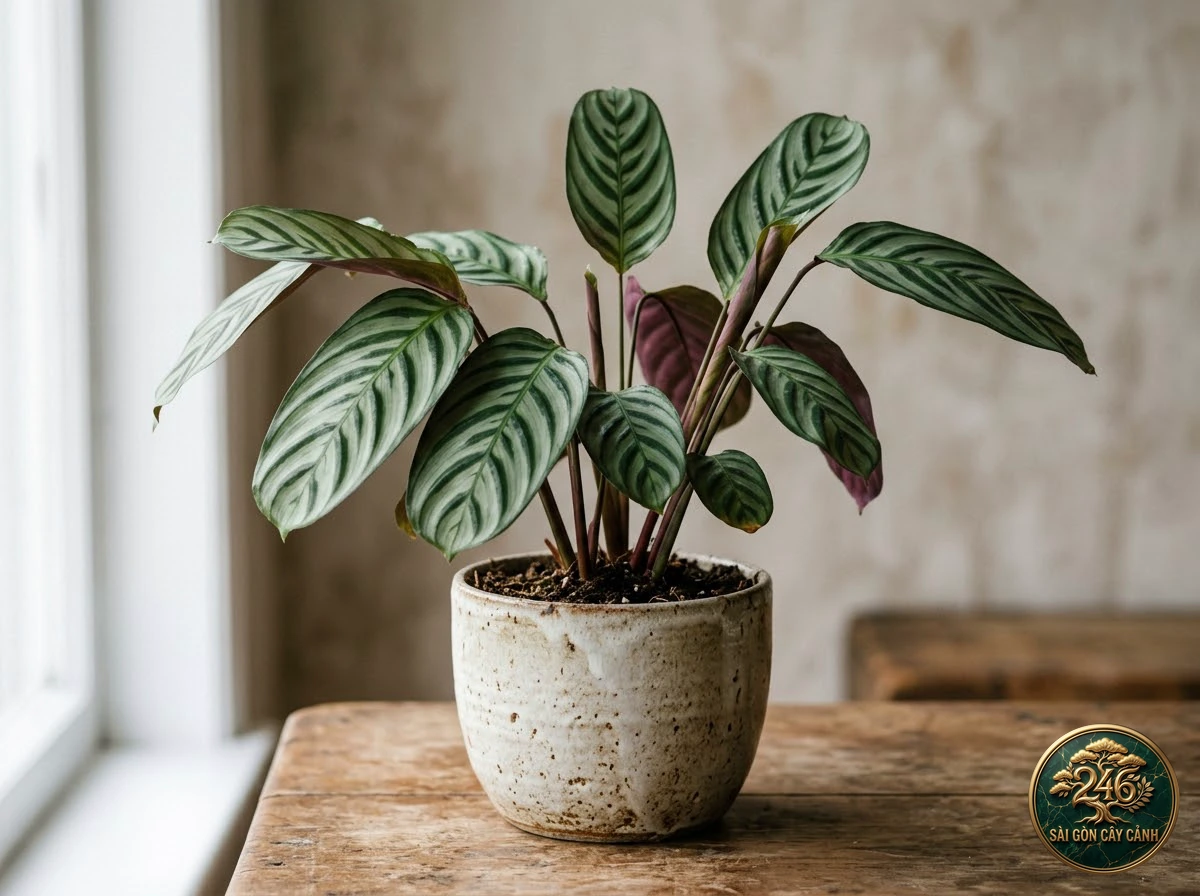
Fishbone prayer plant (Ctenanthe burle-marxii) is a distinguished Neotropical evergreen perennial indigenous to the coastal Atlantic forests of eastern Brazil, dedicated to iconic landscape architect Roberto Burle Marx. The taxon is celebrated for compact oval silver-grey foliage adorned with dark emerald herringbone bars and rich burgundy abaxial surfaces.
1. Core Botanical Taxonomy & Cultural Specifications
| Scientific Name | Ctenanthe burle-marxii |
|---|---|
| Botanical Family | Marantaceae (Prayer Plant Family) |
| Native Distribution | Eastern Brazil (Atlantic Coastal Rainforest) |
| Growth Demeanor | Compact clumping herbaceous perennial with spreading subterranean rhizomes |
| Lighting Threshold | Medium to bright indirect filtered illumination (1,000 – 1,800 lux) |
| Hydration Cadence | Irrigate with demineralized water once upper 2-3cm of substrate dries |
| Substrate Formulation | 35% pumice, 25% mini bark nuggets, 20% sphagnum moss, 20% perlite |
| Thermal Range | 19°C – 28°C (66°F – 82°F), growth arrests beneath 15°C (59°F) |
| Relative Humidity | Optimal ambient relative humidity 65% – 85% |
| Cultivation Difficulty | Moderate (Requires chlorine-free soft water and consistent humidity) |
| Pet Safety Profile | Non-toxic to domestic canines and felines (ASPCA verified) |
Formally integrated into botanical literature to honor Brazilian modernist landscape visionary Roberto Burle Marx (1909–1994), Ctenanthe burle-marxii belongs to the Maranteae tribe within family Marantaceae. The species epithet commemorates Burle Marx’s pioneering integration of native South American flora into modern tropical architecture, celebrating its extraordinary architectural foliage.
In its primary habitat across eastern Brazilian Atlantic rainforest floors, the species colonizes low understory micro-environments characterized by humid shade and dappled sunlight. Specimens establish dense foliage clusters spanning 25 to 40 cm in height with horizontal spreading breadths surpassing 60 cm via vigorous rhizomatous networks.
According to the Royal Botanic Gardens Kew Plants of the World Online (POWO), Ctenanthe burle-marxii represents a validated taxonomic entity, structurally distinguished from Goeppertia and Calathea by imbricate floral bract arrangements and delicate milk-white asymmetric florets.
2. Morphological Identification & Foliar Architecture
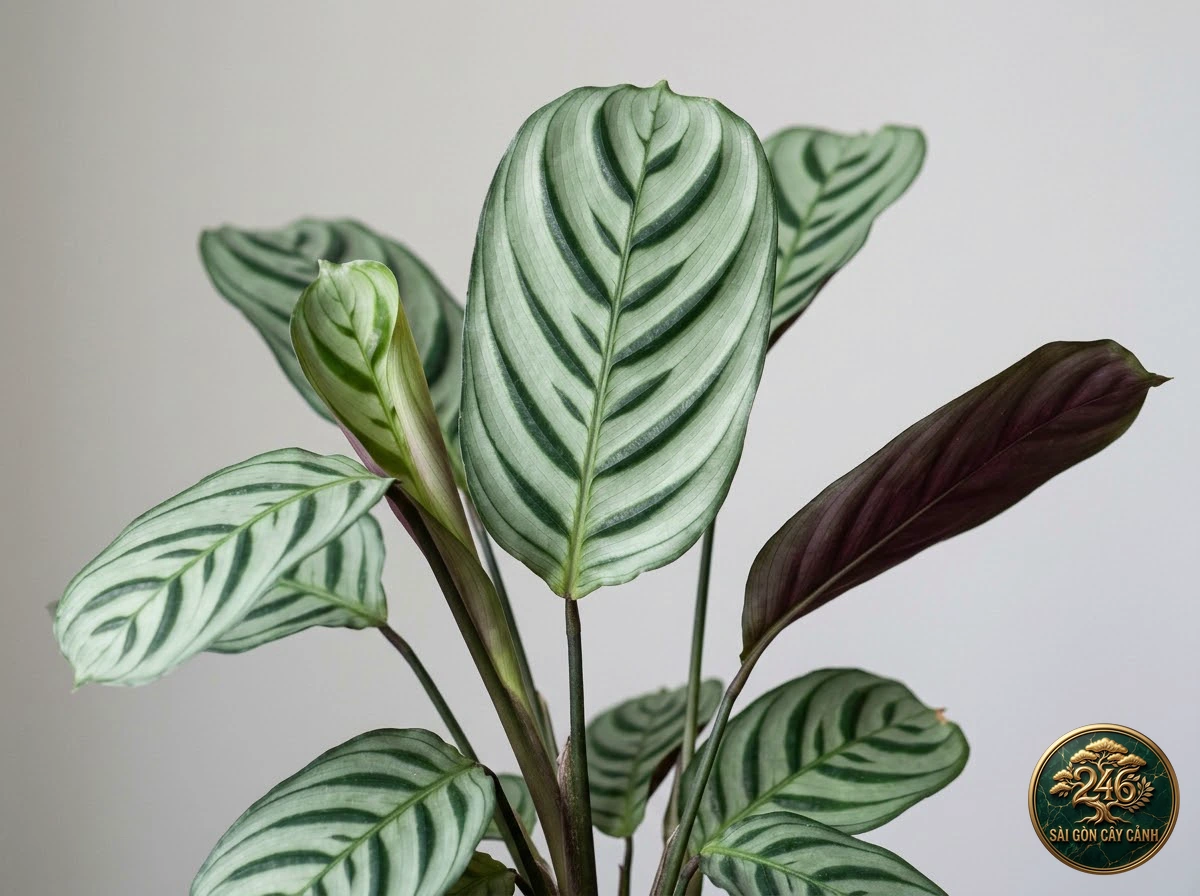
The definitive morphological hallmark of Ctenanthe burle-marxii resides in its mesmerizing graphical foliar patterning. Blades exhibit oblong-elliptic geometry with obtuse to mucronate apices, measuring 10 to 18 cm in length and 5 to 8 cm in width. The background lamina presents a luminous silvery-grey sheen sharply juxtaposed against thick dark emerald herringbone stripes.
The abaxial surface displays saturated wine-red to purple-violet pigmentation, generating an electric chromatic transformation as blades reorient through their circadian diurnal cycle. Slender petioles extend 8 to 15 cm, attaching to the leaf blade through an articulated motor tissue termed the pulvinus.
Micro-anatomical foliar analysis of Ctenanthe burle-marxii reveals that dark green herringbone stripes consist of tightly packed palisade mesophyll cells bearing concentrated chlorophyll a and b. Conversely, the metallic silver-grey background arises from optical light scattering across microscopic intercellular air spaces beneath the translucent cuticular layer. This structural adaptation shields underlying chloroplasts from localized photo-inhibition under shifting forest light flecks.
3. Photometric Calibration & Window Exposure Optimization
Adapted to filtered lower canopy light regimes, Ctenanthe burle-marxii thrives under indoor photosynthetic photon flux densities corresponding to 1,000 to 1,800 lux. Filtered eastern morning illumination or a position 2 to 3 meters back from southern windows preserves high chromatic contrast without bleaching the silver background.
Irrigation purity represents an uncompromising baseline for maintaining pristine foliage. Municipal tap water bearing free chlorine, chloramines, and fluoride ions accumulates inside marginal hydathodes, precipitating crisp necrosis. Cultivators must exclusively utilize rain harvest water, distilled water, or reverse-osmosis filtration.
Biophotometric assessments indicate that net photosynthetic saturation peaks at photosynthetic photon flux densities (PPFD) between 45 and 75 µmol/m²/s. Below this threshold, vegetative habit remains stable but subterranean branching slows. Exposing foliage to sustained PPFD exceeding 120 µmol/m²/s bleaches dark green herringbone stripes and precipitates irreversible epidermal necrosis.
4. Pulvinus Kinematics & Nyctinastic Diurnal Dynamics
Nyctinastic circadian leaf movement in Ctenanthe burle-marxii is mechanically driven by the pulvinus motor swelling at the petiole-blade junction. During daylight hours, active proton pumps expel H+ ions, facilitating potassium (K+) and water influx into dorsal motor cells that flattens blades horizontally for photosynthetic capture.
Upon dusk onset, potassium efflux drives osmotic water trans-localization to ventral motor cells, elevating blades vertically into an upright prayer posture. This nocturnal kinetic response shields upper stomatal surfaces from chill condensation and unmasks the dramatic burgundy under-surfaces.
Optimum physiological development spans 19°C to 28°C (66°F – 82°F). Hailing from tropical maritime Brazilian woodlands, it acclimates effortlessly to warm tropical climates but enters thermal dormancy if prolonged air conditioning drops ambient temperatures below 15°C (59°F).
Ambient relative humidity serves as the primary environmental governor of foliar suppleness, with optimal levels spanning 65% to 85%. Atmospheric dryness beneath 50% promptly provokes inward leaf curling and crisp marginal desiccation.
The optimal vapor pressure deficit (VPD) for this taxon ranges from 0.6 to 0.95 kPa. In high-rise urban apartments during arid weather, stabilizing VPD via ultrasonic humidification and gentle convective airflow keeps stomatal apertures operating normally, eliminating physiological margin crisping.
The pulvinus motor organ of Ctenanthe burle-marxii features an exceptionally high ratio of motor cell volume to laminar surface area, conferring crisp kinematic responsiveness. Transmembrane potential measurements reveal rapid dorsal turgor loss as soon as ambient irradiance drops below 20 lux, elevating horizontal blades from 15 degrees to an 85-degree vertical posture within 45 minutes.
5. Porous Aggregate Substrate Engineering & Aeration Dynamics
The root morphology of Ctenanthe burle-marxii comprises fibrous adventitious rootlets arising from subterranean rhizomes that rapidly deteriorate under anaerobic saturation. The standard aggregate blends 35% Indonesian pumice (3-6mm), 25% boiled pine bark nuggets, 20% sterile sphagnum moss, and 20% horticultural perlite.
This aerated matrix exhibits low bulk density and generous air-filled porosity, enabling irrigation effluent to drain freely without stagnant pooling, safeguarding nascent rhizome nodes from pathogenic fungal rot.
Hydraulic conductivity within the potting aggregate must be carefully calibrated to prevent respiration stress across fine feeder rootlets. Integrating Indonesian pumice with crushed horticultural charcoal establishes an ideal capillary network, retaining gentle moisture while absorbing mineral residues and stabilizing rhizosphere pH near 6.2.
6. Organic Nutrition Schedules & Periodic Micronutrient Priming
Nutritional regimens for Ctenanthe burle-marxii prioritize gentle organic formulations. Apply balanced organic kelp or worm casting tea diluted to quarter-strength every 3 to 4 weeks during active spring and summer flushes.
Avoid topical synthetic fertilizer granules near subterranean rhizomes, as salt accumulation desiccates feeder rootlets and burns delicate leaf tips. Leach containers with generous distilled water flushes quarterly to eliminate mineral residues.
An organic nutritional regimen featuring hydrolyzed fish protein enriched with natural fulvic acid stimulates beneficial rhizosphere microflora. The solution is formulated at an electrical conductivity (EC) below 0.8 mS/cm, supplying chelated magnesium and iron to maintain deep emerald definition along herringbone veins.
7. Clinical Diagnostic Matrix & Rapid Correction Protocols
| Clinical Symptom | Primary Etiology | Diagnostic Evaluation | Corrective Prescription |
|---|---|---|---|
| Crisp brown margins and inward leaf curling | Ambient humidity dropped below 50% or tap water chlorine and mineral salt buildup | Verify room humidity with hygrometer and test irrigation water electrical conductivity | Elevate humidity above 65% with ultrasonic misting and transition exclusively to distilled water |
| Herringbone patterns fade and foliage turns pale yellow | Exposure to direct sunbeams or chronic photonic deficit beneath 700 lux | Measure ambient lux levels at foliage crown with digital light meter | Reposition into diffused illumination of 1,200 to 1,800 lux behind sheer drapes |
| Total canopy collapse accompanied by sour soil odor | Compacted potting medium causing anaerobic root hypoxia and rhizome decay | Unpot root ball to inspect feeder rootlets and evaluate substrate smell | Excise necrotic roots, sanitize in dilute hydrogen peroxide, and repot in fresh pumice aggregate |
| Fine yellow stippling and minute webbing on purple undersides | Two-spotted spider mite infestation triggered by warm, arid indoor air | Inspect abaxial veins with magnification loupe for active mite colonies | Wipe foliage with lukewarm cloth and apply biological cold-pressed neem emulsion at dusk |
8. Cryptic Pest Prophylaxis & Foliar Surface Sanitation
Because foliage clusters densely near the substrate surface, routinely screen petiole sheaths for mealybugs and two-spotted spider mites. Cleanse dusty blades with soft goat-hair brushes and apply gentle coconut-oil-based insecticidal soaps monthly.
Gently cleansing foliage with lukewarm purified water clears domestic dust from the silvery epidermis, optimizing gas exchange through stomata and accentuating the crisp definition of dark green herringbone markings.
Integrated Pest Management (IPM) focuses on proactive surveillance for two-spotted spider mites (Tetranychus urticae). Rather than deploying harsh chemical pesticides, introducing predatory mites (Neoseiulus californicus) quarterly achieves sustainable biological control without damaging the delicate silver epidermis.
9. Asexual Propagation Methodology & Root Strike Protocols
Clonal propagation is most reliably performed through rhizomatous division during spring container maintenance. Each excised division must possess 3 to 4 mature upright leaves alongside a sturdy rhizome section bearing active rootlets.
Sever connecting rhizome bridges with a sterilized blade, potting individual divisions into aerated moist substrate. Maintain warm, humid shade above 75% relative humidity over a 25 to 35 day developmental interval until new spear shoots emerge.
During rhizome clump division, preserving native aggregate around delicate feeder rootlets is vital to minimize transplant shock. Following separation, sheltering newly potted divisions beneath perforated humidity tents for the initial 10 days ensures 90% relative humidity, stabilizing turgor before room acclimation.
10. Companion Animal Safety Profile & ASPCA Non-Toxic Verification
While biochemically benign, positioning specimen planters out of reach from playful puppies or kittens prevents mechanical claw tearing of tender silver foliage and preserves ornamental perfection.
11. Biophilic Curation & Contemporary Interior Design Styling
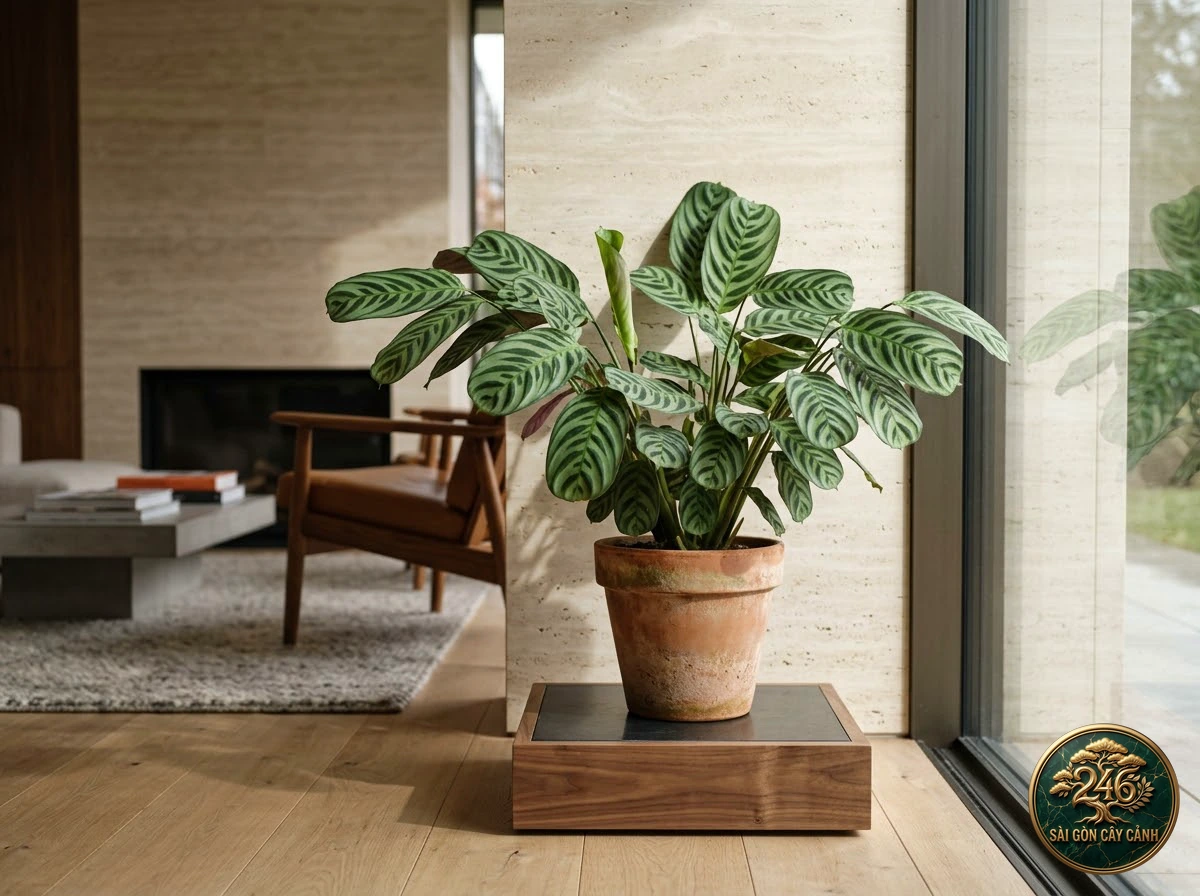
Boasting moderate stature and an artistic spreading canopy, the Fishbone prayer plant serves as a sophisticated interior centerpiece for executive desks, coffee tables, living room credenzas, or bespoke tropical vivariums.
The chromatic synergy between its silvery adaxial sheen and deep wine abaxial undersides delivers rich visual depth, fostering an atmosphere of organic calm and biophilic serenity.
From a Biophilic environmental psychology perspective, the diurnal movement of Ctenanthe burle-marxii resonates harmoniously with human circadian rhythms. Observing the gradual nocturnal closure of its silver-and-green canopy instills profound mental calm, reducing cognitive fatigue after prolonged computer screen exposure.
12. Master Principles for Sustainable Indoor Acclimatization
Three foundational cultivation axioms governing the sustained prosperity of Ctenanthe burle-marxii indoors:
- Hydration axiom: Demineralized Hydration Axiom: Exclusively deploy rainwater, distilled water, or RO effluent; avoid municipal tap water containing chlorine and salts.
- Illumination axiom: Filtered Photonic Calibration: Situate in gentle 1,200 lux indirect light, sheltering foliage from harsh solar rays that bleach silver variegation.
- Maintenance axiom: Microclimatic Humidity Shield: Guarantee atmospheric humidity exceeding 65% through ultrasonic humidifiers or pebble humidity trays.
13. Frequently Asked Questions Regarding Fishbone prayer plant (FAQs)
How does Ctenanthe burle-marxii differ from Calathea or Goeppertia?
Ctenanthe branches freely from spreading rhizomes creating wide spreading carpets, whereas Goeppertia typically forms more singular, upright clumping rosettes.
Why do fishbone leaves elevate vertically at night?
This nyctinastic movement is orchestrated by the pulvinus joint via potassium-driven osmotic shifts, reducing nocturnal transpiration and protecting leaf surfaces.
Is the fishbone prayer plant safe around domestic pets?
Completely safe. The ASPCA categorizes Ctenanthe burle-marxii as non-toxic to cats, dogs, and humans.
How often should repotting take place?
Repot every 12 to 18 months in early spring when spreading rhizomes fully colonize the pot volume.
How can you preserve the shimmering silvery-grey leaf color?
Provide steady indirect light of 1,200 – 1,800 lux, sustain humidity above 65%, and dust foliage monthly with a moist microfiber cloth.
Why is the abaxial underside of the fishbone prayer plant saturated in deep burgundy?
The rich wine-red underside is produced by concentrated anthocyanin pigments. This layer acts as an optical mirror, reflecting photons that penetrate the blade back into the mesophyll, granting chloroplasts a second opportunity for light absorption in dim understory environments.