
Living plant profile
Louisa’s calathea
Goeppertia louisae
Comprehensive botanical dossier for Louisa’s calathea (Goeppertia louisae). Identification, lighting calibration, porous substrate formulation, and cultivation guide by Saigon Cay Canh.
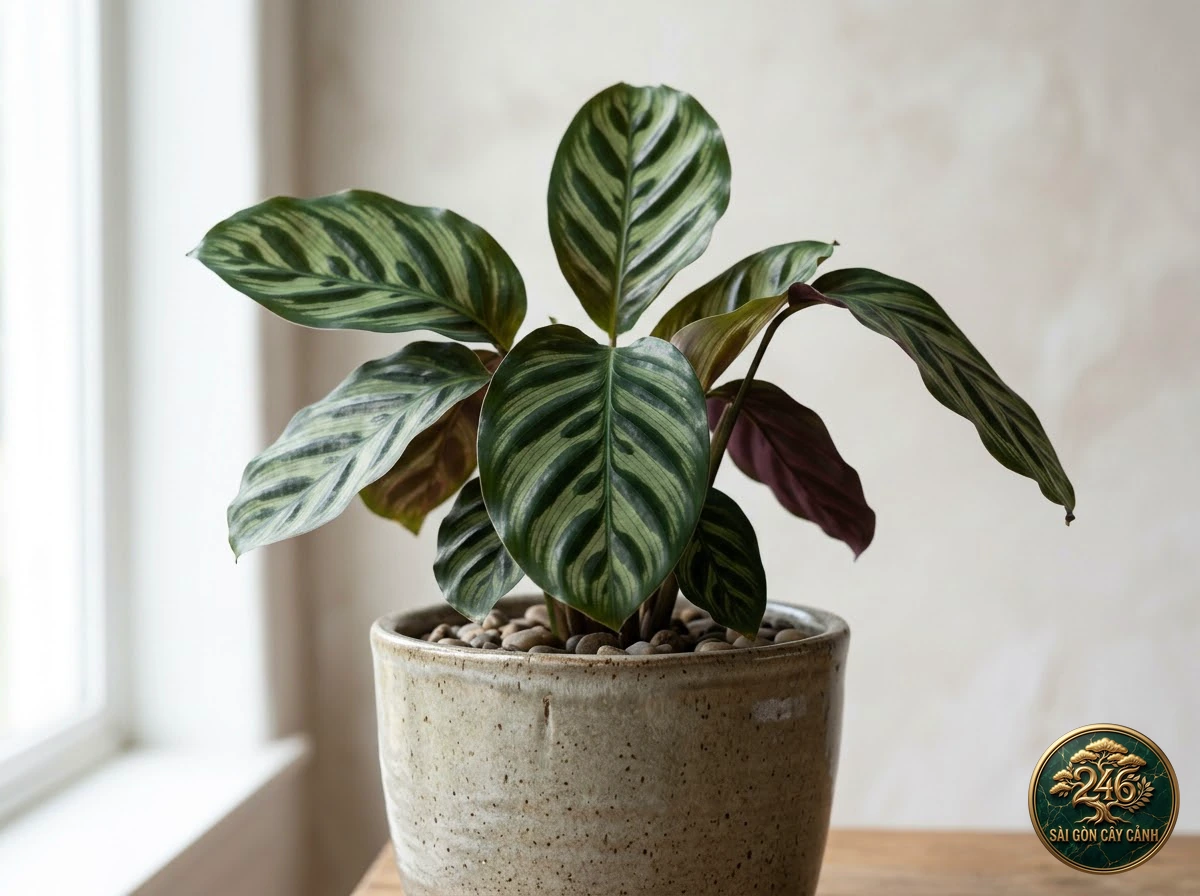
Louisa’s calathea (Goeppertia louisae) is an aristocratic foliage gem of the Marantaceae family, celebrated for slender elliptic blades marked by a luminous chartreuse feathered band radiating along the midrib against deep emerald fields. Undersides are washed in delicate wine-red, complemented by pristine white florets emerging on upright floral spikes in an expression of quiet elegance.
1. Core Botanical Taxonomy & Cultural Specifications
| Scientific Name | Goeppertia louisae |
|---|---|
| Botanical Family | Marantaceae (Prayer Plant Family) |
| Native Distribution | Humid Atlantic coastal rainforest understories of southeastern Brazil (Espirito Santo, Rio de Janeiro) |
| Growth Demeanor | Erect clump-forming perennial 50 to 80 cm tall with elliptic feathered foliage and white blossoms |
| Lighting Threshold | Gentle diffused daylight (1,500 – 3,200 lux); prospers in bright dappled canopy shade |
| Hydration Cadence | Hydrate when top 25-30% substrate dries; favors consistent capillary coolness without moisture extremes |
| Substrate Formulation | 35% pumice, 30% shredded sphagnum and fine aged bark, 20% desalted coco coir pith, and 15% perlite |
| Thermal Range | 21°C – 30°C (70°F – 86°F; flourishes in warm ambient rooms, growth stalls below 16°C/60°F) |
| Relative Humidity | 65% – 85% (High ambient relative humidity preserves blade turgor and flower longevity) |
| Cultivation Difficulty | Easy to Moderate (Resilient nature, dependable growth, adapts smoothly to indoor conditions) |
| Pet Safety Profile | Non-toxic (Completely safe for companion pets; certified non-toxic to dogs and cats by the ASPCA) |
Formally described by French botanist François Gagnepain in 1908 and recombined under Goeppertia by Borchsenius & Suarez, this taxon is verified in Kew’s Plants of the World Online (POWO). The specific epithet ‘louisae’ honors Queen Louisa, celebrating its understated aristocratic poise.
The plant forms upright clumping mounds ascending 50 to 80 cm anchored by sturdy subterranean rhizomes. Slender petioles 30 to 50 cm tall support upright foliage. An active apical pulvinus maneuvers these leaves horizontally by day and erects them in tight prayer formation at nightfall.
A shallow fibrous root network ramifies through Atlantic forest humus. Its robust feeder roots absorb capillary moisture efficiently, showing greater environmental adaptability than fragile micro-papillate velour species.
2. Morphological Identification & Foliar Architecture
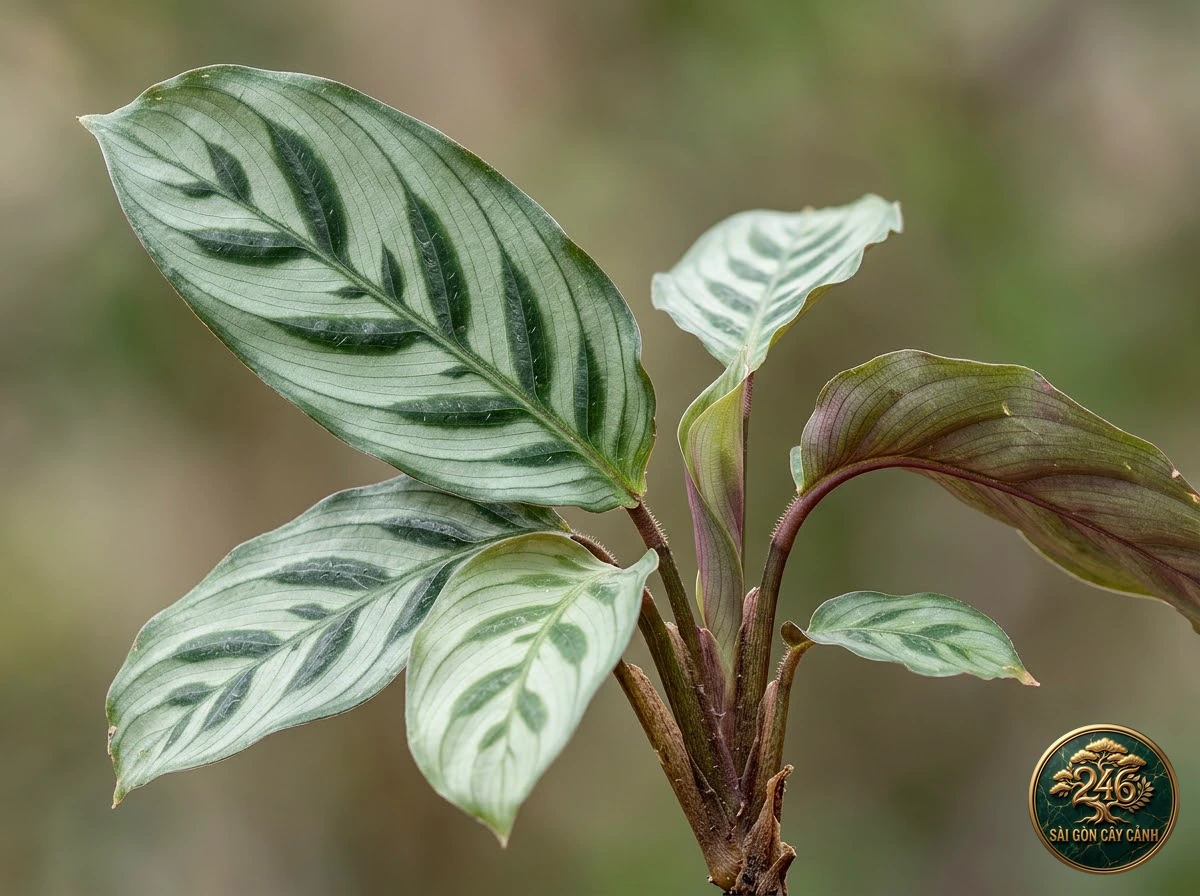
Foliar blades of Louisa’s calathea present an elliptic to broadly lanceolate contour measuring 25 to 35 cm in length and 10 to 16 cm in width. The glossy deep-green adaxial surface is illuminated by a feathered chartreuse-silver band radiating along the central midrib.
The abaxial surface displays a refined soft plum-purple flush. Inflorescences feature delicate ivory-white blossoms emerging from terminal spikes amidst the foliage, persisting for several weeks with a subtle floral perfume.
Micro-anatomical cross-sections of Goeppertia louisae leaves show that the central chartreuse feathered zone contains enlarged chloroplasts specialized for capturing low-intensity diffuse photons. The smooth transition from central chartreuse to peripheral dark emerald is governed by balanced chlorophyll-a and b gradients, creating captivating visual depth.
3. Photometric Calibration & Window Exposure Optimization
The specimen prospers under bright indirect daylight between 1,500 and 3,200 lux. Generous filtered light keeps the central feathered band vibrant while encouraging regular white floral flushes.
Water supply for Louisae requires high chemical purity, ideally distilled or clean air-conditioner condensate, preventing rust-colored necrotic scorch marks from forming across the pale silvery leaf tips.
Photometric assays identify an optimal PPFD between 65 and 135 umol/m2/s for Louisa’s calathea. Positioning near bright indirect daylight (1,500 – 3,200 lux) prompts continuous ivory-white floral flushes while preserving vivid central feathered contrast.
4. Pulvinus Kinematics & Nyctinastic Diurnal Dynamics
Diurnal movement unfolds with graceful rhythm: as daylight dims, pulvinar motor cells contract to raise elliptic blades vertically in prayer-like unison, revealing soft purple-plum reverses.
This motion minimizes nocturnal water loss and shields stomatal pores from cold condensation, establishing a dynamic living biological rhythm within domestic interiors.
Ideal thermal regime spans 21°C to 28°C (70°F – 82°F). Sensitive to sudden microclimate shifts; place well away from thermal computer exhausts or cold air conditioning vents.
Relative humidity must be maintained at 65% to 85%. An ultrasonic humidifier or gravel moisture saucer keeps foliage turgid and margins pristine.
Ideal temperatures from 21°C to 30°C (70°F – 86°F) paired with 65% to 85% relative humidity keep margins supple and prolong floral freshness. Shelter containers from direct frosty AC drafts.
The pulvinus articulates responsively to photoperiodic transitions. At twilight, water efflux from upper motor cells elevates elliptic blades into a vertical prayer formation, showcasing delicate plum-purple reverses.
5. Porous Aggregate Substrate Engineering & Aeration Dynamics
Potting substrate demands maximum porosity: 35% pumice, 30% shredded sphagnum moss with mini composted bark, 20% desalted coco coir, and 15% coarse perlite, balanced to pH 5.8 to 6.5.
This aerated aggregate prevents compaction, shielding subterranean rhizomes from anaerobic fungal decay.
Potting substrate blending 35% pumice, 30% shredded sphagnum moss with mini composted bark, 20% desalted coco coir, and 15% coarse perlite guarantees rapid drainage, shielding subterranean rhizomes from anaerobic saturation rots.
6. Organic Nutrition Schedules & Periodic Micronutrient Priming
Apply diluted liquid organic fertilizer monthly during spring and summer to nourish lush foliage and stimulate pristine white floral spikes.
Avoid high-salinity synthetic fertilizers. Flush containers thoroughly with pure water bi-monthly to eliminate residual mineral salts from root zones.
Apply diluted liquid organic fertilizer monthly during spring and summer to nourish lush foliage and stimulate pristine white floral spikes.
7. Clinical Diagnostic Matrix & Rapid Correction Protocols
| Clinical Symptom | Primary Etiology | Diagnostic Evaluation | Corrective Prescription |
|---|---|---|---|
| Crisp brown edges along leaf margins | Ambient relative humidity dropped below 50% or chlorine toxicity | Monitor room hygrometer and evaluate irrigation water purity | Run ultrasonic humidifier above 65% and switch to pure dechlorinated water |
| Fading of central chartreuse feathered banding | Photon deficit below 900 lux threshold or excessive nitrogen | Measure ambient lux at foliage level with light meter | Relocate to bright filtered daylight (1,800+ lux) and apply chelated feed |
| Sudden drooping and collapse of upright petioles | Severe root zone dehydration or anaerobic root rot decay | Probe substrate core moisture and evaluate root health | Bottom-water if desiccated; prune decayed roots and repot if soggy |
| Minute yellow punctate spots and fine webbing on purple reverses | Tetranychid spider mites colonizing warm, arid environments | Inspect abaxial midrib surfaces with magnification loupe | Shower foliage gently with lukewarm water and treat with neem spray |
8. Cryptic Pest Prophylaxis & Foliar Surface Sanitation
The pale silvery-green central variegation of Louisae is vulnerable to mottling from scale insects and mealybugs. Direct spot treatments with cotton swabs soaked in natural pyrethrin botanical extract eradicate nascent colonies swiftly.
Dust blades with damp microfiber towels bi-weekly to ensure open stomatal pores and optimize photosynthetic efficiency.
Dust blades with damp microfiber towels bi-weekly to ensure open stomatal pores, optimize photosynthetic efficiency, and prevent cryptic pests from harboring.
9. Asexual Propagation Methodology & Root Strike Protocols
Propagate via rhizome clump division during seasonal spring repotting. Separate crowns retaining at least 3 sturdy leaves and independent roots with a sterile blade.
Propagate through root crown separation during early summer repotting. Ensure each division includes at least one viable dormant bud eye and intact feeder roots, wrapping briefly in damp sphagnum prior to potting.
Propagate by rhizome clump division during seasonal spring repotting. Separate crowns retaining at least 3 sturdy leaves and independent roots with a sterile blade, potting into fresh airy mix under shaded humidity for two weeks.
10. Companion Animal Safety Profile & ASPCA Non-Toxic Verification
Evaluated as completely non-toxic to domestic canines and felines in ASPCA toxicology lists. Offers peace of mind for multi-pet households desiring sophisticated foliage.
11. Biophilic Curation & Contemporary Interior Design Styling
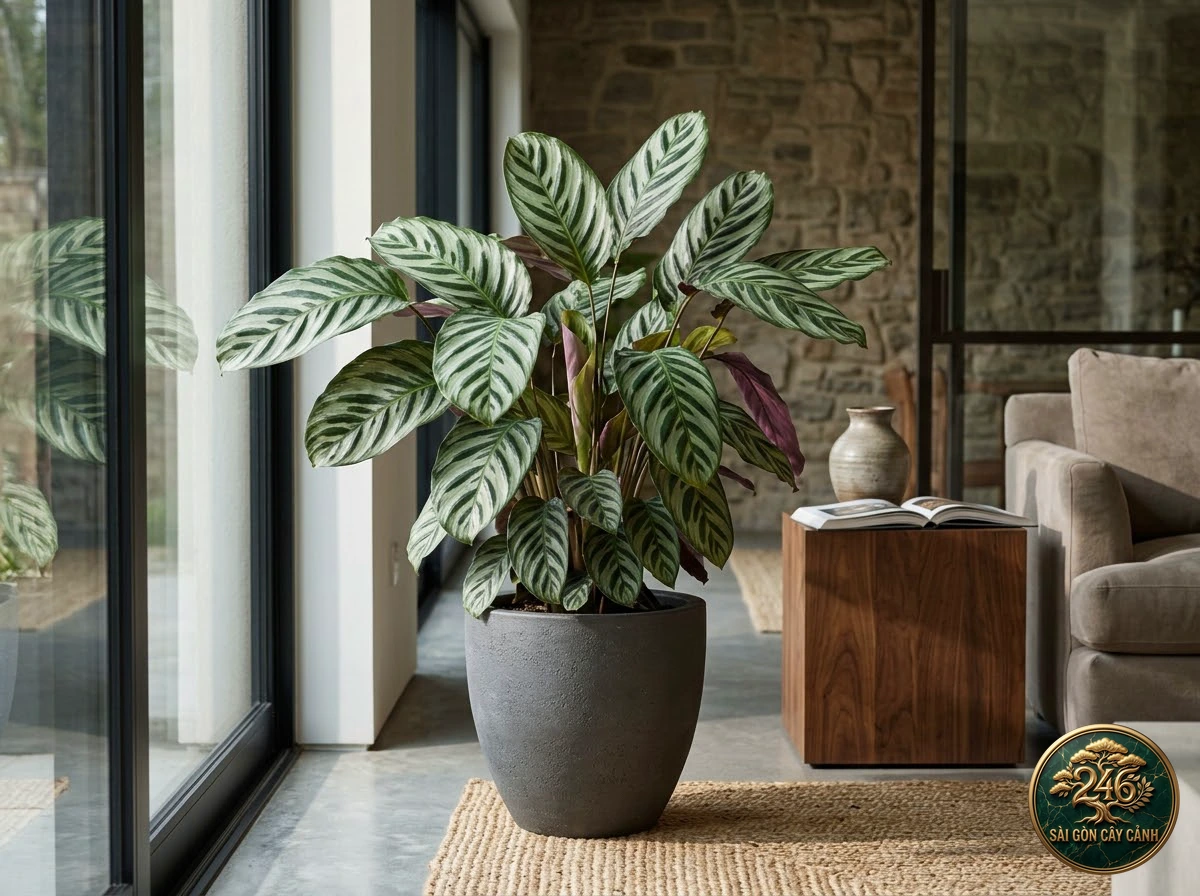
With slender feathered foliage and refined ivory blossoms, Louisa’s calathea serves as an ideal botanical accent for executive desks, living rooms, and modern biophilic sanctuaries.
Its pristine poise and kinetic prayer movement instill soothing tranquility, replenishing mental energy and introducing biological harmony into contemporary homes.
With slender feathered foliage and refined ivory blossoms, Louisa’s calathea serves as an ideal botanical accent for executive desks, living rooms, and modern biophilic sanctuaries.
12. Master Principles for Sustainable Indoor Acclimatization
To cultivate a thriving specimen of Goeppertia louisae and stimulate recurring white blooms indoors, horticulturists should follow three essential rules:
- Hydration axiom: Preserve gentle uniform moisture throughout root column; deploy containers with ample bottom perforations allowing surplus water to escape freely.
- Illumination axiom: Position under 1,200 to 1,600 lux filtered light to sustain high contrast between the pale silvery center and deep green borders.
- Maintenance axiom: Disperse fine purified water mist in surrounding ambient air on arid afternoons to sustain over 65% humidity without wetting foliage excessively.
13. Frequently Asked Questions Regarding Louisa’s calathea (FAQs)
How does irrigation quality impact the silvery-white variegation of Louisa calathea?
To safeguard bright creamy markings along central veins, irrigate with decanted rainwater or pure distilled water. Hard domestic water high in calcium carbonate clouds leaf variegation and curls tender newly unfurled tips.
Does Goeppertia louisae bloom indoors?
Yes. When provided with stable indirect light and sufficient humidity, it frequently produces charming petite white flowers nestled within petiole axils.
Is this plant non-toxic to domestic pets?
Yes, ASPCA records verify that Goeppertia louisae contains no harmful toxins, making it completely pet-safe.
What fertilization regimen suits Louisae best?
Apply gentle liquid organic micronutrients at quarter strength once monthly during active warm spring and summer months.
How can you identify root suffocation in Louisa calathea?
Basal yellowing leaves, floppy petioles, and sour-smelling soil indicate impaired drainage and rhizosphere hypoxia.
Does Louisa’s calathea actually produce flowers indoors?
Yes. It reliably produces terminal spikes of delicate ivory-white to pale rose blossoms that endure fresh for 3 to 5 weeks.