
Living plant profile
Oakleaf hydrangea (Hydrangea quercifolia)
Hydrangea quercifolia
📌 CLINICAL & BIOLOGICAL ABSTRACT — Oakleaf hydrangea (Hydrangea quercifolia)Oakleaf hydrangea (Hydrangea quercifolia) Hydrangea quercifolia, internationally celebrated as oakleaf hydrangea, is an awe-inspiring, structurally dramatic deciduous flowering shrub in the hydrangea family (Hydrangeaceae). Indigenous to moist wooded ravines and river bluffs across the southeastern United States, this North American masterwork stands unique among all hydrangeas […]

Oakleaf hydrangea (Hydrangea quercifolia)
Hydrangea quercifolia, internationally celebrated as oakleaf hydrangea, is an awe-inspiring, structurally dramatic deciduous flowering shrub in the hydrangea family (Hydrangeaceae). Indigenous to moist wooded ravines and river bluffs across the southeastern United States, this North American masterwork stands unique among all hydrangeas by virtue of its deeply lobed 5-to-7-lobed leaves closely resembling the foliage of red oaks, which ignite into breathtaking autumn tapestries of rich burgundy, bronze-purple, and wine-red. Towering conical panicles 15 to 30 cm long showcase creamy-white sterile florets that mature into dusty rose and antique bronze. Categorized with mild-to-moderate veterinary toxicity due to cyanogenic glycosides, Hydrangea quercifolia represents Saigon Cay Canh’s premier four-season architectural shrub for luxury shaded estates, biophilic courtyards, and naturalistic woodland gardens across southern Vietnam.
Sài Gòn Cây Cảnh Care Compass
1. Botanical Identity & Taxonomic Nomenclature History
Hydrangea quercifolia was discovered and systematically documented by pioneering American naturalist William Bartram in 1791 within his celebrated travelogue Travels through North & South Carolina, Georgia, East & West Florida. The generic name Hydrangea derives from the Greek for ‘water vessel’. The specific epithet quercifolia unites Latin ‘quercus’ (oak) and ‘folium’ (leaf), commemorating the distinctive deeply lobed foliar morphology that mirrors the sculptural leaves of North American red oaks.
Indigenous to calcareous bluffs and shaded river valleys across Georgia, Florida, Alabama, and Mississippi, oakleaf hydrangea was internationally acclaimed as one of North America’s premier indigenous shrubs and introduced to European botanical estates in 1803. In Vietnam, it has been acclimated into elite horticultural collections, celebrated across luxury hospitality landscapes for unmatched multi-season interest: monumental summer panicles, incandescent autumn-winter foliage, and artistic exfoliating cinnamon-brown bark.
2. Morphological Architecture & Anatomical Characteristics
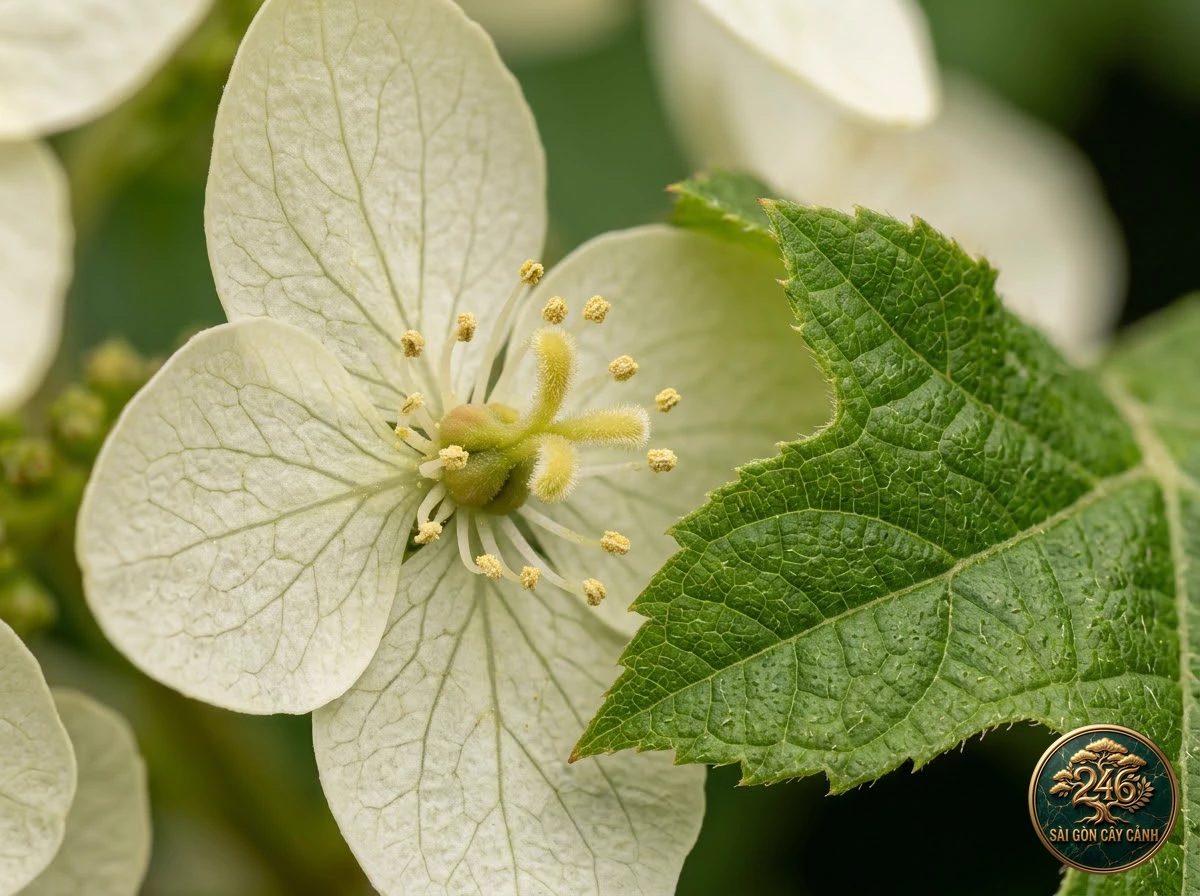
Morphologically, Hydrangea quercifolia develops as an imposing, multi-stemmed deciduous suckering shrub scaling 1.5 to 2.5 meters in height with a broad canopy spanning 1.8 to 3.0 meters wide. Trunks are upright to arching, featuring striking cinnamon-brown bark that exfoliates in papery layers to expose rich orange-tan inner bark; juvenile shoots are stout, brownish-green, densely cloaked in a velvet-like rusty tomentum. Leaves are opposite; stout petioles measure 3 to 8 cm; blades are broadly ovate, 12 to 25 cm long and 10 to 20 cm wide, deeply divided into 5 to 7 acute triangular lobes closely resembling red oak leaves, with coarsely serrate margins; adaxial surfaces are dark green and scabrous, while abaxial surfaces are softly felted with whitish-tan tomentum; in autumn and winter, leaves synthesize massive anthocyanins, shifting into rich burgundy, purple-bronze, and wine-red.
Inflorescences are dense, erect pyramidal panicles 15 to 30 cm long and 10 to 18 cm wide. The inflorescence combines conspicuous sterile florets 3 to 4 cm wide with 4 creamy-white petaloid sepals (which gradually transition to dusty rose and antique bronze), interspersed with minute fertile florets. Floral coloration is completely independent of soil pH. The fruit is a small, 10-ribbed woody capsule containing minute dark brown seeds.
3. Photobiology & Photosynthetic Energy Thresholds
Hydrangea quercifolia thrives under partial canopy shade, adapted to dappled forest understories and ravine slopes. Peak vegetative health, foliar texture, and massive panicle development mandate 3 to 5 hours of direct morning solar irradiance daily (07:00 to 10:30), corresponding to light flux levels between 25,000 and 50,000 lux. Gentle morning sun fuels robust carbohydrate synthesis and promotes anthocyanin pigment development during seasonal transitions.
The species demonstrates greater heat and drought tolerance than bigleaf hydrangeas, buffered by the dense tomentose felting on abaxial leaf surfaces and an expansive woody root framework. However, unmitigated tropical midday sun exceeding 65,000 lux scorches broad foliar margins. Optimal landscape sites reside along east-facing villa foundations, beneath light canopy trees, or under 40% shade pergolas. The shrub adapts comfortably within ambient temperatures between 18 and 32 degrees C.
4. Mineral Substrate Mechanics & Root Aeration Dynamics
The extensive, deep woody root system of oakleaf hydrangea demands a well-aerated, fertile, humus-enriched substrate engineered for instantaneous gravitational percolation. Naturally colonizing limestone bluffs, the species possesses zero tolerance for standing anaerobic moisture; saturation persisting beyond 36 hours invites Phytophthora cinnamomi root rot, precipitating sudden branch dieback and plant loss.
The planting substrate formulated by Saigon Cay Canh incorporates 45% friable alluvial loam, 25% coarse carbonized rice hull ash for macroporosity, 15% coarse river sand or perlite, and 15% mature organic vermicompost inoculated with Trichoderma. Soil pH should remain stabilized between 6.0 and 7.0. Field plantings must be established on elevated landscape berms or well-drained slopes, while containers must feature ample drainage outlets.
5. Irrigation Dynamics & Soil Hydraulic Equilibrium
Oakleaf hydrangea possesses moderate water requirements, supported by superior drought resilience once established due to its extensive woody root system. During the dry season across southern Vietnam, deep irrigation once daily in early morning hours (06:30 to 07:30) adequately maintains root zone hydration.
Watering rule: deliver water directly to the soil perimeter beneath the foliar skirt; avoid spraying forceful overhead water into blooming panicles to prevent trapped moisture provoking fungal blights. Refrain from heavy late-evening watering, and allow the upper soil layer to dry slightly between applications. During monsoon deluges, maintain unobstructed perimeter drainage swales to prevent standing water.
6. Mineral Nutrition Protocols & Periodic Fertilization Schedules
To cultivate stout woody branches, thick oak-like foliage, and towering 30 cm panicles, disciplined periodic feeding is essential. Following summer bloom senescence, top-dress with 2.0 to 3.0 kg of aged organic vermicompost or composted bio-manure per shrub, gently scratching it into the surface horizon beneath organic mulch.
During active vegetative shoot extension, apply a dilute liquid feed of balanced NPK 15-15-15 or NPK 12-12-17 every 15 days around the root zone. Prior to full anthesis, apply foliar sprays rich in chelated calcium, boron, and potassium humate to reinforce peduncle calipers under heavy floral loads and sustain blossom freshness for 6 to 8 weeks on the shrub.
7. Acclimatized Propagation & Germplasm Preservation
Propagation of Hydrangea quercifolia is reliably executed via semi-hardwood stem cuttings or basal layering. At the onset of the monsoon season, select vigorous current-year lateral shoots 12 to 18 cm long bearing 3 to 4 nodes, cut cleanly beneath a node, trim lobed foliage by half, and insert the lower 3 to 5 cm into moist sand or perlite. Maintained under bright indirect light with high humidity, robust roots establish within 14 to 20 days, producing container-ready stock in 6 to 8 weeks.
Pruning protocol is strictly governed by old wood phenology: because floral buds are initiated on previous season’s growth (‘old wood’), pruning must occur immediately following summer bloom senescence, trimming spent panicles back to the first pair of healthy plump buds; never shear shrubs heavily in late autumn, winter, or early spring, as doing so removes overwintering embryonic flower buds, eliminating blooms for the coming season.
8. Biosafety Assessment & Companion Animal Toxicological Profiles (ASPCA)
Botanical safety profile and ASPCA pet safety standards: Classified within the family Hydrangeaceae, Hydrangea quercifolia is officially cataloged by the American Society for the Prevention of Cruelty to Animals (ASPCA) as TOXIC TO DOGS, CATS, AND HORSES DUE TO CYANOGENIC GLYCOSIDES (HYDRANGIN).
All vegetative and floral organs, including woody stems, lobed foliage, and conical panicles, synthesize hydrangin. If companion animals chew or ingest plant tissues, enzymatic hydrolysis inside the digestive tract liberates toxic hydrogen cyanide. Symptoms include hypersalivation, acute vomiting, abdominal pain, diarrhea, and depression, with potential respiratory distress in severe poisonings. Saigon Cay Canh advises establishing oakleaf hydrangeas within elevated planter beds or structured garden borders safely inaccessible to companion animals.
9. Clinical Pathology Diagnostic Matrix & Therapeutic Interventions
Pathology screening for oak lace bug suppression and Phytophthora root rot prevention in Hydrangea quercifolia:
| Clinical Symptomology | Etiological Factor | Prescribed Therapeutic Protocol |
|---|---|---|
| Lobed foliar blades develop angular reddish-brown spots with dark purple borders, displaying minute black fruiting bodies beneath | Phyllosticta hydrangeae leaf spot flaring during prolonged monsoon downpours and persistent foliar wetness | Prune out infected leaves promptly, maintain clean bed hygiene, and apply alternating sprays of mancozeb or Score |
| Entire shrub wilts abruptly despite damp soil, mature bark sheds with dark exudates, and woody roots rot into mush | Phytophthora cinnamomi root rot attacking the woody root framework under poor anaerobic drainage conditions | Rogue diseased shrubs, sanitize pit soil with agricultural lime, reconstruct drainage channels, and drench with Trichoderma |
| Abaxial foliar surfaces show chlorotic bleaching and tiny tar-like black fecal deposits left by lace bugs | Oak lace bugs (Stephanitis pyrioides) feeding on cellular sap, provoking premature foliar bronzing and vigor loss | Power-wash leaf undersides in early morning, and apply horticultural mineral oil combined with bio-rational spinetoram |
10. Comparative Morphology & Sympatric Differentiation
Morphological comparative matrix isolating deeply lobed oak-like foliage with incandescent autumn colors of Hydrangea quercifolia:
| Diagnostic Trait | Hydrangea quercifolia (Oakleaf hydrangea) | Comparative Taxon A | Comparative Taxon B |
|---|---|---|---|
| Inflorescence morphology and floral architecture | Conical panicles 15 to 30 cm long held above deeply lobed oak-like foliage that turns brilliant burgundy in autumn | Colossal globose mopheads or flattened lacecaps 15 to 25 cm across composed of dense imbricated petaloid sepals | Pyramidal conical panicles 20 to 40 cm long held erectly at stem tips, transitioning from lime-cream to antique rose |
| Soil pH color sensitivity and aluminum dynamics | Sepal color is UNAFFECTED by soil pH, opening creamy white and aging gracefully to rosy bronze as season advances | Sepal color SHIFTS DRAMATICALLY with soil pH and aluminum: blue in acidic soils (pH 6.5) | Sepal color is ENTIRELY INDEPENDENT of soil pH, naturally maturing from creamy white to dusty pink over time |
| Floral bud evocation wood and pruning protocol | Blooms on OLD WOOD formed the prior season; prune lightly immediately following summer flowering | Blooms on OLD WOOD initiated the previous season; prune strictly immediately after summer bloom senescence | Blooms on NEW WOOD of the current season; tolerate vigorous rejuvenative pruning in late winter or early spring |
11. Symbolic Heritage, Biophilic Design & Architectural Placement
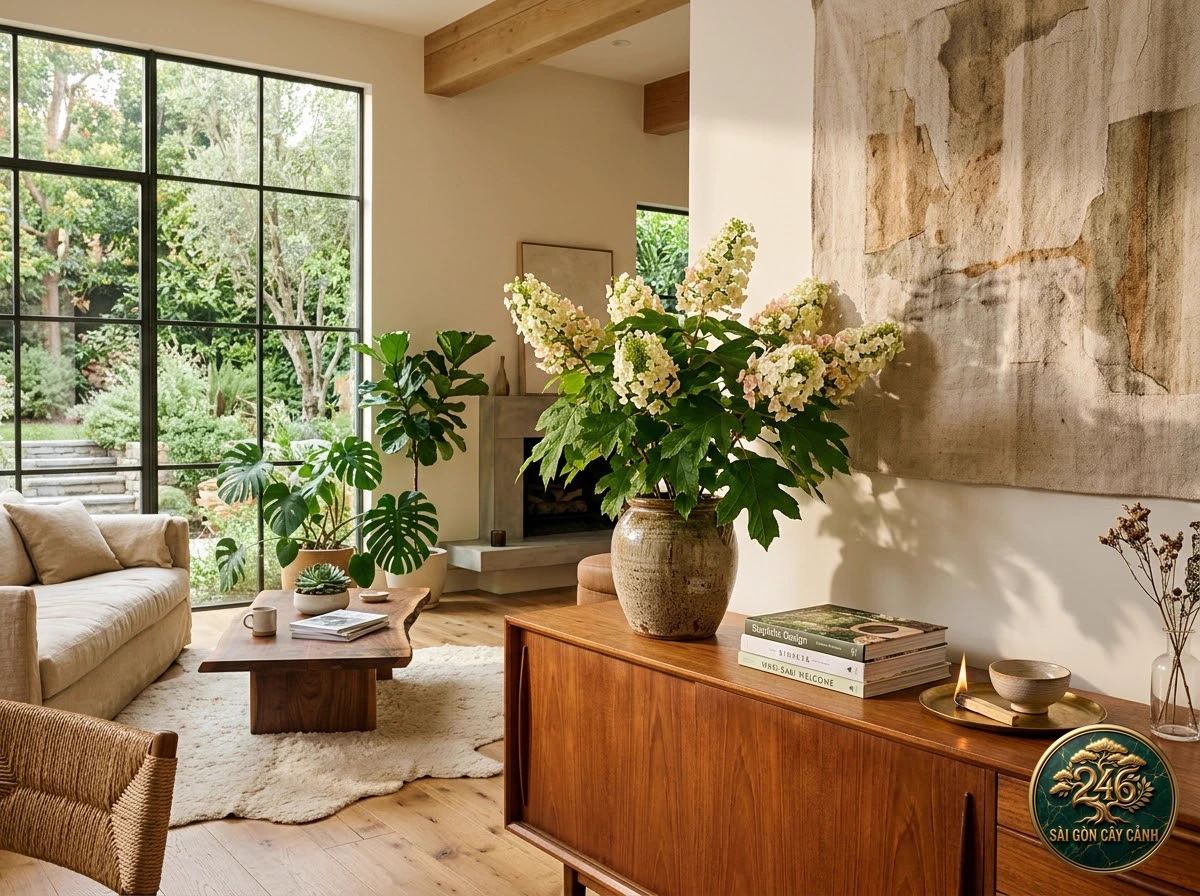
In Eastern biophilic philosophy and Feng Shui metaphysics, Hydrangea quercifolia radiates grounded Wood and transformative Fire energies, symbolizing protective fortitude, venerable longevity, unyielding perseverance, and enduring prosperity. Its majestic oak-like leaves acting as natural protective shields, paired with creamy-white panicles that shift into rich burgundy, inject dynamic positive chi, clearing domestic discord and welcoming stately elegance into living spaces.
Within contemporary Saigon Cay Canh landscape masterplans, oakleaf hydrangea serves as an exceptional four-season architectural shrub: commanding understory focal settings beneath villa shade trees, framing pedestrian walkways in luxury eco-resorts, planted in elevated masonry retaining borders, or featured in oversized ceramic urns adorning shaded porticos.
12. SGCC Acclimatization Benchmarks & Quality Guarantee
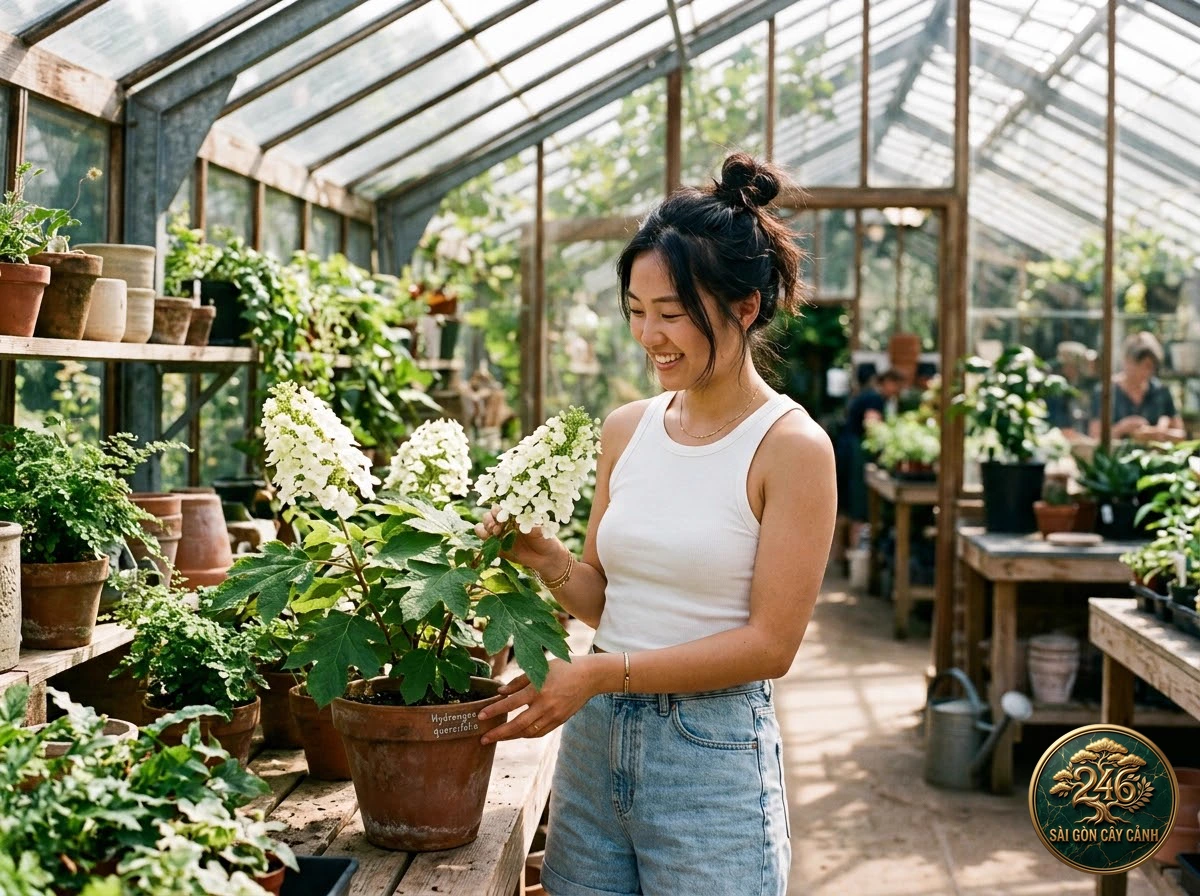
Saigon Cay Canh is an authoritative grower and master distributor of authenticated Hydrangea quercifolia cultivars across southern Vietnam, providing single and double-flowered selections (such as ‘Snowflake’ and ‘Ruby Slippers’) in heavy nursery containers and decorative planters for prestigious estates.nnWe guarantee authentic genetic lineage, superior branch calipers free from soil-borne blights, competitive wholesale pricing, and turn-key architectural landscape installation advisory nationwide.
💬 Góc Tư Vấn & Hướng Dẫn Kỹ Thuật SGCC
Chuẩn E-E-A-T Kinfolk❓ Chăm sóc Oakleaf hydrangea (Hydrangea cần lưu ý điều gì quan trọng nhất?
💡 Dạ điều quan trọng nhất là giữ môi trường sống ổn định, tránh sốc nhiệt hay dao động thông số đột ngột, đồng thời cung cấp khẩu phần ăn sạch và tươi mới ạ.
❓ Làm thế nào để phòng ngừa bệnh tật hiệu quả cho các bé?
💡 Dạ anh chị nên giữ vệ sinh chuồng/hồ nuôi sạch sẽ, thay nước hoặc dọn dẹp định kỳ và bổ sung vitamin, men tiêu hóa đều đặn để tăng sức đề kháng ạ.
🌿 Trang Thiết Bị, Đất Trồng & Dụng Cụ Bonsai Tuyển Chọn
Dụng cụ tỉa, giá thể hữu cơ & phân bón chuyên dụng cho cây cảnh.

Dây uốn cây, dây nhôm bonsai uốn cây cảnh mềm dẻo loại …

Kéo Cắt Cành Lưỡi Gợn Sóng Delixi Kéo Cắt Tỉa Cành Cây …
Tinh Trichoderma BioSun Đậm Đặc – Chế Phẩm Vi Sinh Đối …

Chậu đất nung vẽ tay trồng cây cảnh – sen đá – xương rồ…
Chậu Cây Cảnh quan cá nhân Chậu hoa giả đá làm vườn tro…

Kéo cắt cành SADA chính hãng Nhật Bản SK5 – KÌM CẮT CÀN…

Khay Ươm Hạt Giống 21-32-50-72-105-128-200 Lỗ, Tiện Lợi…

Sào treo chim inox , cắt tỉa hoa quả bẫy chim
Đôn tròn phượng gỗ hương mặt 30cm cao từ 50 đến 80cm kê…
Mùn Dừa, Xơ Dừa Trồng Cây Đã Qua Xử Lý, giá thể trồng s…

Keo liền da, keo liền sẹo, keo hồng Mỹ Tiến, keo đen Mỹ…
Chậu hoa Chậu hoa nhựa resin dày Chậu treo tường ban cô…
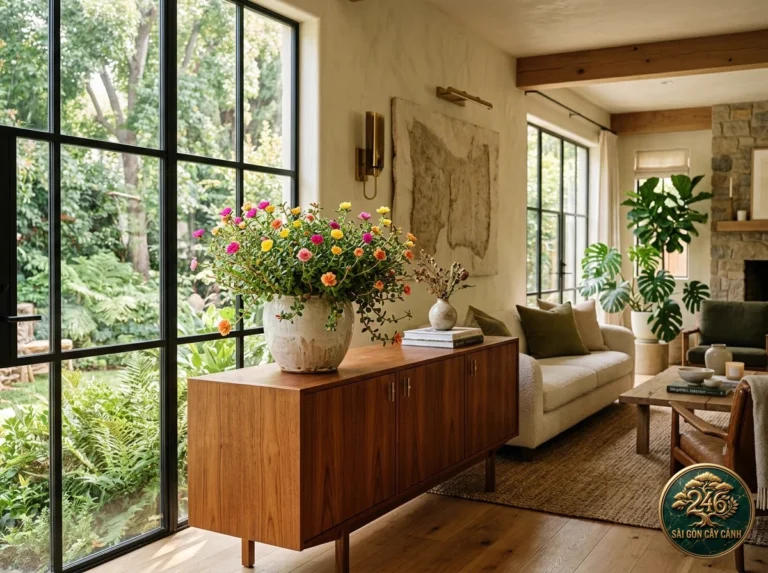
Wingpod purslane (Portulaca umbraticola)
Wingpod purslane (Portulaca umbraticola) Portulaca umbraticola, widely known as wingpod purslane, ornamental purslane, or broadleaf moss rose, is...
Read Monograph →
Red button costus (Costus woodsonii)
Red button costus (Costus woodsonii) Costus woodsonii, internationally celebrated as red button costus, scarlet spiral flag, or Indian...
Read Monograph →
Moss rose (Portulaca grandiflora)
Moss rose (Portulaca grandiflora) Portulaca grandiflora, universally treasured as moss rose, sun plant, or eleven o’clock, is a...
Read Monograph →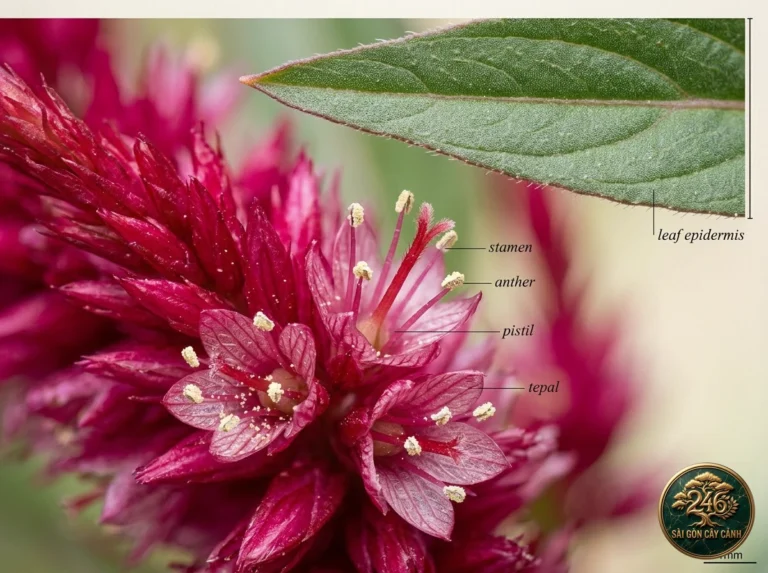
Plumed cockscomb (Celosia argentea)
Plumed cockscomb (Celosia argentea) Celosia argentea, encompassing both feathery plume cockscomb (var. plumosa) and undulating crested cockscomb (var....
Read Monograph →Expert Q&A, Recommended Supplies & Article Feedback
Tap once to connect instantly via Google, Facebook or TikTok — no long forms required!
No questions yet for this article. Tap Google / Facebook / TikTok above to ask the first question!