
Living plant profile
Spider aloe
Aloe humilis
Aloe Asphodelaceae Living Herbarium Master V2 Spider Aloe (Aloe humilis): Incurved Tuberculate Rosette, Clumping Dynamics and Compact Container Care Scientific Name: Aloe humilis (L.) Mill. Common Name: Spider Aloe / Hedgehog Aloe Family: Asphodelaceae Native Range: Eastern and Western Cape, South Africa Aloe humilis is a delightful dwarf succulent featuring densely clumping rosettes of incurved, […]
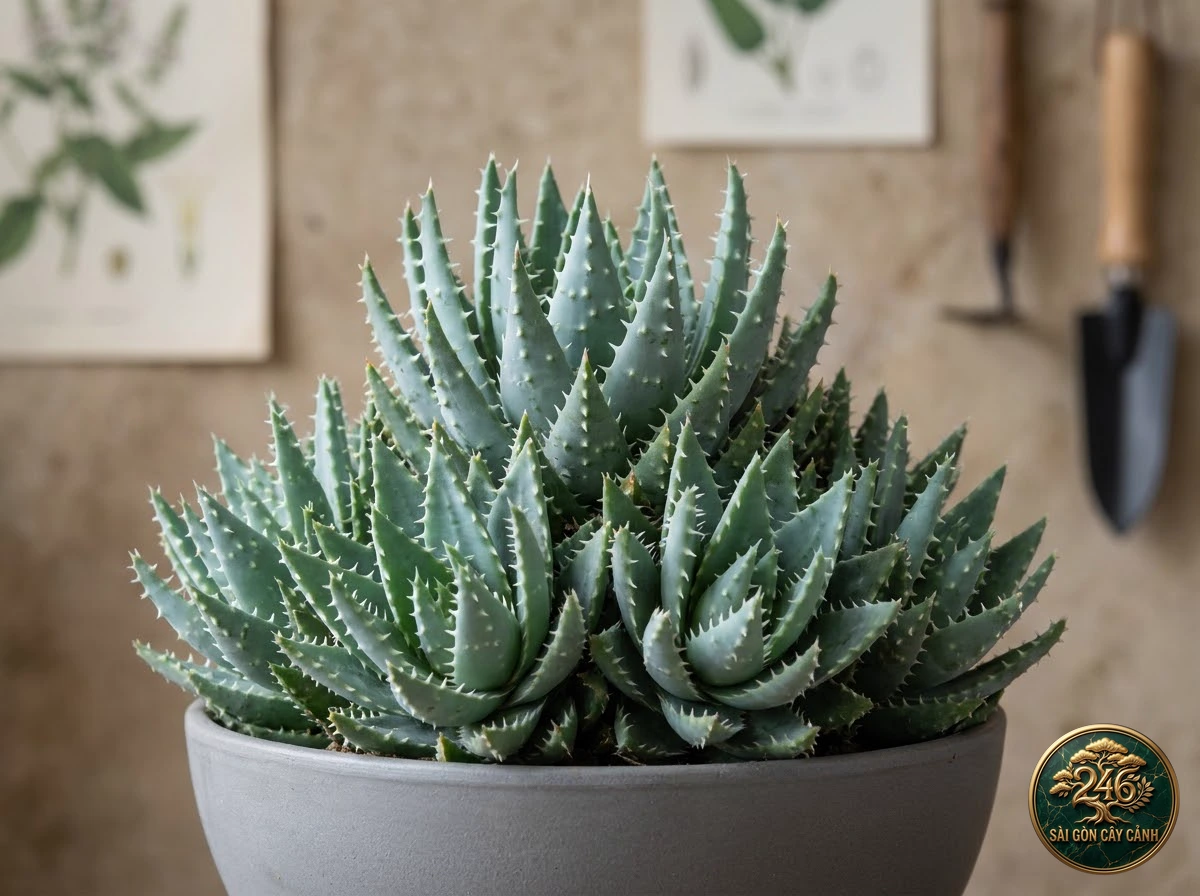
Spider Aloe (Aloe humilis): Incurved Tuberculate Rosette, Clumping Dynamics and Compact Container Care
Common Name: Spider Aloe / Hedgehog Aloe
Family: Asphodelaceae
Native Range: Eastern and Western Cape, South Africa
Aloe humilis is a delightful dwarf succulent featuring densely clumping rosettes of incurved, glaucous leaves studded with soft white conical prickles and commanding coral-red floral spikes.
Sài Gòn Cây Cảnh Care Compass
1. Geographic Origin & Taxonomic Nomenclature History
Aloe humilis was formally published by botanist Philip Miller in 1768. The species is native to gravelly sandstone hills throughout the Eastern and Western Cape provinces of South Africa.
Epidermal tissues are shielded by powdery glaucous wax and hundreds of soft ivory prickles that scatter harsh solar irradiance across arid coastal hills.
2. Morphological Architecture & Anatomical Specializations
The incurved foliar rosette forms a dense protective dome of upward-curving triangular leaves sheltering the tender apical meristem like a succulent hedgehog.
Specialized xerophytic stomatal controls seal foliar moisture during blazing daytime hours, assimilating malic acid at night to fuel steady metabolic growth.
3. Photosynthetic Radiance & Urban Microclimate Dynamics
The plant requires generous filtered light paired with two to three hours of soft early morning sunshine from 3,000 to 6,000 lux to intensify glaucous pruinose wax and induce coral blooms.
Locate containers on east-facing balconies or airy sills, avoiding stuffy stagnant rooms that could cause moisture buildup inside the incurved leaf cluster.
4. Mineral Substrate Engineering & Fast Percolation Dynamics
The recommended growing medium combines 40% pumice, 30% perlite, 15% hard akadama, and 15% matured vermicompost, delivering maximum capillary porosity.
This gritty mineral structure allows water to pass swiftly through root channels and evacuate immediately, ensuring the basal crown remains fresh and well-aerated.
5. Biological Irrigation Protocols & Seasonal Rhythm
Irrigation intervals follow a ten to fifteen day cycle throughout warm vegetative flushes, applying moisture only after core soil dries 80-90% deep.
Pour water gently along container perimeters, avoiding wetting the central cup to prevent water stagnation from damaging delicate crown tissues.
6. Trace Mineral Nutrition & Slow-Release Fertility Protocols
Scatter modest pinches of slow-release pelleted worm castings along root zones bimonthly during monsoon flushes, releasing gentle nutrients that nourish root crowns.
Balanced mineral uptake preserves compact tooth density along margins without inducing soft elongated foliage or disrupting rosette symmetry.
7. Vegetative Propagation Protocols & Aseptic Methodology
Aloe humilis readily produces lateral basal suckers; divide mature clumping mounds in spring once pup offsets develop independent root systems.
Coat severed root junctions with activated charcoal powder and allow divisions to dry in airy shade for ten days prior to potting into fresh porous mix.
8. Botanical Toxicity Profile & Contact Protocols
Yellow aloin sap inside basal leaf sheaths of Aloe humilis possesses a bitter taste and strong purgative action, inducing nausea if ingested by playful pets.
Elevating pots on ceramic stands or timber pedestals provides refined aesthetic presentation while safeguarding curious household companion animals.
9. Physiological Diagnostics & Integrated Pest Management
The physiological diagnosis rubric below details recognizable clinical symptoms and responsive nursery remedies:
| Clinical Symptom | Primary Root Cause | Standard Corrective Protocol |
|---|---|---|
| Central heart of rosette turns black and decays rapidly | Trapped moisture resting inside incurved leaf cup triggering Erwinia rot | Debride necrotic center, dust with powdered sulfur, suspend watering 7 days |
| Foliar blades shrivel thin and soft spines shrivel | Severe protracted root desiccation depleting cellular water storage | Submerge pot base for 15-20 minutes, then move to airy sheltered shade |
| Crowded offsets distort the central rosette symmetry | Root-bound caespitose cluster requiring divisional repotting | Unpot in mild season, tease apart rooted pups with sterile shears into fresh pots |
| Pruinose glaucous wax layer rubs off, leaves turn dull green | Insufficient light intensity or forceful overhead spraying eroding epicuticular wax | Relocate to sunny morning exposure and transition strictly to sub-irrigation |
10. Comparative Taxonomic Evaluation Across Allied Taxa
The comparative matrix below distinguishes specific botanical characteristics separating Aloe humilis from related miniature spiny aloes:
| Species Taxon | Morphological Trait | Growth Architecture | Diagnostic Indicator |
|---|---|---|---|
| Foliar Curvature | Incurved crescent blades creating hedgehog dome | Erect linear-lanceolate tapering blades | Planar two-ranked spreading fan arrangement |
| Prickle Distribution | Soft white spines densely scattered across both faces and margins | Marginal teeth confined strictly to leaf margins | Formidable sharp thorns along dorsal keel and edges |
| Clumping Habit | Prolific caespitose clumping forming dense ground mounds | Solitary rosette or sparsely offsetting habit | Arborescent branching woody trunk development |
| Inflorescence Scale | Oversized coral-red spikes dramatically dwarfing tiny rosettes | Cylindrical yellow-green or orange tubular blooms | Massive branched candelabra racemes atop woody limbs |
11. Urban Landscape Architecture & Living Display Design
The spiny dome rosettes of Aloe humilis contribute organic sculptural charm when displayed on natural timber shelving or sunlit gallery ledges.
Vibrant coral-red flower spikes emerging above powdery blue-green foliage introduce dynamic color harmonies into urban architectural interiors.
Nursery Care Journal & Living Greenery Moments
At Saigon Cay Canh greenhouse, each photograph captures genuine everyday care moments between plant lovers and living greenery, spreading a passion for nature and green-living inspiration.