Living plant profile
Sweet flag
Acorus calamus
Comprehensive botanical dossier for Sweet flag (Acorus calamus). Identification, lighting calibration, porous substrate formulation, and cultivation guide by Saigon Cay Canh.
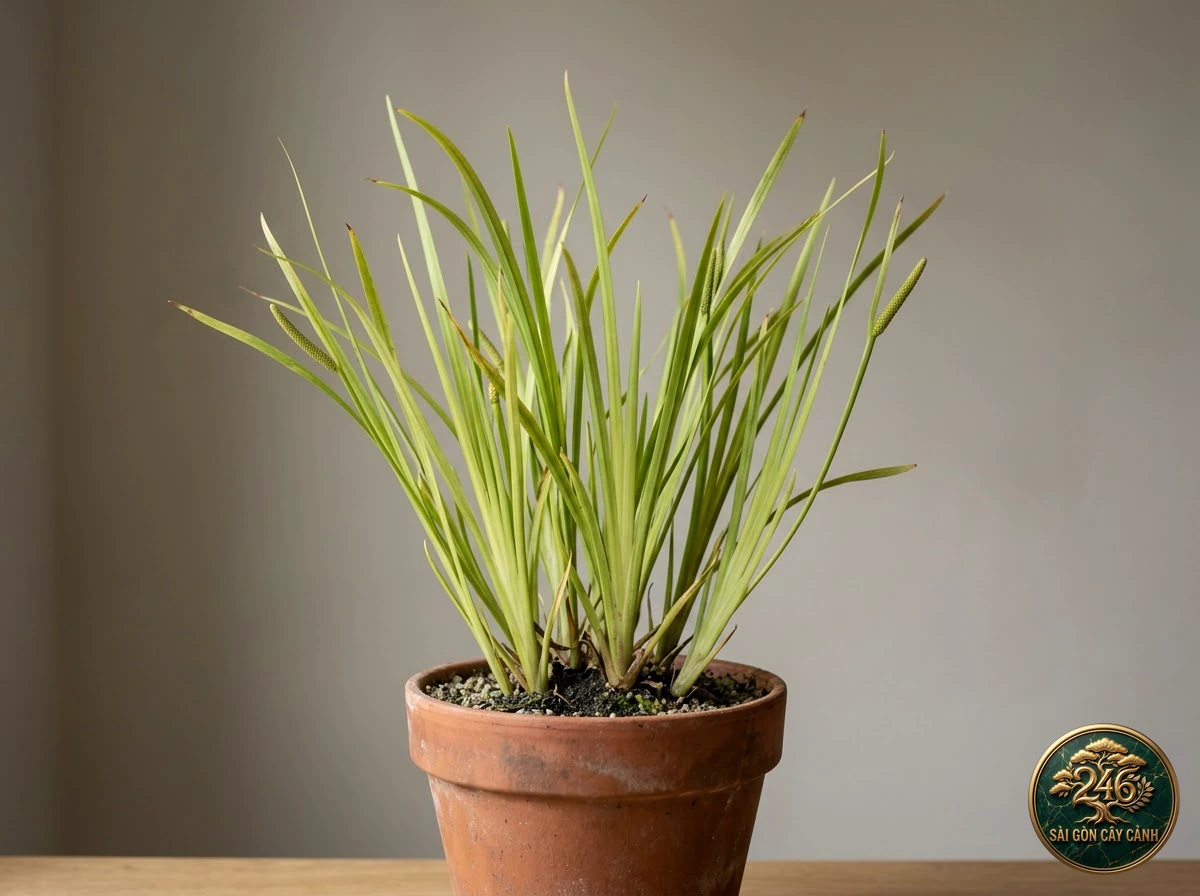
Sweet flag (Acorus calamus) is an ancient emergent wetland perennial in the monotypic family Acoraceae, indigenous to margins of crystal-clear mountain rivulets and freshwater wetlands across temperate and subtropical Asia. Prized for intensely aromatic rhizomes infused with essential terpenes, erect sword-like emerald blades, and natural aquatic bio-filtration vigor.
1. Core Botanical Taxonomy & Cultural Specifications
| Scientific Name | Acorus calamus |
|---|---|
| Botanical Family | Acoraceae (Sweet Flag Family) |
| Native Distribution | East Asia, South Asia, temperate Northern Hemisphere |
| Growth Demeanor | Emergent aquatic perennial, creeping rhizome, erect tufted habit |
| Lighting Threshold | Partial shade to bright diffuse daylight (1,500 – 3,500 lux) |
| Hydration Cadence | Semi-aquatic moisture lover, shallow standing water 2-5 cm |
| Substrate Formulation | Clean alluvial clay, aquatic peat loam, river sand aggregate |
| Thermal Range | 15°C – 30°C (cold hardy, thrives in cool humid air) |
| Relative Humidity | 65% – 85% (riparian humidity levels) |
| Cultivation Difficulty | Low to moderate difficulty with consistent clean water |
| Pet Safety Profile | Caution with pets (volatile essential oils contain beta-asarone) |
Systematic molecular phylogenetics initially uncoupled the genus Acorus from the aroid family Araceae where early morphologists had mistakenly positioned it. Modern APG genomics confirm that Acoraceae constitutes the earliest diverging basal lineage among all monocotyledons, structurally and biochemically distinct from Araceae in every diagnostic metric.
The plant develops horizontally branching rhizomes 1.5 to 2.5 cm in diameter creeping beneath subterranean gravelly loam. Rhizome exteriors display pale tan epidermis with conspicuous annulated leaf scars, while the porous ivory-white pith is packed with specialized oil cells secreting acorone and calamol terpenes that release a spicy, warm aroma upon gentle bruising.
Foliage emerges as erect ensiform linear blades measuring 40 to 80 cm in length and 1 to 2 cm in width, their bases equitant and overlapping in distichous ranks. Leaf margins are acute, reinforced by a prominent, stiffened central midrib traversing from sheath to apex that allows blades to remain upright against brisk freshwater currents.
2. Morphological Identification & Foliar Architecture
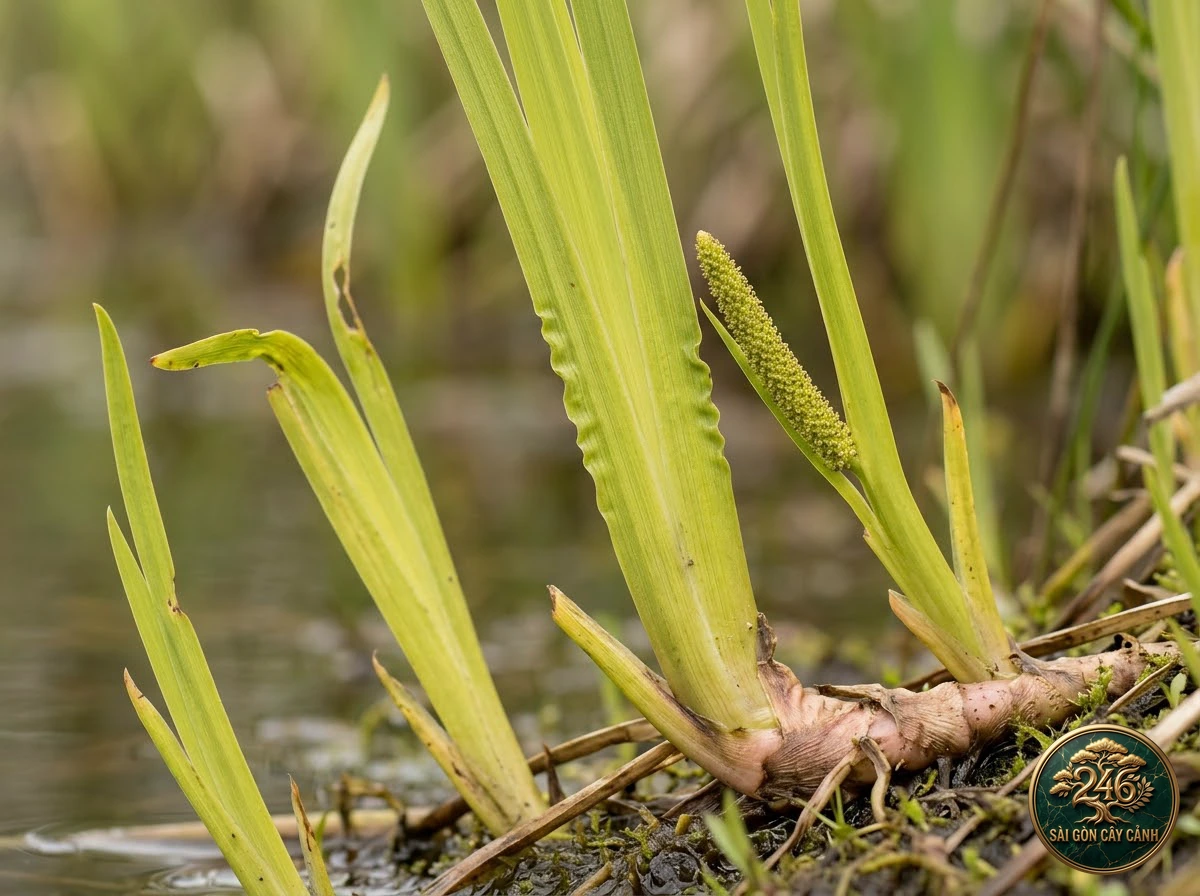
Microscopic diagnosis of Acorus calamus foliage reveals prominent stellate aerenchyma lacunae coursing through spongy mesophyll tissue. This continuous internal venting system functions as internal biological buoyancy chambers while conducting oxygen from stomatal apertures directly down into hypoxic benthic root tips.
The inflorescence consists of a solitary, tapering cylindrical spadix 5-10 cm long projecting laterally from a flattened leaflike scape. The spadix bears hundreds of minute bisexual greenish-yellow florets maturing from base to apex during early summer, conspicuously lacking a colorful decorative spathe found in true aroids.
Micro-histological analysis of the ensiform blade of Acorus calamus demonstrates exceptionally developed aerenchyma channels, forming continuous honeycomb-like air lacunae that extend uninterrupted from the foliar apex down to submerged rhizomes. Transverse epidermal sections reveal elongated epidermal cells interspersed with specialized unicellular essential oil secretory cells concentrated along the prominent midrib, dispersing a crisp aromatic bouquet upon mechanical brushing.
3. Photometric Calibration & Window Exposure Optimization
Photometrically, Sweet flag prospers beneath bright diffuse exposure with photosynthetic photon flux densities (PPFD) between 100 and 250 µmol/m²/s. In residential indoor riparium setups or window-side water bowls, the specimen demands at least 6 hours of gentle illumination daily to sustain verdant jade foliar coloration.
The taxon exhibits adaptive plasticity: early morning direct sun tightens foliar stature and thickens cuticles; however, harsh midday exposure exceeding 400 µmol/m²/s in shallow containers scorches laminar tips straw-yellow while heating stagnant water to temperatures that damage fleshy rhizomes.
Biophotometric assessments show that Sweet flag exhibits remarkable photosynthetic plasticity, flourishing from partial shade to full direct sun with net photosynthetic saturation peaking between 350 and 650 µmol/m²/s PPFD. In indoor riparian containers near south-facing apertures, it retains radiant emerald foliage; when photonic flux falls below 120 µmol/m²/s for protracted periods, newly emerged foliar sheaths become etiolated and lax.
4. Rhizomatous Emergent Aquatic Habit & Aromatic Essential Oil Aerenchyma
Growth architecture in Acorus calamus is governed by horizontal shallow rhizomes trailing across substrate surfaces or submerged 2 to 5 cm beneath clean water. For artistic tabletop aquatic plantings, cultivators regularly prune dark senescent roots, guiding fresh rhizome growth tips to weave organically around smooth river stones.
Rhizomes initiate continuous terminal flushes through spring and summer. As clusters thicken, stripping outer senescent sheaths highlights the sculptured rhizome contours while promoting basal ventilation, preventing submerged decay from clouding ornamental water reservoirs.
Regarding water management, Acorus calamus requires complete rhizosphere saturation. Water levels within containers must consistently cover root collars by 1 to 3 cm. Utilizing clean, dechlorinated municipal water or rainwater refreshed weekly ensures rootlets remain crisp, white, and metabolically active.
Target vapor pressure deficit (VPD) spans 0.5 to 0.85 kPa alongside ambient relative humidity between 65% and 85%. In dry air-conditioned rooms, resting planters in broad water saucers creates a self-humidifying micro-oasis that insulates ensiform leaf tips against dry crisping.
The optimal vapor pressure deficit (VPD) for Acorus calamus spans 0.7 to 1.1 kPa, matched with an ambient relative humidity of 65% to 85%. Supported by a substantial cuticular envelope and continuous water ascent through rhizomatous aerenchyma, this taxon withstands dry airflow far better than delicate tropical rainforest understory foliage.
The creeping horizontal rhizome system of Acorus calamus measures 12 to 25 mm in diameter, exhibiting sympodial zig-zag branching wrapped in fibrous persistent leaf sheath scars. Coarse adventitious fibrous roots descend from the nodal nodes, anchoring firmly into benthic silt or gravelly beds and forming a mechanical stabilizing weave that armors riparian banks against torrential currents.
5. Porous Aggregate Substrate Engineering & Aeration Dynamics
Substrate formulation for Sweet flag pairs alluvial cohesiveness with porous mineral aeration. An ideal blend incorporates 40% clean alluvial clay loam pellets, 30% fine pumice or Japanese akadama, 20% aged aquatic peat, and 10% biochar to actively absorb dissolved organic odors.
In undrained glazed planters or water basins, the 8-12 cm root substrate should be topped with a 2 cm mantle of washed river gravel or quartz sand. This top-dressing prevents mud displacement during refills while providing a pristine micro-habitat for beneficial benthic bacteria.
As an amphibious emergent wetland species, the cultivation substrate requires moisture saturation combined with mineral-rich alluvial components. The ideal formulation combines 40% pasteurized alluvial clay soil, 30% decomposed organic leaf mold, and 30% river sand (2-4 mm grit), sustaining a buffered pH between 6.0 and 7.2 while facilitating gentle benthic water exchange across the crown.
6. Organic Nutrition Schedules & Periodic Micronutrient Priming
Nutritional regimens for aquatic Sweet flag prioritize ultra-dilute organic hydroponic feeds calibrated to an EC of 0.4 to 0.6 mS/cm once monthly. Inserting slow-release root fertilizer tabs deep into benthic clay supplies essential trace elements steadily without fueling opportunistic green algae blooms.
Avoid excessive soluble synthetic nitrogen feeds, which induce overly elongated, weak blades susceptible to mechanical lodging. Supplementing potassium silicate and calcium strengthens cell wall rigidity, enhancing photosynthetic efficiency and preserving the plant’s upright aesthetic posture.
Nutritional management for indoor aquaterrariums involves inserting slow-release bio-organic spikes enriched with natural potassium and humic fractions 5 cm beneath the sediment crown bi-monthly. Liquid chemical fertilizers dispersed directly into the open water column must be avoided to prevent opportunistic algal blooms that compromise water clarity.
7. Clinical Diagnostic Matrix & Rapid Correction Protocols
| Clinical Symptom | Primary Etiology | Diagnostic Evaluation | Corrective Prescription |
|---|---|---|---|
| Straw-brown crisping at blade tips | Substrate desiccation or elevated water temperatures from direct sun | Inspect container water level and assess water temperature | Replenish with cool clean water immediately and relocate to diffuse shade |
| Basal leaves yellowing and softening progressively | Stagnant anoxic water or excessive benthic algae choking capillary roots | Smell container water and inspect rhizome for dark soft rot lesions | Perform complete water exchange, rinse root mass, and excise necrotic tissue |
| Blades overly elongated, spindly, and lodging | Chronic light deprivation beneath 1,000 lux in interior rooms | Measure ambient light levels at foliage height with light meter | Relocate planter to brighter window perimeter or install dedicated LED grow light |
| Black aphid colonies clustered along petiole sheaths | Stagnant dry ambient air and restricted air movement around foliage | Examine petiole crevices under magnification loupe for active pests | Flush aphids with gentle water spray and wipe sheaths with soft organic soap lather |
8. Cryptic Pest Prophylaxis & Foliar Surface Sanitation
The most frequent pests in aquatic cultivation are black aphids along emergent petioles and aquatic snails rasping subterranean tips. The premier biological management tactic introduces small ornamental fish (guppies or dwarf gouramis) into basins to consume mosquito larvae and harmful pests organically.
Perform regular foliage hygiene by gently spraying blades with tepid water to eliminate dust and benthic algae films. Promptly snip yellowing basal blades to maintain water clarity, suppressing anaerobic bacteria that induce rhizome rot.
Biological pest prevention focuses on continuous water circulation to prevent mosquito larvae and localized brown soft scales along basal foliar sheaths. Should benthic biofilm or particulate debris accumulate, gently sweeping exposed rhizomes with a soft-bristled brush accompanied by fresh water rinsing restores ecological sanitation without synthetic chemical intervention.
9. Asexual Propagation Methodology & Root Strike Protocols
Asexual propagation of Sweet flag is straightforward and reliable via rhizome division during spring or the onset of warm rains. Using a sterilized scalpel, segment mature rhizomes into 5 to 8 cm pieces, ensuring each unit retains at least two active vegetative eyes and healthy rootlet tufts.
Anchor divided rhizome sections horizontally into moist alluvial clay, maintaining shallow standing water under bright shaded conditions. Over a 25 to 35 day developmental interval, fresh vegetative shoots emerge vigorously while adventitious root systems colonize the substrate.
Asexual division via rhizome severance yields optimal results using robust segments 6 to 10 cm in length retaining 2 to 3 distinct nodal buds. Orienting segments horizontally shallowly beneath saturated sand-loam with standing water flush to the substrate over a 25 to 35 day interval stimulates synchronous adventitious root strikes and vigorous foliar flushes.
10. Companion Animal Toxicology Profile & ASPCA Safety Evaluation
Because specimens are traditionally cultivated in tabletop water bowls or shallow basins, companion animal owners should position arrangements upon elevated pedestals or protected credenzas, deterring curious pets from drinking aromatic container water or nibbling oil-rich leaf sheaths.
11. Biophilic Curation & Contemporary Interior Design Styling
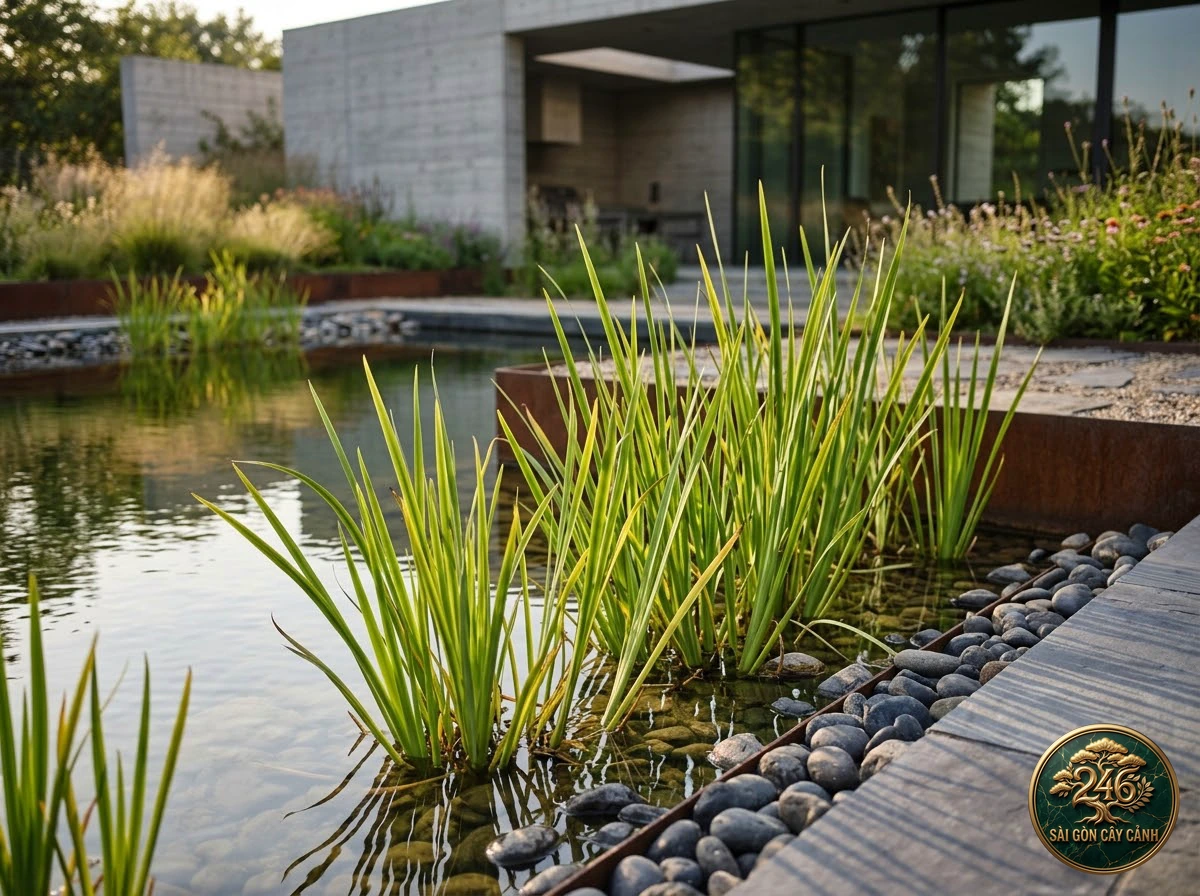
Within East Asian horticultural traditions and Biophilic contemplative interiors, Sweet flag symbolizes purity, tranquility, and resilience. Its pristine linear emerald blades rising serenely from clear water evoke profound meditative stillness, counterbalancing urban digital stress with refreshing aquatic vitality.
A miniature Sweet flag specimen paired with natural river pebbles on executive workspaces, library tables, or tea rooms releases subtle herbal aromas when brushed, naturally elevating localized humidity and relieving ocular strain.
Within contemporary Biophilic architecture, Acorus calamus serves as an exquisite centerpiece for meditative water bowls, minimalist ceramic vessels, and lush paludariums. The subtle aromatic scent released from its linear leaves in ambient air currents instills profound psychological calm, transforming indoor tea pavilions and creative studios into therapeutic natural retreats.
12. Master Principles for Sustainable Indoor Acclimatization
Sustaining luxuriant vigor and aromatic resilience in indoor Sweet flag demands strict adherence to three horticultural axioms:
- Hydration axiom: Maintain consistent 1-2 cm shallow standing water over the rhizome crown; never permit substrate to desiccate completely.
- Illumination axiom: Provide cool diffuse illumination of 1,500 to 3,000 lux, shielding shallow containers from harsh solar water overheating.
- Maintenance axiom: Refresh container water weekly and excise yellowing basal leaves to preserve pristine aquatic rhizosphere hygiene.
13. Frequently Asked Questions Regarding Sweet flag (FAQs)
Can Sweet flag be cultivated purely in water without soil?
Yes, it thrives in soilless water culture anchored by river stones or pumice; however, a thin basal alluvial clay layer supplies essential micronutrients for long-term health.
How do you coax the strongest fragrance from the specimen?
Lightly brushing or rubbing leaves and exposed rhizomes ruptures sub-epidermal oil cells, releasing their crisp, spicy herbal aroma immediately.
How frequently should reservoir water be changed?
Top up water daily and execute a complete water refresh once weekly to maintain crystal clarity and eliminate mosquito breeding.
Does Sweet flag thrive inside sealed air-conditioned offices?
It thrives splendidly in air-conditioned interiors provided bright diffuse light is accessible and the basin remains consistently filled.
Why do leaves darken to deep forest-green tones?
This represents a healthy morphological shade adaptation, increasing chlorophyll density to capture diffuse ambient photons efficiently.
Why do the leaf tips of Sweet flag occasionally turn brown and dry?
Foliar tip necrosis typically stems from stagnant sediment evaporation causing temporary root desiccation, or elevated mineral salt accumulation; replenishing with clean filtered water and flushing bottom sediment restores tip vigor.