Living plant profile
Panda Plant (Kalanchoe tomentosa)
Kalanchoe tomentosa
Panda Plant (Kalanchoe tomentosa) The Panda plant (botanical binomial: Kalanchoe tomentosa Baker) represents one of the most tactilely delightful and morphologically distinct succulent perennials within the stonecrop family (Crassulaceae). Affectionately dubbed the chocolate soldier, pussy ears, or velvet leaf kalanchoe across international horticulture, this subshrubby marvel enchants observers with its plump, spatulate foliage completely enveloped […]
Panda Plant (Kalanchoe tomentosa)
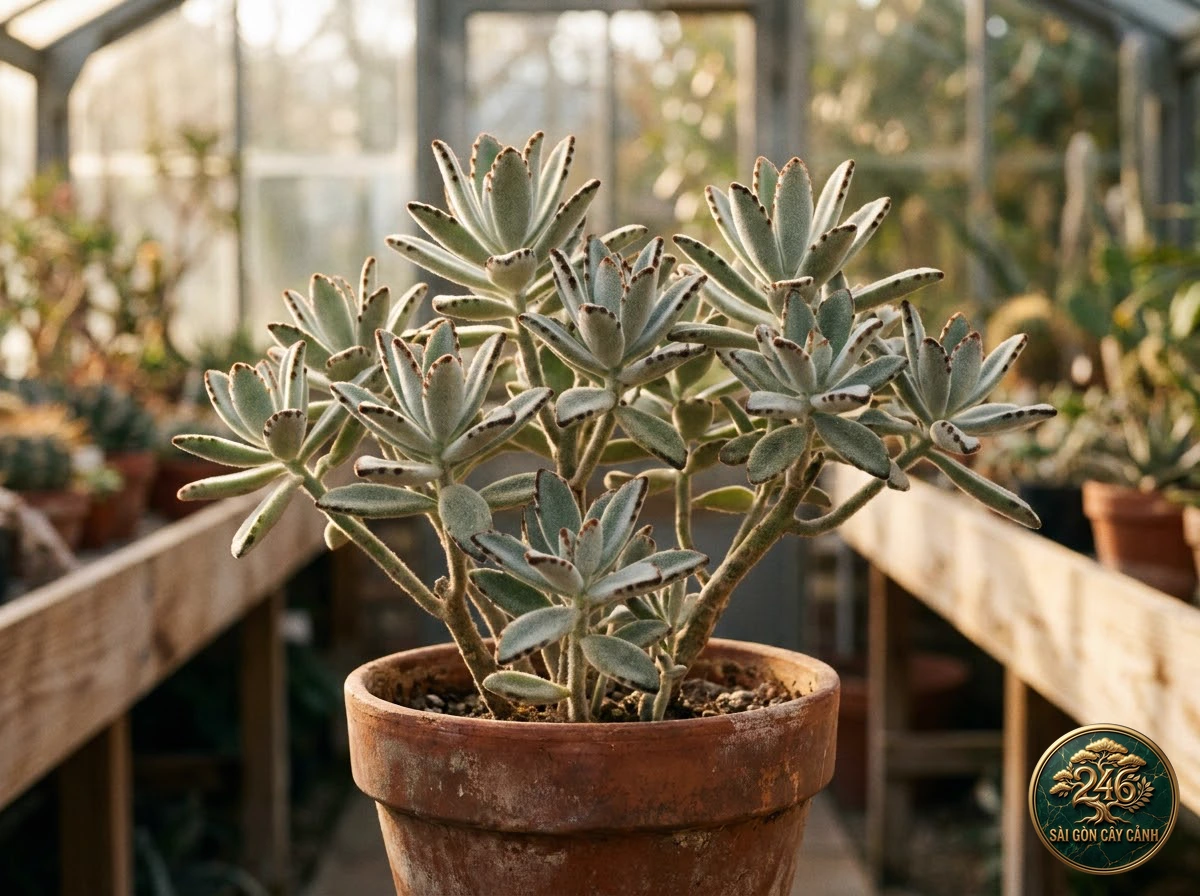
The Panda plant (botanical binomial: Kalanchoe tomentosa Baker) represents one of the most tactilely delightful and morphologically distinct succulent perennials within the stonecrop family (Crassulaceae). Affectionately dubbed the chocolate soldier, pussy ears, or velvet leaf kalanchoe across international horticulture, this subshrubby marvel enchants observers with its plump, spatulate foliage completely enveloped in a plush carpet of silvery-white felt, punctuated along the apical leaf margins by deep chocolate-brown and rusty-maroon micro-crenations.
Endemic to the sun-scorched granitic bluffs of central Madagascar, this xerophytic treasure was first classified in 1882 by British botanist John Gilbert Baker. Far beyond mere visual eccentricity, the dense indumentum of specialized stellate trichomes and water-conserving CAM physiological apparatus exemplify an evolutionary masterclass in thermal dissipation and evaporative resistance. In contemporary interior architecture and biophilic curation, it introduces an irresistible textural contrast, fusing structural restraint with whimsical, organic elegance.
Sài Gòn Cây Cảnh Care Compass
1. Comprehensive Botanical Taxonomy & Key Specifications
To establish rigorous scientific parameters for botanical curators and interior landscape architects, Saigon Cay Canh compiles the empirical baseline below:
| Taxonomic Marker & Botanical Attribute | Empirical Specification & Cultural Value |
|---|---|
| Accepted Botanical Binomial | Kalanchoe tomentosa Baker (J. Linn. Soc., Bot. 19: 272, 1882) |
| Phylogenetic Placement (APG IV) | Order Saxifragales / Family Crassulaceae / Genus Kalanchoe |
| Standard Vietnamese Common Names | Sen đá tai thỏ nhung viền nâu, Sen đá gấu trúc, Sen nhung lông thỏ |
| International Trade Vernaculars | Panda plant, Chocolate soldier, Pussy ears, Velvet leaf kalanchoe |
| Native Geographic Provenance | Granitic rock outcrops and dry montane plateaus of central Madagascar |
| Growth Habit & Ultimate Dimensions | Freely branching succulent subshrub, lightly woody at base, 30-80 cm tall |
| Foliar Structure & Epidermal Cover | Obovate-spatulate fleshy leaves clad in silver felt with chocolate margins |
| Inflorescence & Floral Architecture | Terminal panicle bearing small tubular bell-shaped greenish-yellow flowers |
| Veterinary Safety Classification (ASPCA) | TOXIC TO PETS (contains cardiotoxic bufadienolide glycosides) |
Through dedicated organic nurturing at Saigon Cay Canh, each specimen develops optimal trichome density and crisp margin definition, ensuring enduring vitality across domestic settings.
2. Morphological Identification Keys & Anatomy
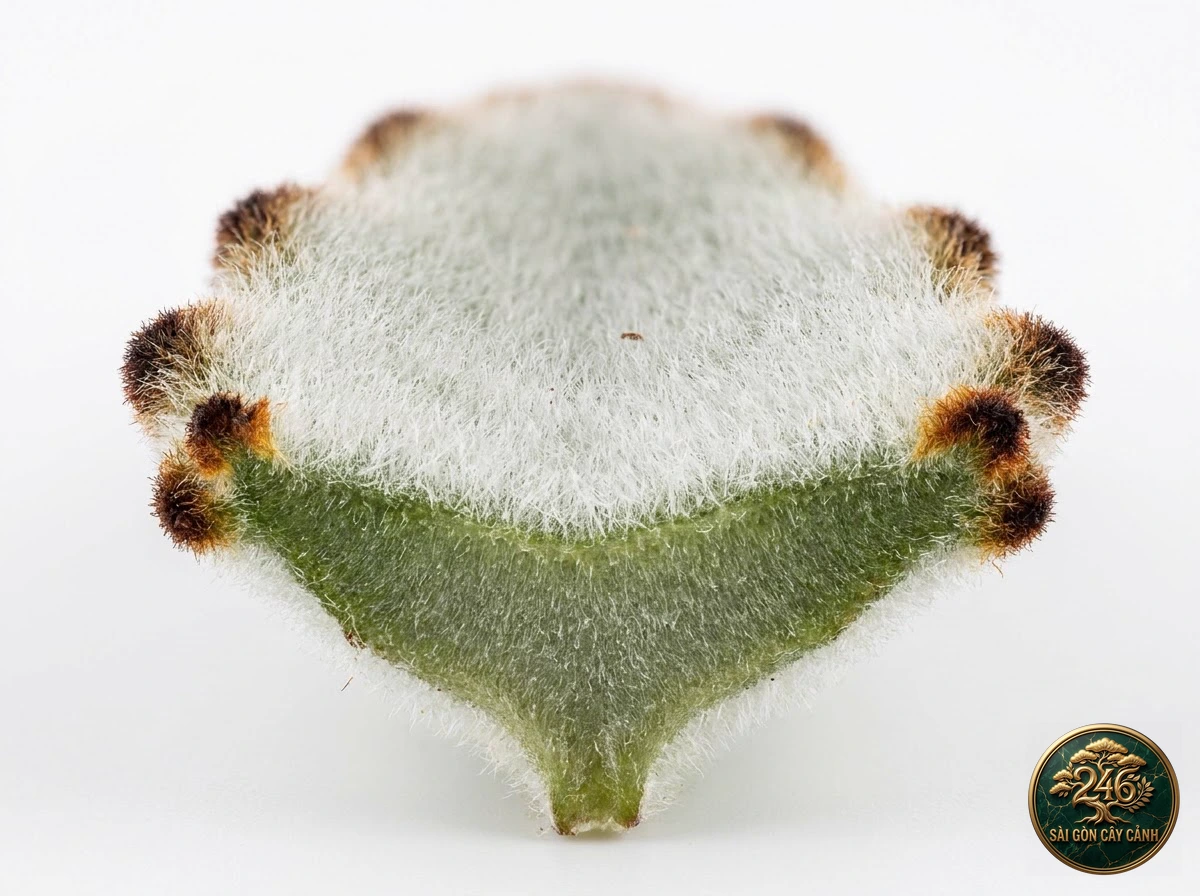
The specialized anatomy of Kalanchoe tomentosa exhibits a suite of evolutionary adaptations finely calibrated for insolation defense and desiccation avoidance:
Stellate Trichome Indumentum: Unlike smooth, glaucous succulents coated in fragile epicuticular wax films, the entire vegetative surface of the panda plant is cloaked in a dense, multi-layered cushion of branched stellate trichomes. This structural micro-fleece functions as a radiant thermal shield, scattering ultraviolet rays, curbing boundary-layer transpiration, and intercepting nocturnal atmospheric moisture rolling over montane plateaus.
Spatulate Foliage with Anthocyanic Crenations: The leaves are sessile or short-petioled, arranged in alternating decussate pairs, obovate to oblong-spatulate in outline, measuring 4 to 9 cm long and 1.5 to 3 cm wide. Along the rounded apex, distinct blunt teeth develop concentrated deposits of protective anthocyanins and dark melanin-like phenolic pigments. These markings create the characteristic rich chocolate-brown or espresso spots that delineate the ear-like silhouette.
Lignifying Stems & Architecture: In juvenile stages, stems are flexible and wrapped in golden-amber wool. With maturity, basal stems undergo progressive lignification, forming a sturdy, grayish-tan woody trunk that easily anchors the spreading succulent crown, creating a charming miniature tree-like profile.
Pendulous Floral Bells: Although inflorescence emergence is rare in standard indoor settings, mature outdoor plants in late spring elevate terminal cymes bearing tubular, bell-shaped nodding blossoms. The calyx and corolla tubes display subtle yellow-green and silvery hues, flaring into rounded lobes shaded in velvety purplish-brown.
3. Botanical Taxonomy & Nomenclature History
The formal scientific documentation of the species dates back to 1882, when eminent English botanist John Gilbert Baker described it in the Journal of the Linnean Society, Botany. The generic name Kalanchoe is widely attributed to Michel Adanson’s latinization of an ancient regional plant moniker, while the specific epithet tomentosa derives directly from the Latin botanical term for dense, matted, woolly hairs, perfectly capturing the velvety feel of the foliage.
Within the APG IV taxonomic hierarchy, the genus Kalanchoe is nested within the subfamily Kalanchoideae of the stonecrop family. Madagascar represents the evolutionary epicenter of the genus, boasting remarkable morphological diversification from climbing lianas to massive arborescent species. Kalanchoe tomentosa belongs to a specialized evolutionary lineage that conquered dry montane rock domes through micro-trichome indumenta rather than massive trunk storage.
Horticultural breeding has selected several prized cultivars, such as ‘Chocolate Soldier’ (bearing wide, intensely blackened foliar teeth), ‘Nigra’ (featuring dark charcoal margins), and ‘Golden Girl’ (possessing warm amber-golden trichomes), each maintaining immense prestige among succulent connoisseurs.
4. Native Habitat & CAM Photosynthetic Physiology
Wild colonies of Kalanchoe tomentosa thrive upon barren granitic inselbergs and rocky mountain crests across central Madagascar, notably throughout the Fianarantsoa plateau. This rugged topography subjects flora to prolonged dry seasons marked by blistering daytime insolation and rapid nighttime radiational cooling, with annual precipitation hovering between 400 and 700 mm.
To endure sustained hydrological deficits, the plant operates a highly tuned Crassulacean Acid Metabolism (CAM) cycle:
During daylight hours, foliar stomata tucked beneath the thick blanket of reflective trichomes remain hermetically sealed, preventing evaporative water loss. The silvery micro-hairs diffuse intense sunlight, maintaining the internal hydrenchyma tissue temperatures several degrees cooler than surrounding rocks.
At dusk, as montane air cools, stomata open to absorb ambient carbon dioxide. Phosphoenolpyruvate carboxylase (PEPC) fixes this atmospheric carbon into four-carbon malate molecules, sequestering them within expansive central vacuoles throughout the night. Come sunrise, stomata close again; stored malate is decarboxylated internally to release concentrated CO2 directly into the Calvin-Benson cycle for RuBisCO-driven carbohydrate synthesis, granting uncompromised carbon assimilation without water wastage.
5. Luminous Flux & Margin Pigmentation Dynamics
Sunlight exposure serves as the primary environmental catalyst regulating foliar compactness and chocolate margin intensity. For robust growth and rich contrast, maintain luminous flux between 4,000 and 8,500 lux.
An east-facing windowsill or sheltered eastern balcony providing 4 to 6 hours of gentle direct morning sunlight represents the gold standard location. Morning solar rays stimulate anthocyanin and protective flavonoid biosynthesis along leaf margins without exposing succulent tissues to scorched infrared stress.
Under insufficient light regimes (below 2,000 lux), plants undergo noticeable etiolation: stems elongate abnormally, leaves space out loosely, and the dramatic chocolate spots fade into pale greenish-white. Conversely, during blistering tropical afternoons with temperatures exceeding 37°C, buffer harsh direct sun behind a sheer curtain to prevent foliar thermal stress.
6. Hydraulic Protocols & Foliar Felt Protection
Engineered with swollen water-storing parenchyma cells, the panda plant exhibits extraordinary tolerance against prolonged drought but reacts poorly to chronically wet substrate around root fibers.
Follow the rigorous soak-and-dry watering protocol. Provide moisture only after the growing medium has dried out completely down to the bottom drainage holes. Validate moisture levels by inserting a clean wooden dowel into the root core: water only when it withdraws entirely dry.
Crucial Cultural Rule: Never mist or shower overhead directly onto the velvety leaves. The dense micro-hairs entrap water droplets for extended durations. When trapped moisture meets stagnant air, opportunistic fungal spores ignite foliar rot and extensive leaf loss. Always water gently around the rim of the pot or perform a 10 to 15 minute bottom soak in shallow water, allowing moisture to rise through capillary action.
7. Mineral Substrate Composition & Rootzone Aeration
Replicating the freely draining decomposed granite fissures of Madagascar requires an open, grit-dominated potting mixture that eliminates perched water tables.
Saigon Cay Canh prepares a bespoke 70:30 mineral-to-organic blend:
- 70% Coarse Mineral Aggregates: 40% horticultural volcanic pumice (3-6 mm grain size establishing stable macro-pore channels), 15% expanded white perlite, and 15% crushed red volcanic scoria providing iron micro-nutrients.
- 30% Screened Organic Substrate: 20% desalted, tannin-free coconut coir peat and 10% microbially active earthworm castings delivering gentle humic substances.
This gritty profile ensures excess water gravitates out in moments, allowing vital dissolved oxygen to bathe delicate root tips. Substrate pH should hover between 6.0 and 6.8, fostering optimal cation exchange and sturdy cell walls.
8. Thermal Hardiness, Humidity & Ventilation Dynamics
Panda plants thrive across a comfortable thermal window of 20°C to 32°C, integrating effortlessly into warm equatorial microclimates.
While brief dry exposures down to 8°C are tolerable, wet roots during cold spells cause swift cell lysis within succulent tissues, triggering fatal crown decay.
Target relative ambient humidity between 35% and 55%. Unlike moisture-loving tropical aroids, the panda plant demands airy, low-humidity surroundings. Gentle, continuous air circulation is paramount: buoyant air movement disperses boundary-layer heat buildup during sunny midday hours, dries accidental water droplets, and suppresses powdery mildew.
9. Clinical Diagnostic Matrix & Cultural Remediation
Consult this diagnostic matrix to troubleshoot common cultural disorders in Kalanchoe tomentosa:
| Clinical Manifestation | Etiological Cause & Pathology | Corrective Horticultural Protocol |
|---|---|---|
| Stem base turns mushy black; lower velvety leaves detach and fall spontaneously | Over-irrigation or compacted soil causing rhizosphere anoxia and fungal root rot | Sever healthy firm top growth above decay using a sterile blade; air-dry 3 days and re-root in dry pumice grit; discard rotten soil |
| Stem stretches tall and spindly; wide internodal spacing; margin spots fade | Prolonged insufficient light exposure disrupting balanced growth (etiolation) | Relocate to an area receiving 4 to 5 hours of direct morning sun; prune apical stems to stimulate compact branching |
| Leaves appear wrinkled, deflated, and limp to the touch while retaining color | Extended drought causing internal water depletion in hydrenchyma storage cells | Perform a 15-minute bottom soak in room-temperature water; foliage will plump up and regain firm turgor within two days |
| Velvety trichomes become matted; grayish fuzzy fungal patches develop on leaf blades | Overhead watering leaving trapped moisture in the foliar felt within stagnant air | Relocate to a well-ventilated breezy location; swab mildew areas with 70% medicinal alcohol; discontinue foliar wetting permanently |
Gently feeling the firm turgidity of the apical ear-shaped leaves offers a dependable indication of correct root hydration.
10. Integrated Pest Management & Sanitation
While the dense trichome coat deters common chewing insects, cryptic pests such as mealybugs (Pseudococcus species) may seek shelter deep within leaf crevices or around subterranean root nodules.
Upon discovering white cottony wax secretions, spot-treat pests directly using a fine cotton applicator dipped in 70% medicinal alcohol. The alcohol instantly dissolves the waxy insect carapace without harming succulent epidermal cells.
Standard nursery hygiene involves clearing away withered bottom leaves and conducting occasional preventative evening mists with a diluted organic cold-pressed neem oil emulsion to repel sap-sucking pests.
11. Specialized Asexual Propagation Protocols
The panda plant exhibits vigorous vegetative regeneration, multiplying reliably through individual leaf cuttings or terminal stem cuttings.
Seasonal Timing: Early spring or the start of the dry warm period provides optimal temperatures (24°C-28°C) for brisk cell division.
Leaf Propagation Technique:
- Gently twist a healthy, plump mature leaf from the mid-stem, ensuring the basal attachment point remains intact with its dormant axillary meristem.
- Place harvested leaves on a dry tray in a shaded, well-ventilated spot for 4 to 5 days to form a firm, protective suberized callus.
- Lay callused leaves flat upon fine, slightly dampened pumice or coarse grit. Avoid heavy drenching; maintain mild ambient humidity.
- Within three to four weeks, delicate pink feeder roots anchor into the medium, followed by the emergence of miniature rosettes resembling tiny fuzzy rabbit ears.
Stem Tip Propagation: Sever a vigorous 7 to 10 cm stem cutting featuring several healthy leaf pairs. Remove lower foliage, allow cut ends to callus for 4 days, then insert into dry mineral substrate. New anchor roots develop readily.
12. Companion Animal Safety & ASPCA Toxicity Disclosure
The botanical tissues of the panda plant contain potent naturally occurring cardiac steroid toxins known as bufadienolide cardiac glycosides (predominantly bryotoxins and bersaldegenin derivatives). These compounds inhibit the crucial myocardial Na+/K+-ATPase enzyme system in mammalian heart muscles, precipitating severe cellular electrolyte disruptions.
Ingestion of foliar or stem tissue by curious dogs or cats triggers acute clinical manifestations within hours: profuse salivation, continuous vomiting, abdominal pain, severe diarrhea, profound lethargy, and potentially fatal cardiac arrhythmias or circulatory collapse if significant quantities are consumed.
Essential Preventive Measures: Households with inquisitive pets or toddlers must place panda plants exclusively upon elevated shelves, high display cabinets, or inside secured plant cabinets well out of physical reach. If accidental ingestion occurs, transport the animal immediately alongside a plant sample to an emergency veterinary clinic for gastric lavage and antiarrhythmic therapy.
13. Biophilic Design & Interior Curation
With its warm woolly texture and playful chocolate-dotted margins, the panda plant is an extraordinary sculptural asset in contemporary biophilic interior design.
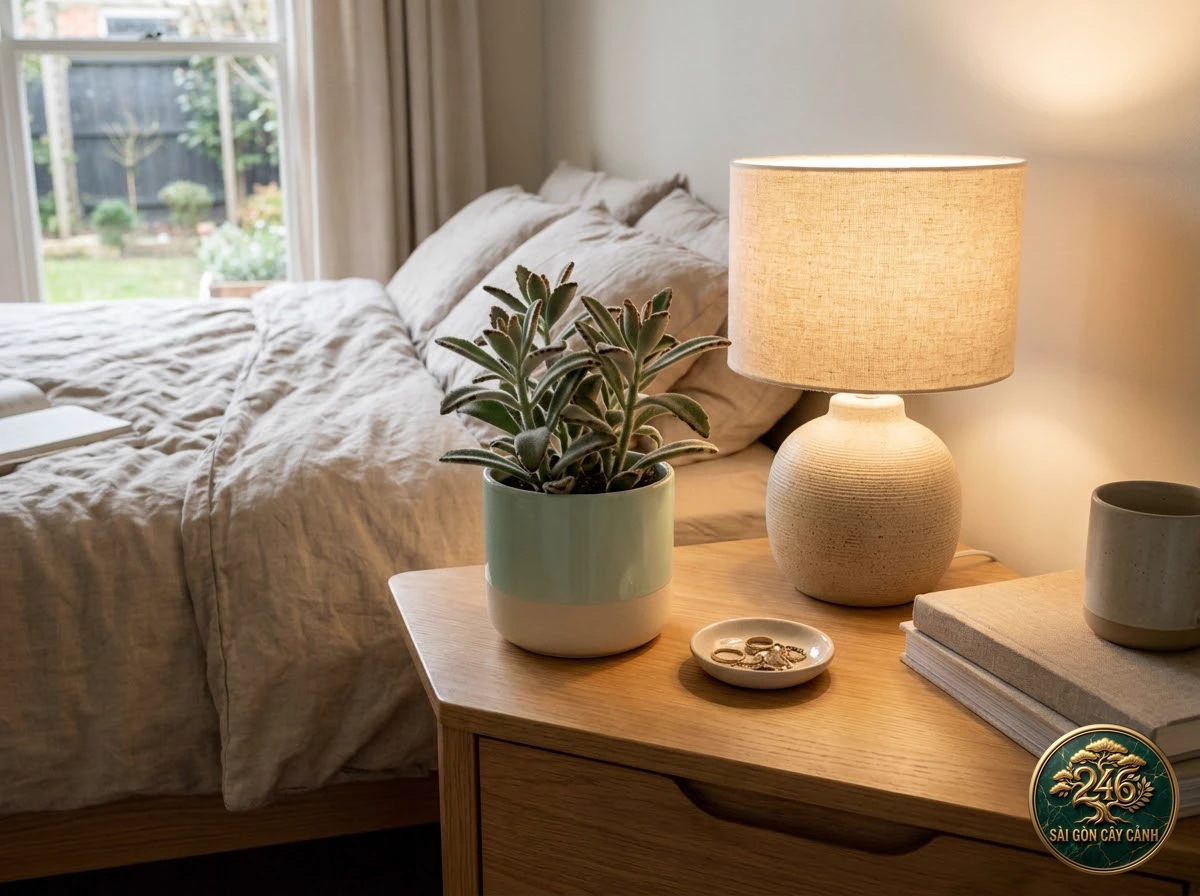
Workspace & Credenza Styling: Housed within minimalist raw concrete planters, matte terra-cotta vessels, or neutral unglazed ceramic pottery, a potted panda plant softens angular contemporary desks and bookshelf displays. Its soft tactile appearance instills a calming organic presence that mitigates digital screen fatigue.
Xeric Succulent Groupings: Within composite succulent bowls, the silvery-gray felt of Kalanchoe tomentosa provides a sublime textural contrast alongside glassy Haworthia and vivid rosette forms.
14. Brand Ambassador & Cultivation Ethos
At Saigon Cay Canh, every living succulent is nurtured with botanical precision and artistic reverence. Our panda plant specimens undergo rigorous greenhouse conditioning under Southern Vietnam’s natural solar warmth, cultivating maximum trichome density and vibrant margin definition.

The dedication reflected in hands dusted with volcanic grit underscores our authentic commitment to horticultural craftsmanship: delivering vibrant, biologically resilient greenery that enriches the human living environment.
15. Frequently Asked Questions (FAQs)
Why are the chocolate-brown margin spots fading and leaves turning pale?
Fading margin pigmentation signals inadequate sunlight exposure. Transition your plant to an eastern exposure receiving 4 to 5 hours of direct morning sunshine daily; anthocyanin synthesis will promptly revive the rich chocolate coloration.
Can I clean dust off the velvety leaves by misting them with water?
Avoid misting or washing the leaves with water, as trapped moisture inside the thick trichomes invites fungal rot. Instead, gently sweep away accumulated dust using a soft, dry makeup brush or watercolor paintbrush.
Does the panda plant bloom when grown indoors?
Indoor blooming is uncommon because artificial interior light rarely supplies sufficient photosynthetic energy. Outdoor specimens receiving abundant natural sunlight may produce small nodding purplish-brown bell flowers upon reaching 3 or more years of age.
Is it safe to keep a panda plant in a home with cats?
Because the plant contains toxic cardiac glycosides harmful to felines, display your specimen only upon high shelves or inside plant terrariums completely inaccessible to climbing cats.