
Living plant profile
Wax mallow (Malvaviscus arboreus)
Malvaviscus arboreus
📌 CLINICAL & BIOLOGICAL ABSTRACT — Wax mallow (Malvaviscus arboreus)Wax mallow (Malvaviscus arboreus) Malvaviscus arboreus, universally celebrated as Wax mallow, Turk’s cap, or sleeping hibiscus, is an enchanting tropical evergreen flowering shrub famous for its brilliant vermilion-red blossoms whose spiraled petals never unfold, creating an intriguing closed lantern form pierced by an exerted staminal column. […]
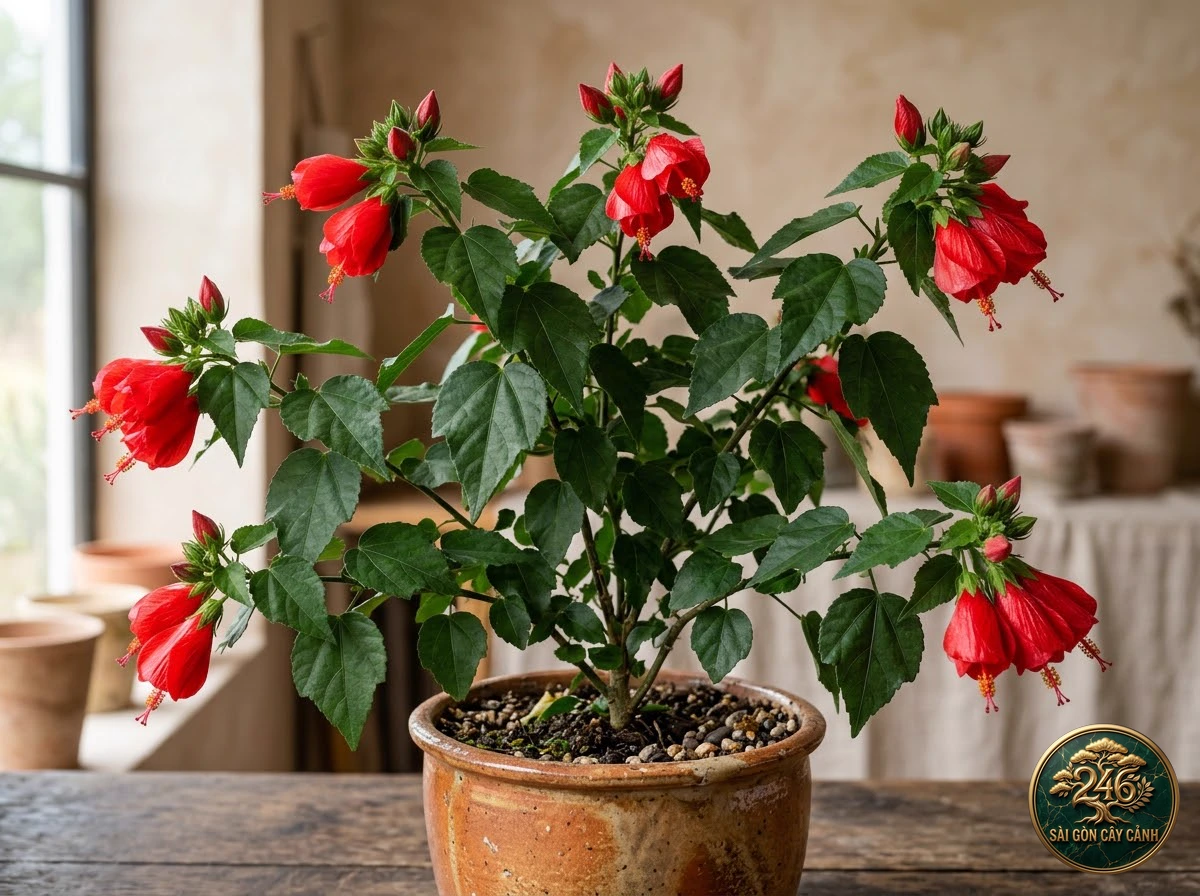
Wax mallow (Malvaviscus arboreus)
Malvaviscus arboreus, universally celebrated as Wax mallow, Turk’s cap, or sleeping hibiscus, is an enchanting tropical evergreen flowering shrub famous for its brilliant vermilion-red blossoms whose spiraled petals never unfold, creating an intriguing closed lantern form pierced by an exerted staminal column. Renowned for its vigorous constitution, year-round blooming flushes, and magnetic attraction for pollinators, this American botanical treasure elevates biophilic villa gardens.
Sài Gòn Cây Cảnh Care Compass
1. Botanical Identity & Taxonomic Nomenclature History
Malvaviscus arboreus was scientifically established by Spanish botanist Antonio Jose Cavanilles in 1787 within his foundational botanical register Monadelphiae Classis Dissertationes Decem. The generic name Malvaviscus unites Malva (the mallow genus) with Latin viscus signifying ‘sticky’ or ‘viscous’, referencing the soothing mucilage abundant in its vegetative tissues. The specific epithet arboreus denotes its tree-like woody architecture.
Positioned within the family Malvaceae, Malvaviscus arboreus ranges natively across coastal thickets and forest margins from Mexico and the Caribbean down to Colombia. Revered in American folklore as a symbol of gentle modesty and enduring devotion, it was widely adopted into international horticulture. In Vietnam, Wax mallow is cherished across discerning gardens for its distinctive twisted red lanterns, relentless year-round flowering, and robust pest resilience.
2. Morphological Anatomy & Structural Architecture

Morphologically, Malvaviscus arboreus manifests as an expansive evergreen woody shrub attaining heights of 2 to 4 meters, with supple spreading branches creating a dense, rounded crown. Stems are enveloped in smooth grey-brown bark, with young branchlets clothed in soft velvety pubescence. Leaves are alternate; blades are polymorphic ranging from broad-ovate to hastate or shallowly three-lobed measuring 6 to 14 cm long by 4 to 10 cm wide, with cordate to rounded bases, acute apices, and serrate margins, displaying a softly pubescent emerald lamina.
Blossoms are solitary, emerging from upper leaf axils on nodding pedicels. The corolla is 3 to 5 cm long, composed of five vibrant vermilion-red petals tightly furled in a spiral configuration that never unfolds, resembling a miniature hanging lantern or Turkish turban. Extending dramatically beyond the corolla tube is a slender scarlet staminal column projecting 2 to 3 cm outward, crowned by reddish-orange anthers and ten capitate stigmatic lobes. This closed floral architecture represents specialized co-evolution with hummingbird pollinators. The fruit is a fleshy 5-lobed berry ripening from scarlet to black.
3. Solar Irradiance Thresholds & Photosynthetic Dynamics
Malvaviscus arboreus exhibits remarkable ecological plasticity regarding solar irradiance, performing admirably in full sun as well as dappled understory shade. For maximum floral abundance, it requires 5 to 7 hours of direct solar exposure daily within light thresholds spanning 35,000 to 75,000 lux. Direct morning solar rays enhance compact branching architecture and saturate vermilion petal pigments.
Unlike many conventional Hibiscus species, Wax mallow displays exceptional shade tolerance; positioned in 30-40% partial shade beneath light tree canopies, it maintains lush deep-green foliage and continues regular blooming flushes. The species easily withstands extreme tropical heatwaves, rebounding swiftly following brief drought spells.
4. Mineral Substrate Mechanics & Root Aeration Porosity
The root architecture of Wax mallow consists of robust, extensively branching woody lateral roots demonstrating phenomenal hardiness across diverse soil profiles, including coastal sands, alluvial loams, and slightly alkaline substrates. For optimal vigor, the medium must guarantee good porosity, high humus content, and swift gravitational drainage to prevent anaerobic waterlogging.
The optimized potting mix developed by Saigon Cay Canh incorporates 40% fertile alluvial loam, 25% washed coco coir, 20% carbonized rice husks, and 15% aged vermicompost inoculated with Trichoderma. The ideal substrate pH ranges between 6.0 and 7.0. Generous drainage apertures lined with coarse gravel are essential in landscape planters and containers.
5. Hydraulic Equilibria & Irrigation Regimens
Hydrological management for Wax mallow adheres to balanced moderate moisture principles: soak thoroughly upon surface drying, then allow free drainage. The plant exhibits superior drought resilience once established. Standard irrigation involves deep morning soaking every 1 to 2 days during hot weather whenever the upper 2 cm of soil feels dry.
Deliver water directly to the soil perimeter; remarkably, the tightly furled corolla protects interior floral reproductive organs from heavy rainfall and mechanical damage, resisting petal rot. During continuous monsoon downpours, verify that container drainage ports remain free of debris to prevent water accumulation around the root collar.
6. Nutrient Biogeochemistry & Fertilization Protocols
To sustain perpetual 365-day flushes of vibrant red lantern blossoms and maintain dense foliar vigor, Wax mallow requires balanced, moderate nutrition. Broadcast slow-release organic bio-fertilizer pellets (NPK 6-12-12) or composted oilcake meal around the perimeter every 45 to 50 days.
During active floral bud initiation flushes, apply a water-soluble high-phosphate and high-potassium fertilizer (NPK 15-30-15) at 1 gram per liter every 10 to 12 days to stimulate heavy budding and enrich corolla saturation. Supplement with foliar sprays of chelated magnesium and zinc every two months to reinforce cellular resilience.
7. Clonal Propagation & Germplasm Conservation
Malvaviscus arboreus propagates with remarkable speed and high success via semi-hardwood stem cuttings or air-layering during warm, humid spring and summer seasons. Stem cuttings represent the prevailing commercial technique: harvest 12 to 18 cm healthy semi-lignified shoots with 3 to 4 nodes, reduce basal foliage by two-thirds, and make a clean angled cut with shears sanitized in 70% medical alcohol.
Dip the basal cut in 1,000 ppm IBA rooting powder, then insert 5 cm deep into moist sharp sand and perlite under 50% shade. Provided ambient humidity is maintained, abundant adventitious roots establish within 20 to 25 days, followed by vigorous axillary shoot growth.
8. Phytochemical Toxicity & Pet Safety Standards (ASPCA)
Botanical safety evaluation and ASPCA pet safety standards: Classified within the Malvaceae family, Malvaviscus arboreus is officially recognized as non-toxic and pet-safe under standard ASPCA companion animal guidelines. The species poses zero chemical poisoning hazards to dogs, cats, or horses, synthesizing no hazardous cardiac glycosides or toxic alkaloids.
In its native American ranges, blossoms and tender leaves are safely brewed into traditional herbal infusions. Nonetheless, to preserve pristine floral architecture and prevent mechanical digestive discomfort from ingesting fibrous foliage, site specimens mindfully. During routine maintenance pruning, sanitize shears with 70% medical alcohol to ensure rigorous garden phytosanitary care.
9. Clinical Pathology Diagnostics & Treatment Strategies
Clinical screening for aphid suppression and structural pruning to stimulate perpetual lantern flushes in Malvaviscus arboreus:
| Clinical Manifestation | Etiological Cause | Standard Treatment Protocol |
|---|---|---|
| Lantern flower buds blacken at tips and fail to exert staminal column | Thrips piercing soft petal tissue within epicalyx bracts during early bud formation | Apply fine spray of dilute organic horticultural mineral oil at dawn to safeguard developing lantern buds |
| Undersides of leaves show white mealybug colonies clustered along primary veins | Mealybugs extracting sap, depressing photosynthesis, and secreting honeydew that fuels sooty mold | Wipe axillary pest colonies with 70% medical alcohol, then apply organic potassium insecticidal soap |
| Branches suffer localized foliar yellowing and leaf shedding following short dry spells | Abrupt moisture stress during canopy expansion causing sacrificial shedding of older foliage | Restore consistent balanced irrigation and apply aged organic mulch around the root collar of Wax mallow |
10. Comparative Morphology & Allied Taxa Diagnosis
Morphological comparative matrix contrasting permanently convolute tubular corollas and exerted staminal column of Malvaviscus arboreus:
| Diagnostic Parameter | Malvaviscus arboreus (Wax mallow) | Comparative Specimen A | Comparative Specimen B |
|---|---|---|---|
| Floral Architecture | Tubular spiraled corolla that never unfurls, pierced by a long exerted staminal column | Colossal corolla 10-18 cm across with flat spreading petals and long exerted staminal column | Dense multi-petaled double bloom displaying miraculous diurnal chromatic shifts |
| Shade Tolerance | Exceptional partial shade tolerance (30-40%), thriving and blooming beneath high tree canopies | Strict full-sun heliophyte, suffering severe bud drop and etiolation in shade | Full-sun heliophyte requiring intensive solar rays to fuel diurnal color shifts |
| Petal Substance & Resilience | Thick waxy corolla lobes resisting rainstorms and mechanical damage without rotting | Thin silky delicate petals susceptible to tearing and waterlogging during deluges | Soft multi-layered ruffled petals heavily influenced by temperature and moisture |
11. Biophilic Design Harmony & Contemporary Spatial Aesthetics

In architectural landscape design and Eastern biophilic philosophy, Wax mallow embodies modest grace, enduring loyalty, nurturing protection, and auspicious domestic blessing. The glowing vermilion lantern blossoms illuminating the garden evoke warmth, dispelling gloom and welcoming dynamic living vitality.
The shrub is ideally suited for sweeping floral hedges framing luxury villa perimeters, understory flowering clusters beneath high canopy trees, vibrant walkway borders across eco-resorts, or dramatic container focal points accentuating shaded terraces and verandas.
12. Saigon Cay Canh Provenance & Cultivation Assurance

Saigon Cay Canh curates and delivers verified acclimated Malvaviscus arboreus selections, featuring established root systems, dense branching frameworks, and prolific developing red lantern buds ready for immediate landscape integration.
We provide 100% certified international botanical taxonomy, professional pruning schedules to stimulate continuous flowering cycles, and comprehensive establishment guarantees across all distinguished residential and commercial developments.
💬 Góc Tư Vấn & Hướng Dẫn Kỹ Thuật SGCC
Chuẩn E-E-A-T Kinfolk❓ Chăm sóc Wax mallow (Malvaviscus arbo cần lưu ý điều gì quan trọng nhất?
💡 Dạ điều quan trọng nhất là giữ môi trường sống ổn định, tránh sốc nhiệt hay dao động thông số đột ngột, đồng thời cung cấp khẩu phần ăn sạch và tươi mới ạ.
❓ Làm thế nào để phòng ngừa bệnh tật hiệu quả cho các bé?
💡 Dạ anh chị nên giữ vệ sinh chuồng/hồ nuôi sạch sẽ, thay nước hoặc dọn dẹp định kỳ và bổ sung vitamin, men tiêu hóa đều đặn để tăng sức đề kháng ạ.
🌿 Trang Thiết Bị, Đất Trồng & Dụng Cụ Bonsai Tuyển Chọn
Dụng cụ tỉa, giá thể hữu cơ & phân bón chuyên dụng cho cây cảnh.

chậu đất nung bầu có chân sơn wax xuất khẩu tiêu chuẩn …

chậu đất nung bầu kim cương hoạ tiết hoa wax xuất khẩu …

Chậu gốm đất nung xuất khẩu Wax mộc, trồng cây xanh sen…

Chậu trồng cây, chậu đất nung wax màu trắng cà phê bông…

chậu đất nung trồng sen nước trứng sọc dọc sơn wax xuất…

chậu đất nung thau mạ đồng sơn wax xuất khẩu tiêu chuẩn…

Phân Bón Lá Đầu Trâu 901 Hũ 100g – Kích Hoa Đồng Loạt, …

Kéo Cắt Cành Siêu Sắc Kéo Tỉa Cành Dụng cụ Làm Vườn Đa …

chậu bonsai mini – sen đá- xương rồng men hỏa biến gốm …

Bộ Ống Vòi Xịt Rửa Xe 8 Chế Độ Đầu Nối Vòi Nước Đa Năng…

keo liền da,liền sẹo cho cây Mỹ Tiến (100g)

5kg Phân Trùn Quế 100% nguyên chất SFARM PB01 dạng bột_…

Busy Lizzie (Impatiens walleriana)
Busy Lizzie (Impatiens walleriana) Impatiens walleriana, internationally celebrated as busy Lizzie, sultana, or patient Lucy, is a luxuriant...
Read Monograph →
Oakleaf hydrangea (Hydrangea quercifolia)
Oakleaf hydrangea (Hydrangea quercifolia) Hydrangea quercifolia, internationally celebrated as oakleaf hydrangea, is an awe-inspiring, structurally dramatic deciduous flowering...
Read Monograph →
Scarlet wrightia
Wrightia coccinea, celebrated among connoisseurs of rare tropical flora as scarlet wrightia or red jasmine tree, is a...
Read Monograph →
Spiny spiderflower
Cleome spinosa, universally celebrated in ornamental horticulture as spiny spiderflower, spider plant, or pink queen, is an aristocratic,...
Read Monograph →Expert Q&A, Recommended Supplies & Article Feedback
Tap once to connect instantly via Google, Facebook or TikTok — no long forms required!
No questions yet for this article. Tap Google / Facebook / TikTok above to ask the first question!