Living plant profile
Winged spurge
Euphorbia grandialata
Euphorbia Euphorbiaceae Living Herbarium Master V2 Winged Spurge (Euphorbia grandialata): Sinuous Flanged Wings, Chevron Variegation and Arid Horticulture Scientific Name: Euphorbia grandialata R.A.Dyer Common Name: Winged Spurge Family: Euphorbiaceae Native Range: Limpopo and Mpumalanga, South Africa Euphorbia grandialata is a dramatic South African succulent shrub featuring deeply scalloped sinuous wings marked with pale green chevron […]
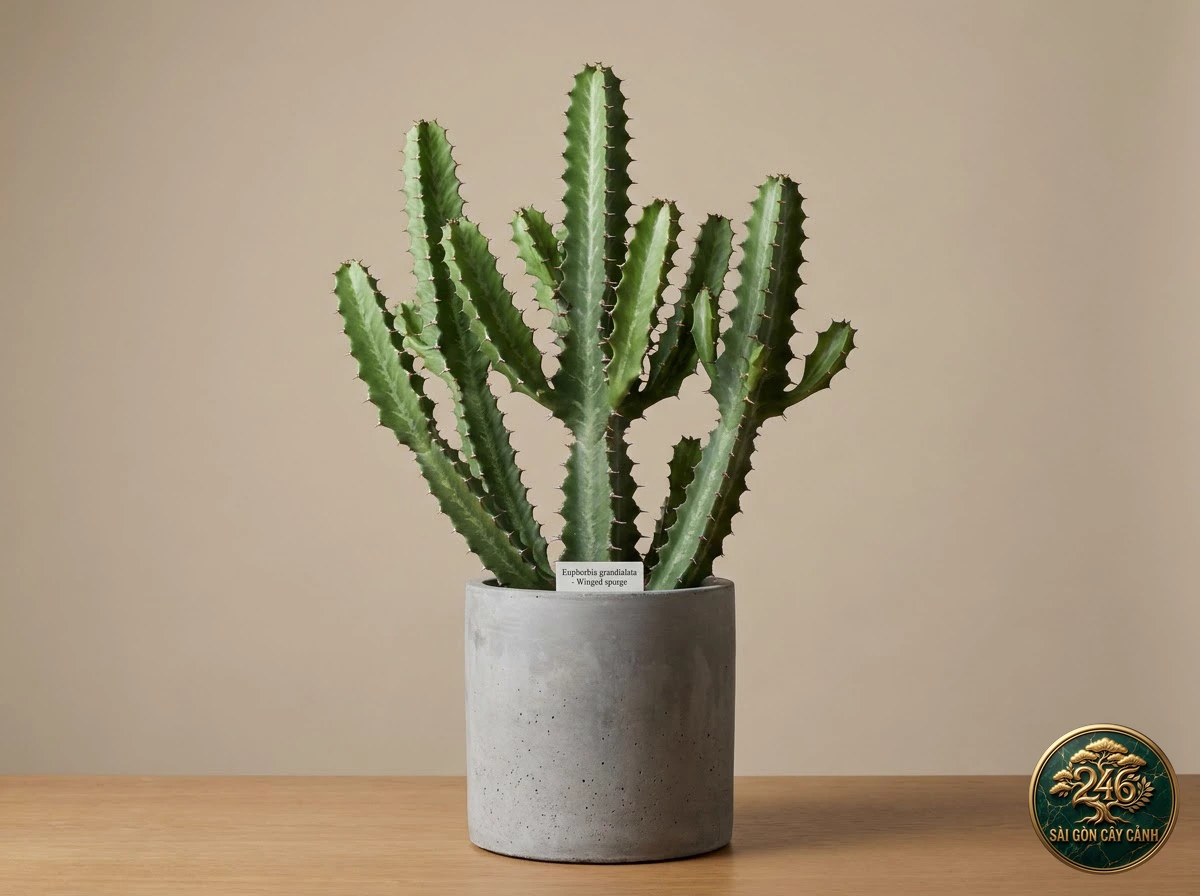
Winged Spurge (Euphorbia grandialata): Sinuous Flanged Wings, Chevron Variegation and Arid Horticulture
Common Name: Winged Spurge
Family: Euphorbiaceae
Native Range: Limpopo and Mpumalanga, South Africa
Euphorbia grandialata is a dramatic South African succulent shrub featuring deeply scalloped sinuous wings marked with pale green chevron striping and stout paired spines.
Sài Gòn Cây Cảnh Care Compass
1. Geographic Origin & Taxonomic Nomenclature History
Euphorbia grandialata was scientifically published by South African botanist Robert Allen Dyer in 1937. The species inhabits arid rocky savanna valleys across Limpopo and Mpumalanga, South Africa.
Its crowning taxonomic feature is broad deeply undulating sinuous wings accented by pale green V-shaped chevron markings and formidable paired spines.
2. Morphological Architecture & Anatomical Specializations
Wing anatomy reveals that sinuous undulating margins act as aerodynamic cooling flutes while casting self-shading micro-shadows across ribs during peak solar angles.
Expansive horny spine shields support rigid paired thorns up to two centimeters long, forming an impenetrable barrier guarding high-pressure internal diterpene canals.
3. Photosynthetic Radiance & Urban Microclimate Dynamics
Light requirements center upon bright filtered sunshine with gentle morning exposure between 4,000 and 8,000 lux; critical to maintain vivid chevron contrast and deep wing folds.
Situate containers on sheltered breezy verandas or bright sunny living areas to encourage symmetrical lateral branching without foliar distortions.
4. Mineral Substrate Engineering & Fast Percolation Dynamics
Substrate formulation mandates heavy gritty minerals: 45% pumice, 25% crushed volcanic rock, 15% perlite, and 15% seasoned loamy compost.
High mineral porosity allows water to pass swiftly through container drainage ports, supplying continuous oxygen to active feeder rootlets.
5. Biological Irrigation Protocols & Seasonal Rhythm
Hydration protocols observe disciplined dry-down intervals: deep soak every ten to fourteen days during warm months only after 80-90% core soil desiccation.
During humid rainy periods, widen watering intervals to three or four weeks to stimulate deep exploratory rooting while protecting root crowns from rot.
6. Trace Mineral Nutrition & Slow-Release Fertility Protocols
Administer cold-extracted liquid kelp fertilizer at mild concentration bimonthly in summer flushes, enhancing crisp definition along variegated chevron bands.
Avoid excessive synthetic fertilizers that soften undulating wing margins and dilute the striking chromatic contrast of stem markings.
7. Vegetative Propagation Protocols & Aseptic Methodology
Propagate by taking semi-hardwood lateral branch cuttings in spring using a sterile blade, rinsing sap under cool water, and sealing wounds with activated charcoal.
Allow cuttings to cure in airy dry shade for fifteen days until a tough suberized shield forms before anchoring in damp mineral grit.
8. Botanical Toxicity Profile & Contact Protocols
Milky latex in Euphorbia grandialata contains caustic diterpene esters capable of provoking severe oral mucosal irritation and dermal blistering upon unshielded contact.
Always wear goggles and sturdy gloves when pruning; prevent toxic latex splashes from touching skin, eyes, or household furnishings.
9. Physiological Diagnostics & Integrated Pest Management
The diagnostic pathological table below assists growers in identifying and resolving common cultivation challenges on winged spurges:
| Clinical Symptom | Primary Root Cause | Standard Corrective Protocol |
|---|---|---|
| Chevron variegation fades and wing margins turn solid green | Inadequate photosynthetic irradiance in dim indoor positions | Relocate to brighter ambient exposure to reactivate contrasting markings |
| Undulating wing edges become watery, soft and yellowish | Bacterial soft rot from overwatering in stagnant air | Excise decayed margin with sterile tool, apply sulfur powder, dry 10 days |
| New apical segments emerge constricted and deformed | Sudden thermal fluctuation or severe erratic moisture stress | Establish consistent watering cadence under warm stable room temperatures |
| Mealybugs nestling behind large horny spine shields | Pests exploiting protective spine bases to tap vascular sap | Dab directly with 70% alcohol-moistened cotton swab, follow with neem spray |
10. Comparative Taxonomic Evaluation Across Allied Taxa
The taxonomic rubric below delineates diagnostic distinctions separating Euphorbia grandialata from allied undulating winged spurges:
| Species Taxon | Morphological Trait | Growth Architecture | Diagnostic Indicator |
|---|---|---|---|
| Wing Undulation Amplitude | Exceedingly deep sinuous scalloped wing flanges | Straight or mildly undulate vertical ribs | Cylindrical cladodes lacking wings entirely |
| Foliar Chevron Patterning | Distinct pale V-shaped chevrons radiating between spines | Continuous longitudinal milky-white marbled stripe | Monochrome green or yellow-orange without stripes |
| Spine Shield Stature | Formidable paired spines 1-2 cm long from prominent shields | Short paired spines under 0.5 cm along margins | Entirely spineless smooth twigs |
| Branching Architecture | Basal branching forming expansive sculptural clusters | Erect vertical branching into a tall candelabrum | Dense intricate coral-like branching habit |
11. Urban Landscape Architecture & Living Display Design
The sinuous sculptured wings and geometric chevron bands of Euphorbia grandialata deliver high architectural impact when potted in ash-grey stoneware.
It functions as an arresting living sculpture for modern living spaces, art galleries, or minimalist luxury villa terraces.
Nursery Care Journal & Living Greenery Moments
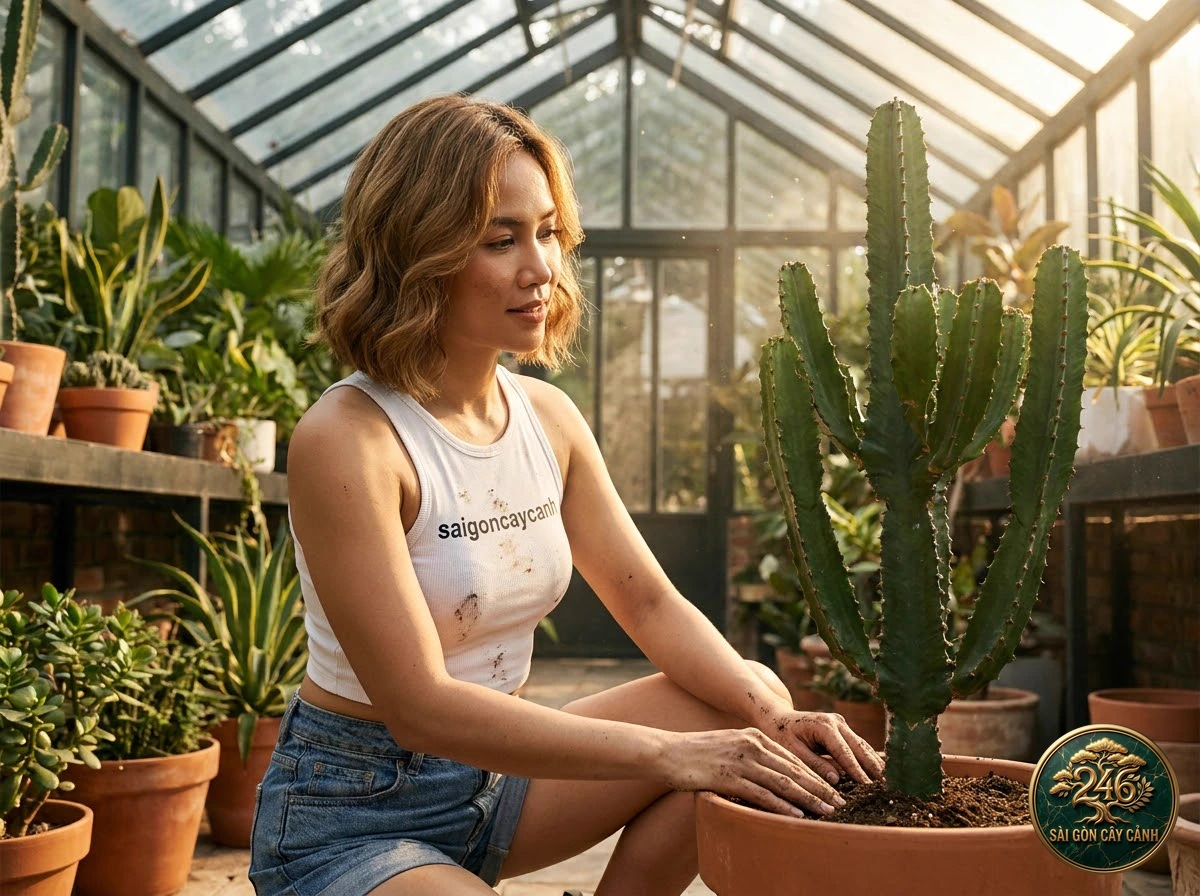
At Saigon Cay Canh greenhouse, each photograph captures genuine everyday care moments between plant lovers and living greenery, spreading a passion for nature and green-living inspiration.