
Living plant profile
Mother of cholls cactus
Mammillaria compressa
Mammillaria Cactaceae Living Herbarium Master V2 Mother of Hundreds (Mammillaria compressa): Caespitose Mound Architecture, Curved Spines and Xeriscape Culture Scientific Name: Mammillaria compressa DC. Common Name: Mother of Hundreds / Clumping Pincushion Family: Cactaceae Native Range: Central Mexico (Hidalgo, Queretaro, San Luis Potosi) Mammillaria compressa is a magnificent clumping Mexican cactus forming massive caespitose colonies […]
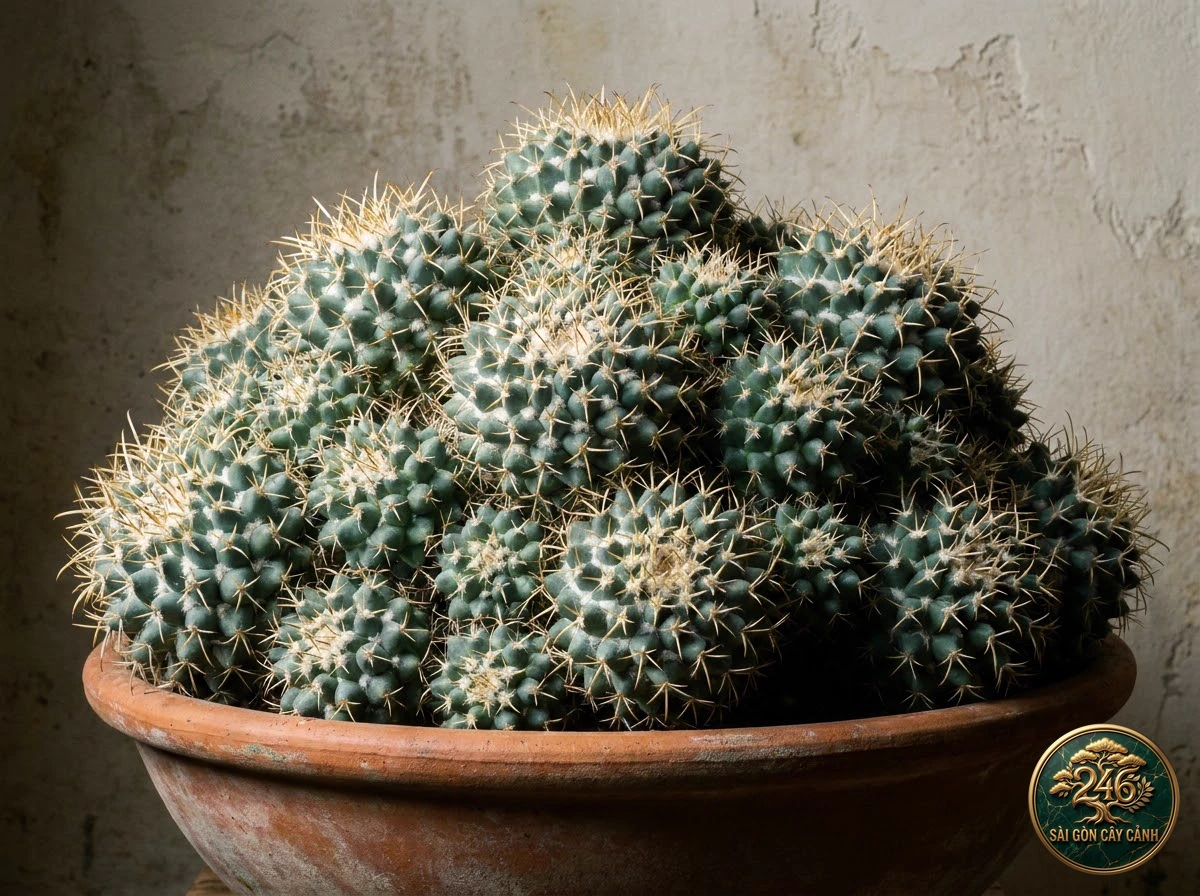
Mother of Hundreds (Mammillaria compressa): Caespitose Mound Architecture, Curved Spines and Xeriscape Culture
Common Name: Mother of Hundreds / Clumping Pincushion
Family: Cactaceae
Native Range: Central Mexico (Hidalgo, Queretaro, San Luis Potosi)
Mammillaria compressa is a magnificent clumping Mexican cactus forming massive caespitose colonies of bluish-green stems adorned with stout curved spines and woolly axils.
Sài Gòn Cây Cảnh Care Compass
1. Geographic Origin & Taxonomic Nomenclature History
Mammillaria compressa was scientifically established by Augustin Pyramus de Candolle in 1828. This monumental clumping cactus spans dry limestone valleys across Hidalgo, Queretaro, and San Luis Potosi, central Mexico.
It exhibits extraordinary caespitose vigor forming expansive mounds of dozens to hundreds of globes, adorned with angular curved ivory spines and dense snow-white axillary wool.
2. Morphological Architecture & Anatomical Specializations
Stem anatomy displays angular pyramidal bluish-green tubercles coated in pruinose glaucous wax, bearing four to six stout curved spines measuring two to seven centimeters in length.
Deep axils are densely packed with snow-white wool and stiff bristles, forming an insulative microclimate sheltering embryonic flower buds from scorching desert heat.
3. Photosynthetic Radiance & Urban Microclimate Dynamics
Culture requires generous direct sunlight between 4,500 and 8,500 lux; intense irradiance is essential to harden curved horn spines and stimulate dense white axillary wool.
Position large specimen bowls on open sunny terraces, rockeries, or breezy balconies where continuous cross-ventilation circulates between congested branches.
4. Mineral Substrate Engineering & Fast Percolation Dynamics
Substrate engineering mandates a durable gritty mineral mix: 45% pumice, 25% red volcanic scoria, 15% perlite, and 15% sandy loamy vermicompost.
Granular porosity permits rapid drainage through wide shallow pots, eliminating stagnant dampness around crowded branch junctions.
5. Biological Irrigation Protocols & Seasonal Rhythm
Hydration cycles observe disciplined intervals every ten to fourteen days during warm seasons, moistening thoroughly only after 85-90% soil desiccation.
During humid rainy periods, widen watering intervals to three or four weeks to preserve stem firmness and protect the subterranean root mass from fungal decay.
6. Trace Mineral Nutrition & Slow-Release Fertility Protocols
Scatter slow-release organic microbial pellets bimonthly in spring and summer to supply steady foundation nourishment for dozens of proliferating offsets.
Naturally available minerals reinforce horn-like spine rigidity and maintain the characteristic pruinose blue-green cuticular glaze.
7. Vegetative Propagation Protocols & Aseptic Methodology
Mammillaria compressa propagates effortlessly by detaching peripheral pup globes in spring using a sterile scalpel.
Cure pup cuttings in airy dry shade for seven days until cut surfaces suberize into firm woody plugs before potting into barely damp mineral grit.
8. Botanical Toxicity Profile & Contact Protocols
This clumping cactus is entirely pet-friendly and free of toxic alkaloids under ASPCA veterinary standards.
Growers only need to note that stout curved spines present minor mechanical scratch risks, warranting placement with comfortable clearance.
9. Physiological Diagnostics & Integrated Pest Management
The clinical monitoring rubric below outlines identifiable physiological symptoms and responsive nursery remedies for clumping mother of hundreds cacti:
| Clinical Symptom | Primary Root Cause | Standard Corrective Protocol |
|---|---|---|
| Axillary wool turns dirty black and mats flat | Water and airborne dust collecting inside deep woolly crevices | Switch to perimeter or sub-irrigation; use gentle airflow to dry wool |
| Interior offsets within dense mound yellow and soften | Overly congested clump suffocating inner stems under low light | Thin out crowded interior pups to restore cross-ventilation |
| Curved spines emerge soft and pale brownish | Insufficient direct solar photons to drive cuticle hardening | Move container to open terrace receiving 4-5 hours direct daily sun |
| Mealybug colonies nesting deep between crowded branches | Pests exploiting tight contact junctions between adjacent stems | Target spray with pressurized diluted 70% alcohol solution to flush colonies |
10. Comparative Taxonomic Evaluation Across Allied Taxa
The comparative matrix below delineates definitive morphological traits separating Mammillaria compressa from allied caespitose pincushion spurges:
| Species Taxon | Morphological Trait | Growth Architecture | Diagnostic Indicator |
|---|---|---|---|
| Growth Habit | Expansive caespitose mounds of dozens to hundreds of stems | Modest basal clumping into compact clusters | Predominantly solitary globes clumping sparsely |
| Spine Architecture | 4 to 6 stout angular curved horn-like spines | 15-20 star-radiating golden yellow spines | Soft feathery plumose radial spines |
| Axillary Wool | Copious snow-white wool and bristles packing stem axils | Axils relatively bare without prominent wool puffs | Entire body enveloped in plumose down |
| Bloom Characteristics | Small bell-shaped purplish-red flowers in apical rings | Tiny cream-yellow tubular florets | Vivid magenta-violet blossoms |
11. Urban Landscape Architecture & Living Display Design
The monumental scale of a mature Mammillaria compressa specimen bowl packed with dozens of globes provides breathtaking architectural xeriscape impact.
It stands as a living emblem of fertility, abundance, and familial unity, commanding admiration and natural grandeur in contemporary gardens.
Nursery Care Journal & Living Greenery Moments
At Saigon Cay Canh greenhouse, each photograph captures genuine everyday care moments between plant lovers and living greenery, spreading a passion for nature and green-living inspiration.