
Living plant profile
African milk tree
Euphorbia trigona
Euphorbia Euphorbiaceae Living Herbarium Master V2 African Milk Tree (Euphorbia trigona): Architectural Winged Morphology, Latex Toxicity and Care Protocols Scientific Name: Euphorbia trigona Mill. Common Name: African Milk Tree / Cathedral Cactus Family: Euphorbiaceae Native Range: Central Africa (Zaire, Gabon, Angola) Euphorbia trigona is a dramatic succulent shrub distinguished by upright 3-winged ribbed stems marbled […]
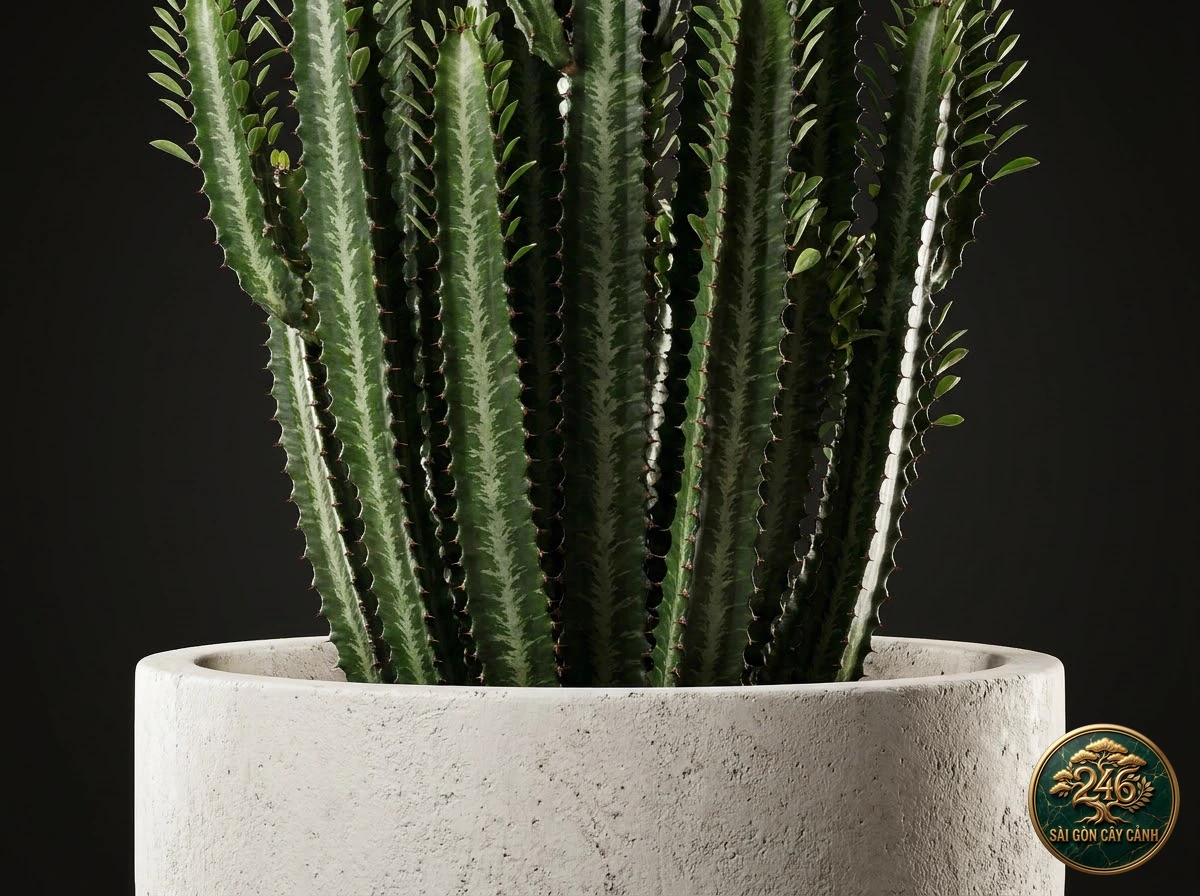
African Milk Tree (Euphorbia trigona): Architectural Winged Morphology, Latex Toxicity and Care Protocols
Common Name: African Milk Tree / Cathedral Cactus
Family: Euphorbiaceae
Native Range: Central Africa (Zaire, Gabon, Angola)
Euphorbia trigona is a dramatic succulent shrub distinguished by upright 3-winged ribbed stems marbled with creamy-white chevron patterns, paired stipular spines, and ephemeral drop-shaped foliar crests.
Sài Gòn Cây Cảnh Care Compass
1. Geographic Origin & Taxonomic Nomenclature History
Euphorbia trigona was formally established by Philip Miller in 1768. This majestic columnar succulent originates from dry tropical savannas of Central Africa, notably across Zaire, Gabon, and Angola.
Stems evolved into three flanged sinuous ribs marked with milky chevron variegation, bearing ephemeral teardrop leaflets and paired stipular spines to deter herbivores.
2. Morphological Architecture & Anatomical Specializations
Stem cross-sections reveal specialized high-pressure laticifer canals transporting milky latex rich in defensive diterpene esters throughout vegetative tissues.
Lightly suberized outer epidermal cells form a resilient tough dermal layer, supporting multi-meter vertical growth against powerful savanna gusts.
3. Photosynthetic Radiance & Urban Microclimate Dynamics
Optimum growth requires intense filtered daylight or direct morning rays between 4,000 and 8,000 lux; cultivar Rubra demands ample sunlight to sustain deep burgundy coloration.
Locate pots in spacious living areas with large south-facing windows or breezy verandas to foster erect vertical columns with tight internodal spacing.
4. Mineral Substrate Engineering & Fast Percolation Dynamics
Substrate architecture requires substantial ballast to prevent top-heaviness: mix 40% pumice, 20% volcanic scoria, 20% perlite, and 20% well-drained sandy loam.
Granular mineral porosity facilitates rapid drainage following heavy waterings, providing oxygen continuously to extensive root systems within deep planters.
5. Biological Irrigation Protocols & Seasonal Rhythm
Hydration follows a thorough soak-and-dry regimen, applied every ten to fourteen days during warm seasons only after substrate desiccates 80%.
During prolonged overcast or rainy weather, extend drying intervals to three or four weeks to safeguard basal stems against opportunistic soil fungi.
6. Trace Mineral Nutrition & Slow-Release Fertility Protocols
Feed with diluted clarified vermicompost tea at one-fifth standard strength during summer growth flushes, fueling vibrant new leaf clusters along stem crests.
Avoid excessive chemical nitrogen that forces soft, lanky growth, preserving firm architectural integrity and crisp variegated chevrons.
7. Vegetative Propagation Protocols & Aseptic Methodology
Sever branch cuttings with a sterile sharp knife, dipping bases immediately into cool water to staunch sap flow, followed by an activated charcoal dusting.
Rest cuttings in dry shaded airflow for fifteen days until cut ends form a tough suberized callus before inserting into barely damp mineral grit to root.
8. Botanical Toxicity Profile & Contact Protocols
The milky latex of Euphorbia trigona contains potent diterpene esters capable of provoking acute dermal inflammation and severe keratoconjunctivitis upon eye contact.
Protective eyewear and heavy rubber gloves are mandatory when pruning; position plants safely away from narrow family pathways or playful domestic animals.
9. Physiological Diagnostics & Integrated Pest Management
The clinical physiological chart below outlines recognizable stress manifestations and corrective actions:
| Clinical Symptom | Primary Root Cause | Standard Corrective Protocol |
|---|---|---|
| Small leaflets drop en masse along stem ridge crests | Environmental shock from sudden relocation, temporary drought or low light | Check soil moisture, rehydrate moderately if parched, provide bright morning light |
| Stem base turns soft blackish-brown and collapses | Overwatering causing basal stem rot through Fusarium fungal invasion | Sever top healthy stem 5cm above rot, seal cut with sulfur, dry 7 days and reroot |
| Columnar stems stretch pale and narrow, losing architectural stiffness | Etiolation caused by prolonged low photon levels in dark indoor corners | Gradually acclimate to brighter sunny exposure over two weeks to restore vigor |
| Milky white fluid bleeds abundantly from accidental abrasion | Mechanical breakage rupturing pressurized internal laticifer tubes | Blot sap immediately with paper towel; flush skin thoroughly with cool water if exposed |
10. Comparative Taxonomic Evaluation Across Allied Taxa
The diagnostic matrix below outlines morphological traits differentiating Euphorbia trigona from neighboring succulent columnar spurges:
| Species Taxon | Morphological Trait | Growth Architecture | Diagnostic Indicator |
|---|---|---|---|
| Stem Architecture | 3-winged wavy ridges marbled with milky chevrons and leaflets | Smooth cylindrical green branchlets resembling branching coral | Spherical spineless globe lacking wings or prominent leaves |
| Foliar Persistence | Teardrop leaflets emerge and persist along ridge crests | Ephemeral micro-leaves drop swiftly, stems photosynthesize | Completely leafless throughout mature growth stages |
| Spine Morphology | Paired short sharp stipular spines flanking leaf bases | Spineless, branching slender smooth green twigs | Entirely spineless with minute button-like floral scars |
| Latex Danger Profile | Copious diterpene latex causing severe contact dermatitis | Potent vesicant diterpene latex posing acute ocular hazard | Latex present internally but rarely discharged unless punctured |
11. Urban Landscape Architecture & Living Display Design
The commanding columnar stature and milky chevrons of Euphorbia trigona deliver high architectural impact within sophisticated contemporary interiors.
Housed in tall composite or polished concrete vessels, this species serves as a living sculptural monument accentuating modernist living zones.
Nursery Care Journal & Living Greenery Moments
At Saigon Cay Canh greenhouse, each photograph captures genuine everyday care moments between plant lovers and living greenery, spreading a passion for nature and green-living inspiration.