
Living plant profile
Lace Aloe (Aloe aristata): Aristate Morphology, Thermal Tolerance and Indoor Tabletop Cultivation
Aloe aristata
Sai Gon Cay Canh • Living Herbarium V2 Lace Aloe (Aloe aristata): Aristate Morphology, Thermal Tolerance and Indoor Tabletop Cultivation Aloe aristata (Aristaloe aristata) is a delightful dwarf succulent revered for delicate aristate bristle tips adorning each leaf, dense white tuberculate patterning, and a neat spherical rosette silhouette. Record ID: SGCC-PLANT-00536 Scientific Name: Aloe aristata […]

Lace Aloe (Aloe aristata): Aristate Morphology, Thermal Tolerance and Indoor Tabletop Cultivation
1. Botanical Morphology & Ecological Adaptations
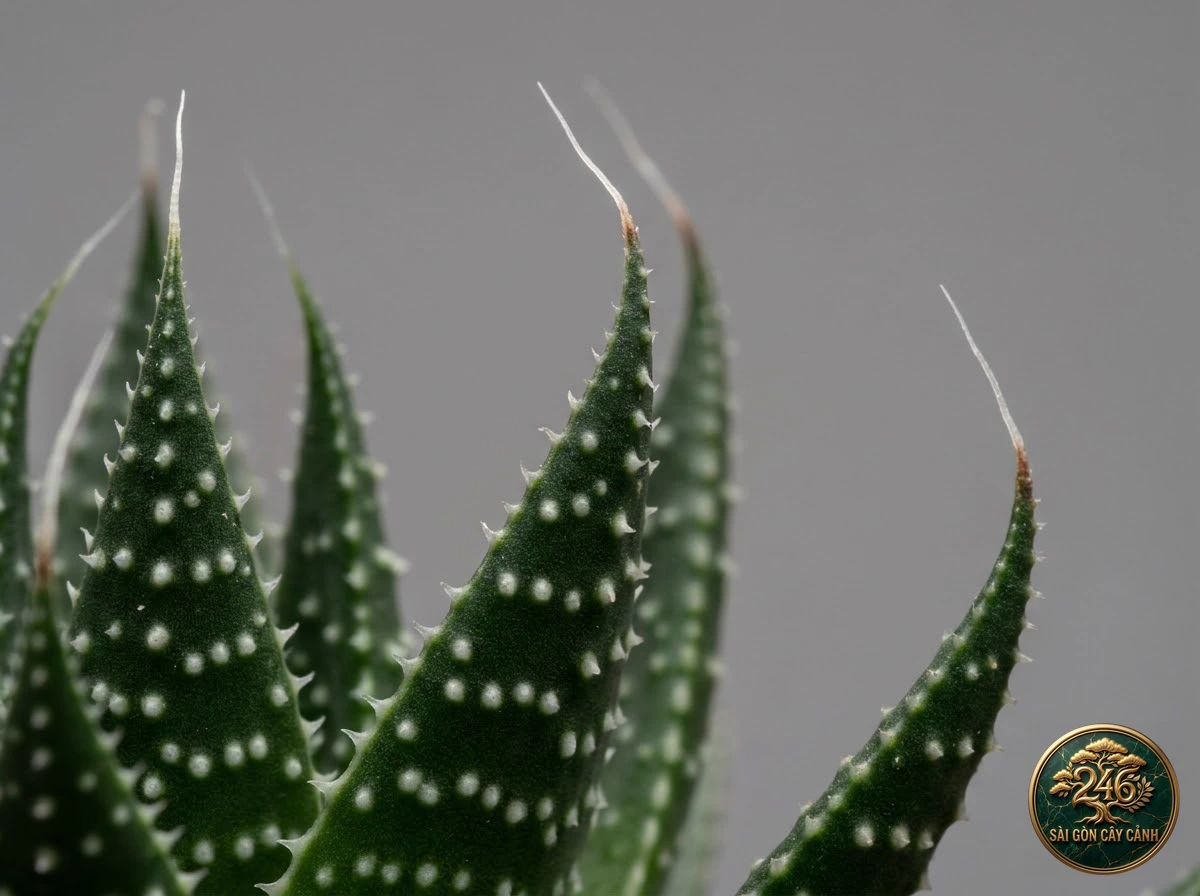
Aloe aristata, widely recognized under the vernacular name Lace Aloe / Torch Plant, is a highly distinguished succulent perennial belonging to the family Asphodelaceae. Native to the ecologically diverse landscapes of South Africa (Karoo & Free State), this species has evolved sophisticated anatomical adaptations to endure severe seasonal droughts, rocky scree terrain, and fluctuating thermal regimes.
Aloe aristata (Aristaloe aristata) boasts an exquisitely symmetrical dense rosette packed with dark green lanceolate leaves dotted with soft white tubercles. Each leaf apex terminates in a long translucent thread-like bristle (arista), providing unmistakable identification.
The fibrous root system of Aloe aristata is compact yet grips tenaciously into chilly montane Drakensberg gravels, affording rare light-frost tolerance. Tubular pinkish-orange florets emerge on slender 30 cm scapes.
2. Taxonomic Chronicle & Botanical History
Aloe aristata (Lace Aloe) was scientifically described in 1825 by English botanist and entomologist Adrian Hardy Haworth in the Philosophical Magazine. The specific epithet aristata derives from Latin arista meaning an awn or bristle, perfectly capturing the delicate white hair-like terminal filament projecting from every leaf apex. Because it exhibits morphological and floral characteristics bridging Aloe and Haworthia, botanist Gordon Douglas Rowley in 2014 established the monotypic genus Aristaloe, transferring the taxon to Aristaloe aristata (Haw.) Boatwr. & J.C.Manning, marking a milestone in modern succulent systematics.
3. Histological Specialization & CAM Photosynthetic Pathway
Anatomically, Aloe aristata is a microscopic wonder of montane rock-crevice survival: deltoid leaves pack tightly into an immaculate spherical rosette. Both adaxial and abaxial epidermal surfaces are adorned with hundreds of pearlescent white tubercles arranged in intricate transverse rows that scatter rainfall droplets and suppress cuticular transpiration. The terminal aristate bristle functions as a tactile sensor and atmospheric dew condenser, capturing moisture from morning fog and channeling micro-droplets along foliar keels directly to the root collar. Its root cells harbor concentrated soluble sugars that impart frost hardiness down to -5°C.
4. Comprehensive Care Compass (Care Compass 360°)
La bàn chăm sóc Sài Gòn Cây Cảnh
5. Diagnostic Pathology & Clinical Horticultural Interventions
The apical foliar arista on Aloe aristata functions as a moisture gauge: withered or broken hair-tips indicate dry air stress or compromised root absorption.
| Observed Physical Symptom | Etiological Factor / Pathology | Horticultural Intervention Protocol |
|---|---|---|
| Terminal aristate bristles wither, snap off and discolor | Excessive dry ambient heat or physical contact with scorching window glass | Move container back from sun-baked panes, elevate ambient tabletop humidity |
| Central apical crown decays into mushy brown necrosis | Stagnant irrigation water trapped within dense rosette core overnight | Wick away pooled moisture using paper towel, adopt bottom-wicking watering method |
| Rosette flattens out, loses tight spherical globe conformation | Inadequate photosynthetic light triggering foliar horizontal spreading | Relocate to brighter diffused window sill or provide 15W LED desk grow light |
| Dense basal offsets crowd parent crown causing asymmetrical distortion | Prolific vegetative pup proliferation competing for root space | Excise offsets cleanly using sterilized blade, pot up individually into 7cm containers |
6. Infrageneric Taxonomic Differentiation Matrix
The diagnostic matrix below clarifies boundaries differentiating Lace Aloe (Aloe aristata) from superficially similar Haworthia and Haworthiopsis species:
| Taxonomic Characteristic | Aloe aristata (Lace Aloe / Torch Plant) | Comparative Counterpart A | Comparative Counterpart B |
|---|---|---|---|
| Apex Feature | Distinctive flexible white hair-like bristle (arista) 1 – 2 cm | Sharp rigid lignified terminal spine without bristle | Blunt obtuse apex without spine or hair |
| Rosette Diameter | Neat compact sphere measuring 10 – 15 cm across | Massive spreading rosette reaching 60 – 150 cm across | Medium-sized architectural clump 25 – 40 cm across |
| Epidermal Tubercles | Dense raised white pearlescent pustules across both faces | Smooth waxy epidermis or flat subterranean speckles | Distinct longitudinal parallel deep green veins |
| Cold Tolerance | Exceptional cold resistance down to 5°C – 8°C (41°F – 46°F) | Sensitive to chilling injury, halts growth below 12°C | Strictly adapted to warm tropical conditions |
7. Vegetative Propagation & Offsetting Protocols
Propagating Aloe aristata is delightfully uncomplicated due to prolific basal pup production around the mother rosette. A robust specimen generates 5 to 8 offsets each active growing season. Once offsets attain 3 to 5 cm in diameter, insert a sterilized craft scalpel into the subterranean junction, detach cleanly, dust with charcoal powder, and dry in shade for 3 days. Pot into small vessels filled with fine pumice, perlite, and biochar; offsets anchor tenaciously and produce new aristate bristles within 10 days.
8. Phytopathology & Integrated Pest Management
The most perilous pathology confronting Aloe aristata is apical crown rot caused by water stagnation within dense foliar crevices. When moisture lingers overnight in unventilated rooms, opportunistic oomycetes attack the tender apical meristem, collapsing the rosette from the center outward. Prevention relies upon the golden rule of watering: utilize bottom-wicking or perimeter hydration exclusively, never sprinkling water overhead into the crown. If early central moisture pooling is detected, wick it away immediately with tissue and increase convective airflow.
9. Companion Planting & Xerophytic Groupings
With its compact spherical globe habit and refined aristate filaments, Aloe aristata harmonizes impeccably alongside crystalline Haworthia cooperi, cryptic Lithops living stones, and aromatic Plectranthus. Blending these lacy globes with glassy windowed succulents inside an artisan planter creates an enchanting desktop wonderland that sparks botanical curiosity and horticultural joy.
10. Spatial Placement & Interior Architectural Styling
Aloe aristata reigns supreme in modern tabletop botanical design. Compactly reaching 10 to 15 cm in diameter, it pairs exquisitely with handcrafted ceramic bowls, miniature unglazed terracotta, or hollowed river stones. Displayed alongside a laptop monitor, upon an intimate tea table, or on a bedroom windowsill, it imparts intricate living elegance and a soothing touch of organic perfection to urban dwellings.
11. Urban Apartment Microclimates & Architectural Cultivation
Aloe aristata adapts with exquisite finesse to contemporary apartment interiors. Compactly proportioned with delicate aristate filaments, it thrives upon executive consoles, timber shelves, or sunny bedroom sills. Shield from direct air-conditioning drafts and employ bottom saucers for sub-irrigation.
Within apartment interiors, Aloe aristata (Aristaloe aristata) performs impeccably upon work desks, deep windowsills, or living room shelving. Preferring temperate conditions, avoid hot west-facing glass panes where afternoon heatwaves can exceed 40 degrees Celsius and scorch foliar tissue. Rest vessels upon unglazed ceramic saucers to promote omnidirectional airflow around the root zone.
To accentuate the spherical snow-dusted form of Lace Aloe (Aloe aristata), arrange containers upon slender metal plant stands or pale marble pedestals. Its pearlescent tuberculate dots and crystalline hair-tips glisten delightfully in morning sunlight, infusing workspaces and creative studios with crisp botanical elegance.
12. Domestic Pet Safety & Household Placement Guidelines
TOXIC TO HOUSEHOLD PETS (ASPCA Alert) – Contains minor bitter anthraquinone glycosides; keep away from inquisitive pets prone to chewing indoor plants.
Characterized by minimal toxicity and soft harmless spines, Aloe aristata is gentle indoors, though pets should be discouraged from chewing fleshy rosettes.
13. In-Depth Botanical Q&A with Sai Gon Cay Canh
Frequently Asked Question: Why has my Lace Aloe rosette flattened out horizontally, losing its tight spherical globe shape?
Expert Diagnosis from Saigon Cay Canh: Foliar flattening into a horizontal dish is an adaptive physiological response to insufficient photosynthetic radiation. To capture minimal available light in dim locations, the leaves reflex outward to expand their horizontal surface area. To restore its tight spherical dome silhouette, relocate the container to vibrant diffused light or position a 15W 4000K overhead LED grow lamp directly above it; within three weeks, emerging foliar tiers will compact tightly into their signature globe form.
14. Nursery Botanical Journal & Green Sanctuary Notes
At the Sai Gon Cay Canh nursery pavilion, spherical rosettes of Aloe aristata inspire quiet wonder as white aristate bristles greet morning sunshine. Its presence fosters mindful relaxation, relieving mental fatigue after demanding days.
The spherical, snow-dusted rosettes of Lace Aloe at our sanctuary remain a perpetual magnet for visitors. Their flawless geometric symmetry and gossamer terminal bristles offer a calming presence, relieving digital fatigue and kindling creative inspiration.
15. Seasonal Mineral Nutrition & Micro-Nutrient Management
Lace Aloe thrives on very dilute nutrition: dissolve one teaspoon of soluble worm casting extract in two liters of water, irrigating along the pot perimeter every six weeks during warm seasons. Cease fertilizing during cool periods to protect delicate root hairs.
Nutrient demands of Lace Aloe remain exceptionally modest: dilute a single droplet of organic plant tea in one liter of clean water, gently moistening the substrate perimeter bimonthly during cool growth windows. Never allow irrigation water to linger within the central crown funnel to avert crown rot.
16. In-Situ Conservation Status & Ethical Botanical Stewardship
High Karoo montane grasslands hosting wild Aloe aristata face pressures from pastoral grazing. Vegetative offset propagation at Sai Gon Cay Canh safeguards pure germplasm, bringing untamed mountain beauty responsibly into urban homes.
We enforce rigorous vegetative cloning protocols from certified micropropagated stock at Sai Gon Cay Canh, safeguarding pristine genetic traits and thread-like foliar aristae without disturbing fragile montane Drakensberg habitats.
17. Native Habitat Ecology & Environmental Stress Physiology
Aloe aristata (now frequently classified in the monotypic genus Aristaloe as Aristaloe aristata) is endemic to the high Drakensberg alpine plateaus across Lesotho, the Free State, and the Eastern Cape Karoo at altitudes between 1,500 and 2,400 meters. Its wild habitat comprises steep basalt screes, sheltered rock crevices beneath boulders, and montane grasslands. At these elevations, the species endures cold winter regimes with sub-zero temperatures and severe frosts, developing cold-hardiness unmatched within the subfamily Alooideae.
The architecture of Aloe aristata is exquisitely adapted to high-altitude stress: over one hundred leaves overlap tightly into a compact hemispherical globe, minimizing thermal exposure against alpine winds. Soft white tuberculate dots diffuse intense mountain UV while retaining morning fog condensation. Crucially, the slender translucent bristle (arista) terminating each leaf tip acts as a fog condenser, channeling microscopic dew droplets inward toward the central rosette. Dense fibrous roots grip mineral scree crevices but rot swiftly under waterlogged conditions. In domestic culture, strong diffused photons, gritty drainage, and cool ventilation maintain its immaculate spherical geometry.
Nursery Care Journal & Living Greenery Moments
At Saigon Cay Canh greenhouse, each photograph captures genuine everyday care moments between plant lovers and living greenery, spreading a passion for nature and green-living inspiration.

18. Concluding Horticultural Appraisal
This curated monograph on Aloe aristata by Sai Gon Cay Canh celebrates the refined aesthetics and ecological resilience of the Lace Aloe within contemporary urban living spaces.
Lace Aloe (Aloe aristata / Aristaloe aristata) represents a sublime manifestation of sacred geometry within the botanical kingdom. Its concentric rosette tiers adorned with crystalline pearls and gossamer bristles serve as an enduring reminder of nature’s delicate design precision. It enriches interior sanctuaries with tranquil focus, crystalline vitality, and perpetual scientific wonder.